

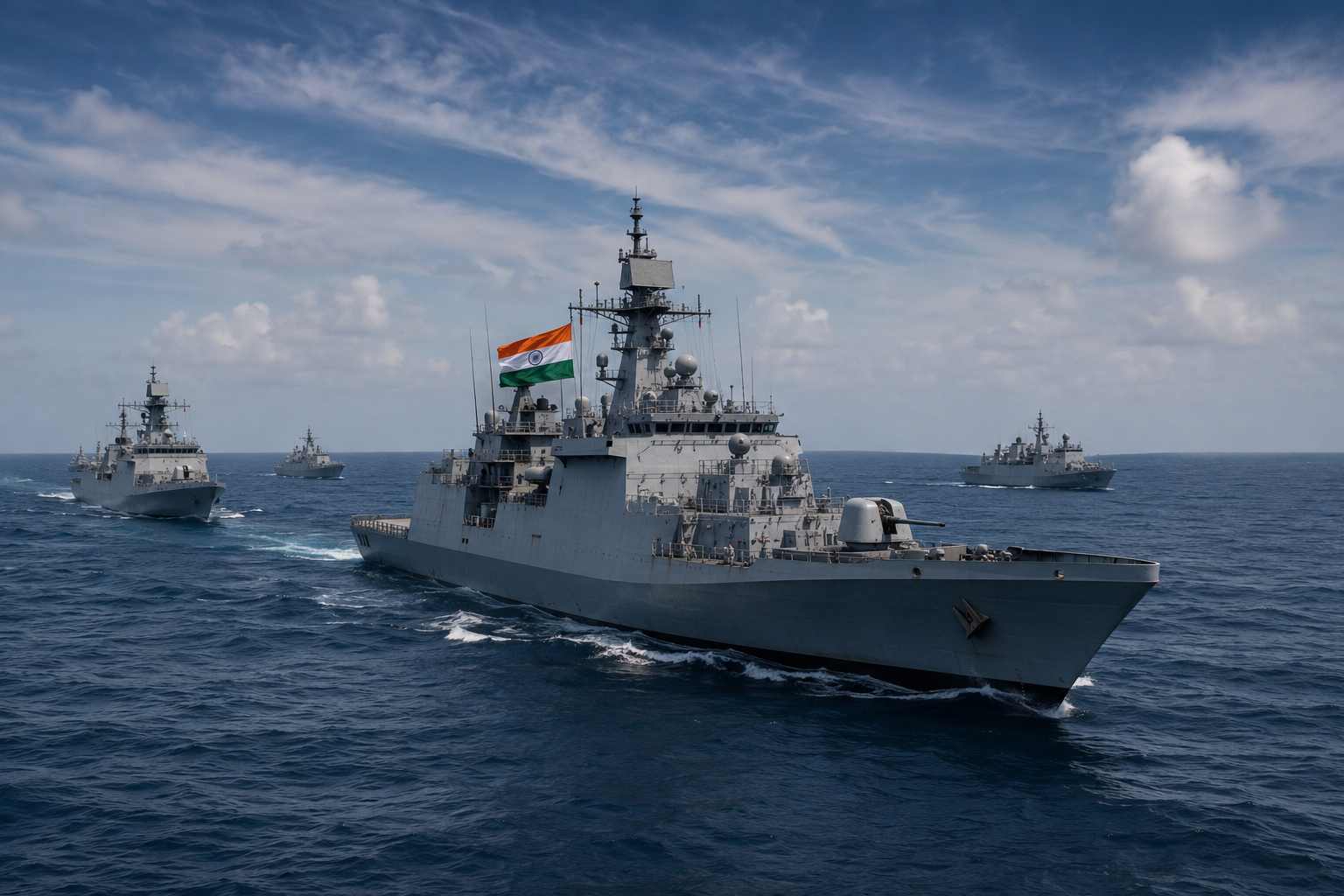
For most citizens, national security is often imagined on land borders. Whenever India and Pakistan tensions rise, people usually think of the Army at the border or the Air Force in the sky. But the Indian Navy plays a very different and equally powerful role. It may not always be visible on television, but its presence at sea can quietly shape the outcome of a crisis.
This is why the conversation with Naval Veteran Commander Sudhir Kumar is important. It explains the Indian Navy not as a ceremonial force, but as a strategic arm that protects trade routes, deters enemies, supports maritime security and gives India influence in the Indian Ocean Region.
India is a maritime nation. A large part of India’s economic security depends on the sea. Energy, trade, shipping, ports and global supply chains all connect through maritime routes. Defence Minister Rajnath Singh has highlighted that around 95% of India’s trade by volume is linked to the Indian Ocean Region, which shows why a strong naval presence is not optional for India.
This is where the idea of a blue-water navy becomes important. In simple terms, a blue-water navy is not limited to coastal defence. It has the ability to operate far from home waters, protect sea lanes, project power, assist friendly countries and remain prepared for long-range operations. For India, this matters because the Indian Ocean is not just water on a map. It is a strategic space where global trade, energy movement and military competition meet.
One of the most important symbols of naval power is the aircraft carrier. An aircraft carrier is not just a big ship. It is a floating airbase at sea. But it never moves alone. It operates as part of a carrier battle group or carrier task group, supported by destroyers, frigates, submarines, helicopters, supply ships and aircraft. Together, this group creates air defence, anti-submarine protection, surface strike capability and long-range presence.
India’s aircraft carrier capability is a major part of its maritime strength. The Indian Navy has operated INS Vikramaditya and the indigenously built INS Vikrant together in exercises, with the Navy describing such dual-carrier operations as a milestone in enhancing maritime security and power projection in the Indian Ocean and beyond.
This matters because a carrier group can change the strategic picture during a crisis. It can move closer to an area of concern, monitor maritime activity, support air operations, protect shipping and create pressure without necessarily firing a shot. Naval power is often about presence. Sometimes, the message is not what is publicly shown, but what is quietly positioned.
Submarines add another layer to this strength. A submarine’s value lies in stealth. Conventional submarines can operate silently in important waters and create uncertainty for the enemy. Nuclear-powered submarines and ballistic missile submarines add deeper strategic meaning because they support long-endurance operations and deterrence. The idea of second-strike capability means that even if a country faces a major attack, it retains the ability to respond. This is a key part of strategic stability.

For a layperson, the missile discussion can sound complicated. Cruise missiles are generally used for precision strike over distance, while ballistic missiles follow a different flight path and are linked with strategic deterrence when placed on certain platforms. The important point is this: modern naval power is not just about ships. It is about sensors, submarines, missiles, aircraft, drones, networks and command systems working together.
Drones and unmanned systems are also changing naval warfare. In the air, drones can help with surveillance, reconnaissance and target tracking. Underwater unmanned vehicles can support mine detection, seabed mapping, intelligence gathering and future combat roles. The Navy of the future will not depend only on large platforms. It will depend on a combination of manned and unmanned systems.
This is why the public question around “Operation Sindoor” needs a mature answer. People often ask why the Navy’s action is not always visible. The answer is simple: naval operations are not always designed for public display. During a crisis, the Navy may be involved in surveillance, deployment, deterrence, readiness, sea control, sea denial and protection of trade routes. These activities may not always appear as dramatic visuals. Reports on Operation Sindoor noted that Indian forces were coordinated and that the Navy was action-ready, with warnings that further escalation could have had serious consequences for Pakistan.
This is where comparison with Pakistan becomes relevant, but it must be understood carefully. Pakistan’s Navy may focus on sea denial, coastal defence and protecting its maritime interests. India’s Navy has a wider responsibility because India has a larger maritime geography, larger trade dependence and a much bigger role in the Indian Ocean. India does not only think about one adversary. It must think about trade security, island territories, choke points, piracy, energy routes and regional influence.
China adds another dimension. China’s naval expansion and presence in the Indian Ocean Region create long-term strategic concern for India. But India has an advantage in geography. The Indian peninsula sits at the centre of the Indian Ocean, and India’s island territories and maritime partnerships give it strategic reach. The challenge is to convert this geography into capability through ships, submarines, aircraft, surveillance, bases and indigenous manufacturing.
This is why the future roadmap toward 2047 matters. A strong Navy cannot be built overnight. Warships take years to design, build, test and induct. Submarines take even longer. Skilled manpower, shipyards, weapons, sensors and maintenance ecosystems are equally important. Indigenous shipbuilding is therefore not just a slogan. It is the foundation of long-term maritime strength.
India has already shown growing confidence in indigenous naval capability, especially through INS Vikrant and wider shipbuilding efforts. But future strength will depend on continuous investment, faster production, better technology absorption and strong public understanding of why the Navy matters.
The Indian Navy also has a major peacetime role. Anti-piracy operations, humanitarian assistance, disaster relief, evacuation support, maritime cooperation and training with friendly countries all build India’s image as a responsible maritime power. Recent regional maritime training and cooperation efforts show how the Navy also contributes to security partnerships in the Indian Ocean.
For young defence aspirants, the Navy offers opportunities far beyond traditional imagination. It is a force of engineering, aviation, submarines, cyber systems, navigation, logistics, communication, special operations and leadership. For veterans and serving personnel, it is a reminder that maritime power is a national asset that deserves wider public attention.
The biggest takeaway from this discussion is clear: the Indian Navy’s power is not always loud, but it is deeply strategic. It protects trade, deters adversaries, supports national security and gives India influence across the seas. In a world where geopolitics is shifting toward the Indo-Pacific and the Indian Ocean, sea power will only become more important.
So when people ask whether Pakistan is worried or whether China is watching, the real answer is bigger than one headline. A capable Indian Navy changes the strategic calculation of every power operating in the Indian Ocean. It gives India options, confidence and reach.
The Army protects the land. The Air Force protects the sky. The Navy protects the sea lanes that keep the nation moving. And in the years ahead, India’s rise will depend not only on what happens on land, but also on how strongly it commands its maritime future.



Leave a Reply