

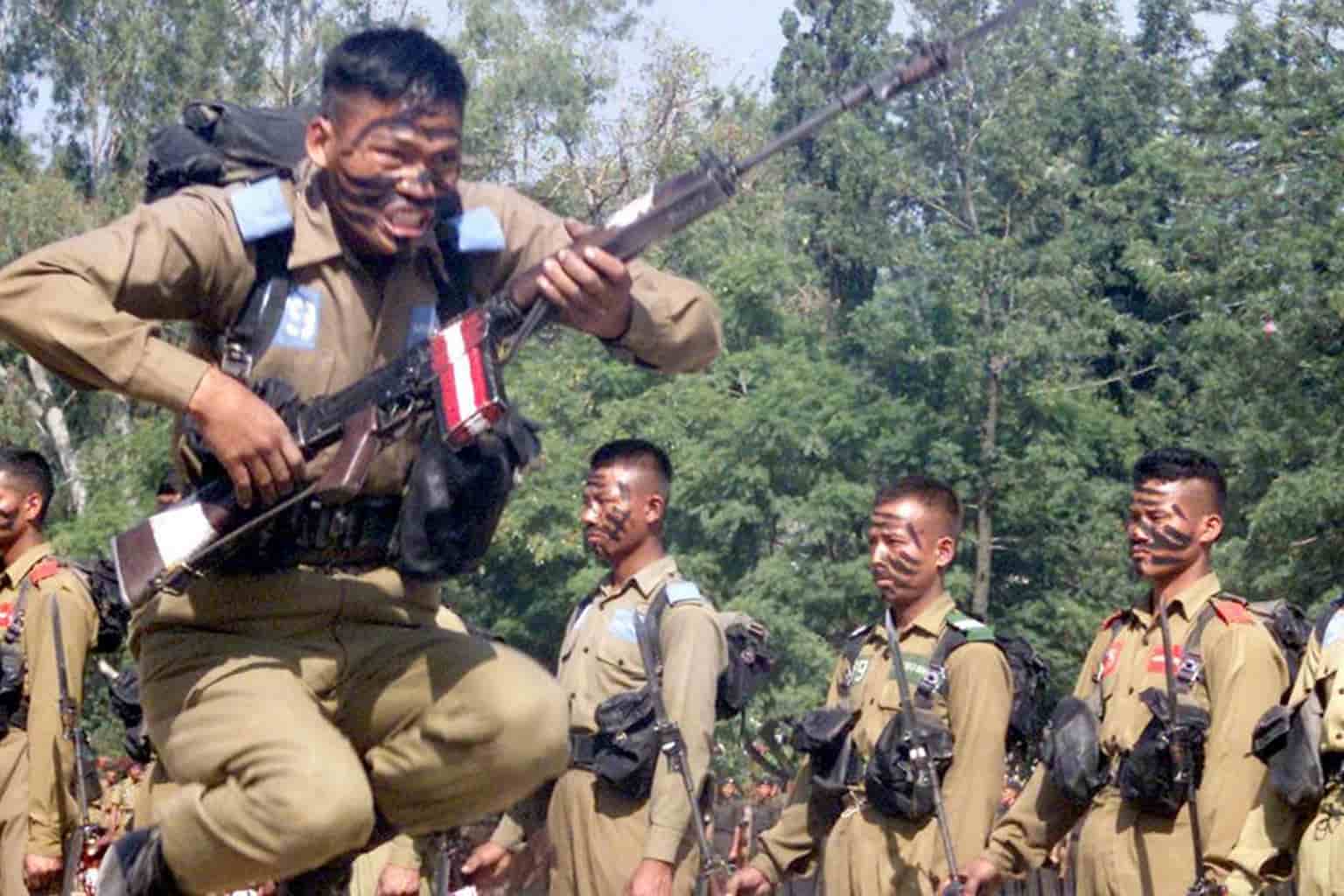
A long-pending issue involving Nepali Gorkha recruitment into the Indian Army has returned to the spotlight as Chief of the Army Staff General Dhiraj Seth visits Nepal and interacts with Indian Army veterans in Pokhara.
The immediate trigger, however, did not begin with the Army Chief’s visit.
On 12 August 2026, former Gorkha soldiers, their families and supporters held a protest in Pokhara demanding that Nepal allow its youths to once again join the Indian Army under the Agnipath recruitment scheme. Just days later, General Seth arrived in Nepal for high-level military engagements, with an Ex-Servicemen Rally at Pokhara scheduled for 19 August.
The timing has brought an unresolved question back into focus:
Will Nepal finally permit recruitment of Nepal-domiciled Gorkhas into the Indian Army under Agnipath?
For now, the answer is important: there has been no official announcement that recruitment has restarted.

What happened in Pokhara on 12 August?
The protest was organised by the Indian Ex-Servicemen Gorkha Brigade Nepal, Pokhara.
According to Nepalese reporting subsequently carried by India Today, former Indian Army Gorkha personnel and their supporters marched in Pokhara and submitted a two-point memorandum to Nepal’s federal government through the local administration.
Their primary demand was clear:
Restart the recruitment of Nepali youths into the Indian Army under the Agnipath policy.
The second demand concerned the renewal of organisations representing former soldiers, particularly organisations using terms such as “soldier” or “ex-servicemen” in their names.
This makes the development more than a recruitment story. It also concerns the veteran community in Nepal and organisations built around generations of service in the Indian Army.
Why has Gorkha recruitment from Nepal remained stopped?
The present situation has its roots in two developments.
Recruitment was first disrupted around the period of the COVID-19 pandemic. Then, in June 2022, India introduced the Agnipath scheme as the new recruitment system for personnel below officer rank in the Armed Forces.
Under the officially notified Agnipath framework, Agniveers are enrolled for four years. After completing that tenure, they can apply for regular enrolment, with up to 25% of a particular batch eligible to be enrolled in the regular cadre depending on organisational requirements, policies and selection criteria.
For Nepal, this represented a major departure from the longer military career and pension-linked structure traditionally associated with Nepali Gorkha service.
Nepal therefore put recruitment under the new model on hold in 2022 while raising concerns about the implications of the changed service conditions. Reporting from Kathmandu at the time noted concerns about the short tenure, absence of the traditional pension arrangement for those leaving after four years, and questions about what returning Agniveers would do after completing service.
Since then, Nepal-domiciled Gorkha recruitment under Agnipath has not resumed.

What exactly are Gorkha veterans asking Nepal to do?
One of the most important points in this story is often lost in headlines.
The veterans are not primarily asking the Indian Army to create a separate recruitment system for Nepal.
They are asking the Nepal government to permit Nepali citizens to participate in Indian Army recruitment under the Agnipath policy that India currently follows.
Colonel Krishna Bahadur Khatri (Retd), chairman of the veterans’ organisation, told the Times of India that the continued freeze was denying Nepali youths an employment opportunity that many Gorkha families still value. The organisation’s memorandum called for the process to be restarted under Agnipath.
That distinction is crucial.
The correct question is therefore not:
“Why is the Indian Army refusing to recruit Gorkhas?”
The present issue is:
“Will Nepal permit its citizens to join the Indian Army under India’s Agnipath recruitment conditions?”

Why do some Gorkha veterans now support Agnipath?
This is perhaps the most interesting part of the current development.
The four-year structure of Agnipath was one of the reasons the issue became politically sensitive in Nepal. Yet a section of the Gorkha veteran community is now arguing that even the Agnipath model provides a valuable employment pathway for Nepali youths.
Veteran representatives have compared the opportunity with migration to Gulf countries for low-paid and physically demanding work.
Retired Captain Rudra Thapa told TOI that an Agniveer from Nepal could, according to his calculation, receive around NPR 45–50 lakh including benefits over four years. The veterans’ memorandum similarly argued that military service would offer young people training, earnings and professional experience that may be preferable to difficult overseas labour.
This figure should be understood as a claim made by veteran representatives, not as a newly announced official Indian government package for Nepali recruits.
The official Agnipath framework provides salary, allowances where applicable and a Seva Nidhi package on completion of four years.
Why does the recruitment freeze matter to Gorkha families?
Gorkha service is not simply another foreign-employment route for many families in Nepal.
It represents a military tradition that has continued across generations and has formed an important part of India-Nepal defence ties.
TOI reported that approximately 12,000 Nepal-domiciled Gorkha soldiers have retired since 2021, while fresh Nepal-domiciled recruitment has not taken place to replace them. The same report said Nepali personnel historically make up a significant share of manpower in Gorkha battalions. These are reported figures rather than a new officially released Indian Army manpower statement.
That creates a long-term issue.
If retirements continue while no fresh recruits from Nepal enter the system, the traditional Nepal-based recruitment pipeline becomes progressively smaller.
The issue therefore affects three groups at the same time:
- Nepali youths seeking military employment
- Gorkha families with generations of Indian Army service
- the long-standing institutional military relationship between India and Nepal
Why is General Dhiraj Seth’s Nepal visit important?
The timing is significant.
The Ministry of Defence officially announced that General Dhiraj Seth’s Nepal programme would include senior-level military interactions and, on 19 August 2026, participation in an Ex-Servicemen Rally at Pokhara.
According to the PIB release, the Army Chief is scheduled to felicitate Veer Naris and Gallantry Awardees and interact with Indian Army veterans during the Pokhara event.
His visit also continued one of the most distinctive traditions between the two armies.
General Seth was conferred the honorary rank of General of the Nepali Army by President Ramchandra Paudel. Nepal and India have for decades followed the reciprocal practice of conferring the honorary rank of General on each other’s Army Chiefs.
He also met Nepal’s Prime Minister Balendra Shah, who holds the defence portfolio. The Kathmandu Post confirmed the courtesy meeting and reported the presence of India’s Ambassador to Nepal Naveen Srivastava.
This makes the visit diplomatically important—but it does not automatically mean there has been a breakthrough on Agnipath.
Did the Army Chief discuss Gorkha recruitment with Nepal’s Prime Minister?
This needs to be stated very clearly.
There is no publicly confirmed evidence so far that Agnipath or the restart of Gorkha recruitment was formally discussed during General Seth’s meeting with the Nepal government.
TOI noted that official accounts of his talks focused on defence cooperation and military ties, while Agnipath received no public mention.
Similarly, the Kathmandu Post’s report confirming General Seth’s meeting with Prime Minister Shah did not say that the Gorkha recruitment dispute was discussed.
Therefore, headlines claiming that:
“India and Nepal have agreed to restart Gorkha recruitment”
or
“Army Chief secured approval for Agnipath recruitment”
would currently go beyond the available evidence.

Does India still want to recruit Nepal-domiciled Gorkhas?
The current reporting indicates that India’s position has remained that Agnipath is the recruitment route now available for joining the Indian Army, and a resumption of Nepal-domiciled recruitment would require Nepal’s consent.
The roots of that position can also be seen in the discussions from 2022.
At that time, then Army Chief General Manoj Pande had indicated that vacancies earmarked for Nepali Gorkhas could have to be redistributed if Nepal did not permit recruitment within the prescribed schedule. The Kathmandu Post reported that Nepal had put the recruitment process on hold while political consultations continued.
So the present deadlock is not simply an Indian Army vacancy issue.
It is a policy and diplomatic decision involving Nepal’s acceptance of the changed recruitment conditions.
Could the deadlock now move towards a solution?
There is a reason the current development deserves attention.
TOI reported signs of a somewhat more open tone from Kathmandu. Nepalese Foreign Minister Shisir Khanal had earlier indicated that Nepal could discuss the matter if India wished to engage. However, he also said that the issue had not featured in the relevant formal discussions at that stage.
That means the door to talks may not be completely closed.
But willingness to discuss the matter is very different from approving recruitment.
Until either government issues an official statement, the correct status remains:
The Gorkha-Agnipath recruitment deadlock is unresolved.
Why the 19 August Pokhara rally matters?
General Seth’s interaction with veterans is important because Pokhara is home to a substantial Gorkha veteran community and the protest demanding recruitment took place in the same city only days earlier.
The official PIB programme, however, describes the 19 August event as an Ex-Servicemen Rally, including interaction with veterans and felicitation of Veer Naris and Gallantry Awardees. It does not describe the rally as an Agnipath negotiation or recruitment meeting.
Therefore, what happens around the rally—and whether either side subsequently makes a statement on recruitment—will be worth watching closely.
What should Gorkha aspirants understand right now?
For anyone interested in joining the Indian Army from Nepal, the most important point is simple:
Do not treat the veterans’ demand as a recruitment notification.
As of 19 August 2026, the sources reviewed for this report do not show:
- a fresh Indian Army recruitment notification for Nepal-domiciled Gorkhas;
- dates for a Gorkha Agniveer recruitment rally in Nepal;
- an application opening date;
- approval by the Nepal government; or
- an official agreement between India and Nepal restarting recruitment.
Any future recruitment should be relied upon only after an official notification from the competent authorities.
Why this story is bigger than Agnipath?
The Pokhara protest reveals a wider debate taking place within the Gorkha community.
For Nepal’s government, the question involves the implications of sending young citizens into a four-year foreign military service model.
For veterans, the issue is about preserving an employment route, a military tradition and a connection through which generations of Gorkha families served.
For India and Nepal, it also touches one of the oldest and most visible elements of their military relationship.
That is why the dispute has survived for more than four years without becoming merely another pending recruitment issue.
It sits at the intersection of military policy, employment, veterans’ interests and India-Nepal relations.
The latest development should not be interpreted as the restart of Gorkha recruitment.
What has happened is significant in a different way.
Gorkha veterans have publicly increased pressure on the Nepal government to permit recruitment under Agnipath. Their protest and memorandum came just before Indian Army Chief General Dhiraj Seth’s Nepal visit and his scheduled interaction with veterans in Pokhara on 19 August.
The veteran community is therefore putting the unresolved recruitment issue back on the agenda at a diplomatically important moment.
But the next decisive step must come through official policy.
Until Nepal approves participation under Agnipath—or India and Nepal reach some other mutually accepted arrangement—Nepal-domiciled Gorkha recruitment into the Indian Army remains stalled.
For Gorkha aspirants and ex-servicemen, the development is important because the demand has become louder.
For now, however, it remains a demand for recruitment to restart—not an announcement that recruitment has restarted.

Sources:-
- Ministry of Defence / Press Information Bureau — General Dhiraj Seth’s official Nepal visit & Pokhara Ex-Servicemen Rally
Click here to read the official PIB release - Ratopati, Nepal — Ex-Gorkha soldiers protest in Pokhara demanding restart of recruitment under Agnipath
Click here to read Ratopati report - India Today — Gorkha veterans’ protest, memorandum and Agnipath recruitment background
Click here to read India Today report - Times of India — Gorkha veterans press Nepal government to break Agnipath recruitment deadlock
Click here to read Times of India report - The Kathmandu Post — Indian Army Chief General Dhiraj Seth meets Nepal PM Balendra Shah
Click here to read The Kathmandu Post report - Ministry of Defence — Official Agnipath Scheme document, 14 June 2022
Click here to open the official Agnipath PDF - Press Information Bureau — Official Agnipath terms: 4-year service & up to 25% regular-cadre intake
Click here to read the official PIB Agnipath release


Leave a Reply