

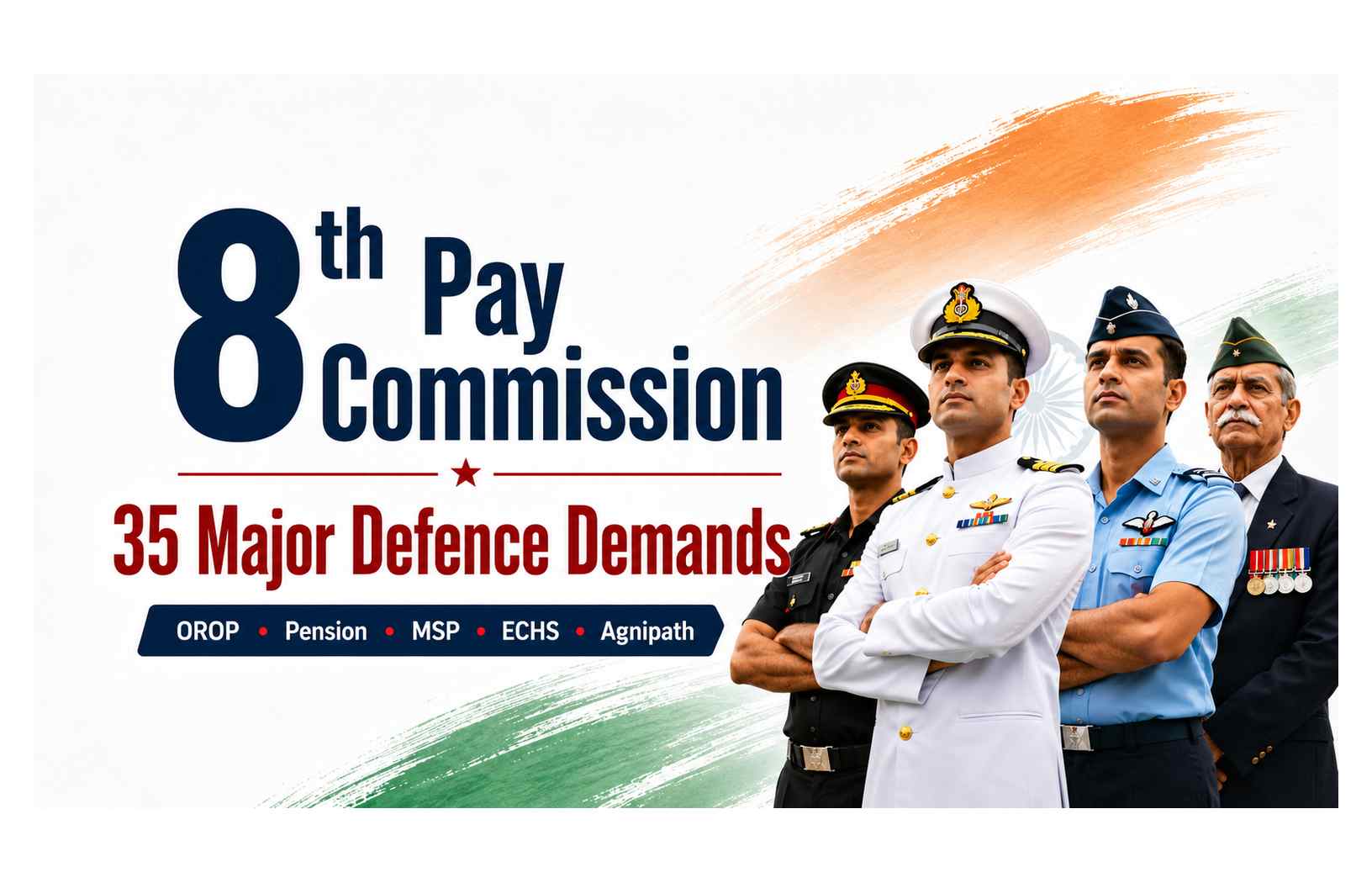
Sainik Welfare News has prepared a comprehensive memorandum containing 35 major demands for serving Armed Forces personnel, ex-servicemen, reservists, defence pensioners, family pensioners and their dependants.
The memorandum, dated 20 April 2026 and carrying Reference No. SWN/8CPC/2026/101, has been addressed to the Prime Minister of India, the Defence Minister and the Chairperson of the Eighth Central Pay Commission.
It covers OROP, Military Service Pay, ECHS, pension, family pension, fitment factor, annual increment, leave, MACP, disability pension, SPARSH, toll exemption and the Agnipath recruitment system.

Important clarification: These are stakeholder demands submitted for consideration. They are not approved government decisions, sanctioned benefits or final recommendations of the 8th Pay Commission.
OROP, ECHS and military-service-related demands
1. Resolution of all OROP anomalies
Differences in pension caused by retirement dates, pension tables, trades, groups, ranks and qualifying service should be removed before the new pay structure is implemented.
Incorrect pension fixation and omitted service should be corrected automatically, with full arrears and a fixed grievance-resolution timeline.
2. OROP for premature retirees
Personnel taking Premature Retirement, voluntary retirement or discharge before the normal retirement age should not be denied OROP solely because they left service earlier.
Entitlement should be based on the rank earned and qualifying service completed.
3. OROP equalisation every two years
OROP pension tables should be reviewed and equalised at intervals not exceeding two years.
The revision should be automatic so that pensioners are not required to submit individual applications.
4. Full OROP benefits for reservists
Reservists who completed Colour Service and Reserve Liability should be included under OROP and periodic pension equalisation.
Their pension should consider Colour Service, Reserve Service, total qualifying service and the last rank held.
5. Contribution-based ECHS room entitlement
ECHS room entitlement should not depend only on the rank held at retirement.
Beneficiaries willing to pay an additional contribution should be allowed to select General Ward, Semi-Private or Private Room facilities. Room category should not delay emergency treatment, surgery or ICU admission.
6. Increase in Fixed Medical Allowance
The memorandum proposes increasing Fixed Medical Allowance from ₹1,000 to ₹5,000 per month.
FMA should be linked to medical inflation and reviewed annually. Higher support should be considered for elderly pensioners, persons with disabilities, chronically ill pensioners and those living in remote areas.
7. Same Risk, Same Allowance
Risk and Hardship Allowances should be based on actual danger, isolation, hardship and operational exposure.
Personnel performing the same hazardous duty at the same location should not receive excessively different allowances merely because of rank.
8. Restructuring of Military Service Pay
Military Service Pay should remain separate from Risk and Hardship Allowances.
MSP recognises military conditions such as round-the-clock readiness, strict discipline, frequent transfers, family separation, statutory restrictions and risk to life. Its rates should be equitable across eligible ranks.
Pay, promotion, leave and career progression
9. Annual increment of 6%
The normal annual increment should be increased to at least 6% of Basic Pay.
An additional 1% stagnation increment should be granted where no regular promotion or MACP is received for six consecutive years.
10. Minimum fitment factor of 3.0
A minimum fitment factor of 3.0 should be applied uniformly to serving defence personnel and pensioners.
Minimum pay, pay-matrix progression and pay bunching should also be reviewed separately.
11. Soldiers’ entry pay at Pay Level 5
The entry pay of soldiers should be fixed at least at the equivalent of Pay Level 5.
Technical and skilled personnel should receive qualification pay, while the training period should count as qualifying service.
12. Liberalisation of LTC
LTC rules should be made more practical for personnel serving in field, remote and high-altitude areas.
Up to 120 days of accumulated leave should be permitted to be combined with LTC, with up to 20 days used on one occasion. Full ticket costs should be reimbursed when travel is cancelled because of operational recall.
13. Additional leave for Counter Insurgency Operations
Eligible personnel deployed in Counter Insurgency Operations should receive 30 days of additional leave every year.
This leave should be separate from Annual Leave and Casual Leave and should be carried forward or encashed where operational requirements prevent its use.
14. Leave encashment up to 450 days
The leave encashment ceiling should be increased from 300 to 450 days.
Leave cancelled because of service requirements should not lapse. In the event of death, the accumulated benefit should be paid to the family.
15. Operational Readiness Bonus
The Non-Productivity Linked Bonus should be replaced with an Operational Readiness and Service Performance Bonus.
The amount should consider unit readiness, training standards, emergency response, difficult-area service, technical efficiency and exemplary discipline.
16. Increment for exemplary service
Personnel retiring with an exemplary, disciplined and unblemished service record should receive one additional pensionable notional increment.
It should be counted while calculating pension, gratuity, commutation and leave encashment.
Pension and family-security demands
17. Restoration of commuted pension after 12 years
The commuted portion of pension should be restored after 12 years instead of 15 years.
Restoration should be automatic, and the applicable date should be displayed in the PPO and on SPARSH.
18. Family pension from 30% to 60%
Ordinary Family Pension should be increased from 30% to 60%.
Family pensioners should receive full Dearness Relief, automatic revision and time-bound arrears. Permanently disabled children and wholly dependent family members should receive lifelong protection.
19. Basic pension at 70%
Basic Pension should be fixed at 70% of the last pensionable emoluments.
The calculation should include Basic Pay, pensionable MSP and other admissible pensionable emoluments.
20. Financial benefits for honorary ranks
Honorary Naib Subedar, Honorary Lieutenant, Honorary Captain and other honorary ranks should carry corresponding financial and pensionary benefits.
Pension should be revised from the effective date of the honorary rank, with automatic payment of arrears.
21. Protection of existing benefits
Granting an honorary rank should not result in the withdrawal of group classification, trade benefits, protected pension, qualification benefits or any other existing financial advantage.
22. Merger of 50% DA/DR
When Dearness Allowance or Dearness Relief reaches 50%, the prescribed portion should be merged with Basic Pay or Basic Pension.
HRA, percentage-based allowances, pension, gratuity and leave encashment should then be recalculated on the revised basic amount.
23. Interim relief of 10%
If the 8th Pay Commission report or its implementation is delayed, serving personnel, pensioners and family pensioners should receive 10% interim relief on Basic Pay or Basic Pension.
The relief may be adjusted during final fixation but should not later be recovered.
24. Four MACPs
Four Modified Assured Career Progressions should be granted after completing:
- 6 years of service
- 12 years of service
- 18 years of service
- 24 years of service
Each MACP should include an increment followed by placement in the next applicable pay level.
25. Additional pension from age 65
Additional pension should begin from the age of 65 years instead of 80 years.
A graded increase should begin at 65 and rise progressively at higher ages. It should apply to pensioners and family pensioners.
Health care, pay anomalies and pension administration
26. Patient Care Allowance for eligible hospital staff
Patient Care Allowance should be granted according to actual patient contact, infection exposure, biological risk and critical-care workload rather than designation alone.
Eligible categories should include nursing, ward, ambulance, laboratory, radiology, operation theatre, physiotherapy, mortuary, sanitation and other patient-handling staff.
27. Automatic correction of senior-junior anomalies
Where a junior draws higher pay because of promotion, MACP, fixation or the revised pay matrix, the senior’s pay should be stepped up automatically.
The correction should be completed within 90 days without requiring an individual representation.
28. Resolution of X-Group and technical pay anomalies
Pay and pension anomalies affecting former X-Group personnel and technical trades should be removed.
Technical qualifications, advanced training, professional skills and certifications should receive appropriate financial recognition.
29. Disability and War Injury Pension reforms
Personnel whose disabilities are attributable to or aggravated by service should receive fair pension protection.
Disability broad-banding should apply uniformly, and an admissible disability element should not be denied solely because of Premature Retirement.
Medical Board decisions should include reasons, while appeals should be simple and time-bound.
30. Indexation of gratuity, ex-gratia and insurance
Retirement Gratuity, Death Gratuity, operational casualty ex-gratia and insurance cover should be linked to DA or an appropriate inflation index.
Death and casualty claims should be settled within 30 days. Delays should attract interest payable to the family.
31. Human support under SPARSH
The digital pension system should be supported by strong human assistance.
Pension should not be stopped without written notice and a reasoned order. The memorandum also proposes a free SPARSH help centre in every district, face-to-face support for elderly pensioners and a 30-day grievance timeline.
32. Protection for widows and dependants
A comprehensive financial-protection framework should cover widows, dependent parents, permanently disabled children and other eligible dependants.
Widow claims should be fast-tracked, repeated medical certification for disabled dependants should be relaxed and battle-casualty families should receive dedicated assistance.
33. Automatic revision of fixed allowances
Dress Allowance, Transport Allowance, Children Education Allowance, Hostel Subsidy, Patient Care Allowance, Nursing Allowance and other fixed allowances should be linked to inflation and DA.
These allowances should be revised automatically whenever DA increases by 50%.
Toll exemption and Agnipath review
34. Toll exemption for veterans
Ex-servicemen should receive uniform toll exemption on National Highways and other government-controlled toll roads.
The facility should be implemented through secure digital verification by linking the veteran identity credential with FASTag or another authorised system.
35. Review of the Agnipath Scheme
The Agnipath recruitment model should be reviewed in consultation with Service Headquarters, serving personnel, veterans and affected stakeholders.
The memorandum proposes restoring the previous regular enrolment procedure as the principal recruitment system, with normal service tenure, pensionary protection and post-service safeguards.
Any short-term recruitment model, where retained, should operate only as a supplementary channel.
Why these demands matter?
The memorandum is not limited to a general salary or pension increase. It addresses the distinctive conditions of military service, including operational risk, shorter careers, family separation, disability protection, health care, pension administration and post-retirement security.
The proposals seek a fairer structure for serving personnel while also strengthening financial and medical protection for veterans, pensioners, widows and dependants.
Have these 35 demands been approved?
No. These are stakeholder proposals submitted for consideration. They are not approved government orders or final 8th Pay Commission recommendations.
What fitment factor has been demanded?
The memorandum proposes a minimum uniform fitment factor of 3.0.
What increase has been proposed in FMA?
Fixed Medical Allowance has been proposed to increase from ₹1,000 to ₹5,000 per month.
What is the proposed family pension rate?
Ordinary Family Pension has been proposed to increase from 30% to 60%.
When should commuted pension be restored?
The memorandum proposes automatic restoration after 12 years instead of 15 years.
What is the demand regarding Agnipath?
The memorandum seeks a comprehensive review of the Agnipath Scheme and restoration of the previous regular enrolment procedure as the principal recruitment system.
Conclusion
The 35-point memorandum presents a detailed charter of demands for serving Armed Forces personnel, ex-servicemen, reservists, defence pensioners, family pensioners and their dependants.
Its main proposals include OROP reforms, a 3.0 fitment factor, higher annual increment, improved MSP, enhanced family pension, restoration of commuted pension after 12 years, additional pension from age 65, SPARSH support, disability pension reforms, toll exemption and a review of Agnipath.
However, all these points remain proposals for consideration. Any actual benefit will depend on the recommendations of the Eighth Central Pay Commission and subsequent approval and notification by the Government.


Leave a Reply