

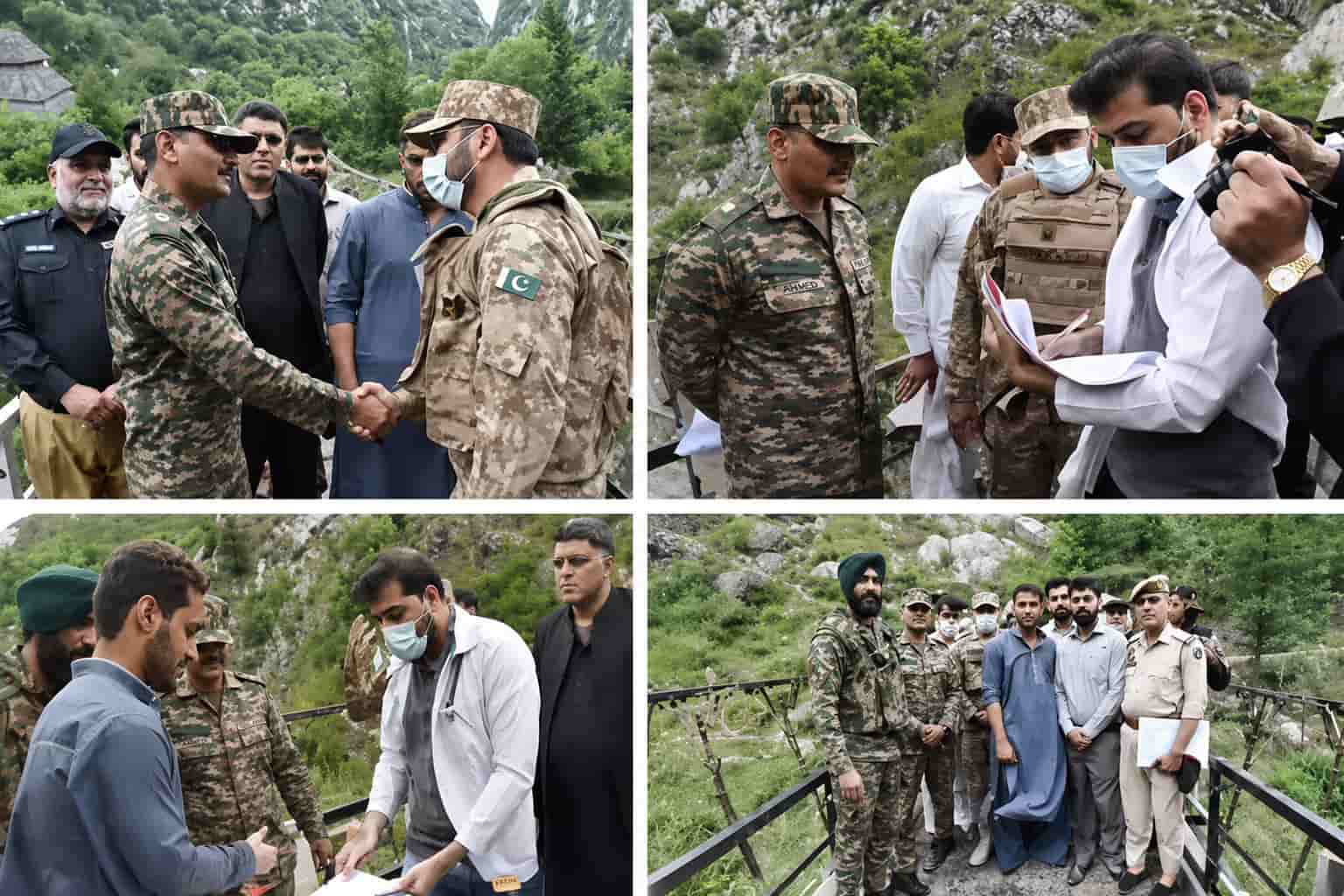
A Pakistani national, Asad Khan, was repatriated after crossing the LoC in Kupwara. The Indian Army’s rare handshake during the handover has drawn attention for professionalism, border protocol and humanitarian conduct.

At the Line of Control, even a small movement is never treated casually. Every crossing, every report and every suspicious movement is checked with alertness because one mistake can become a security risk.
But sometimes, a border incident also shows another side of the uniform.
A Pakistani national identified as Asad Khan crossed the Line of Control in Jammu and Kashmir’s Kupwara district and was apprehended near Simari village on 12 June 2026. After the required procedures, he was repatriated to Pakistan on 18 June 2026. What made the incident widely discussed was not only the repatriation, but a photograph from the handover: an Indian Army officer and a Pakistani Army officer shaking hands at the border.
In a tense India-Pak environment, that single frame caught public attention. But the real story is deeper than the handshake. It is about alertness, procedure, military courtesy and the Indian Army’s ability to combine firmness with humanity.
What happened near the LoC?
Asad Khan, a resident of Khyber Pakhtunkhwa in Pakistan, was apprehended after he crossed the Line of Control into the Kupwara sector. The area is sensitive, and any crossing near the LoC is taken seriously by security forces.
According to reports based on the Chinar Corps update, Indian Army personnel, along with Jammu and Kashmir Police, acted after specific inputs and intercepted the individual to prevent any possible security breach.
This is an important point. The Army did not ignore the crossing. It did not treat the matter lightly. The first response was professional and security-focused.
After that, the necessary questioning, verification and formalities were carried out. Once the process was completed, Asad Khan was handed back to the Pakistan side on 18 June 2026.
Why did the handshake go viral?
The LoC is not an ordinary boundary. It is a heavily watched, highly sensitive military line where every action carries meaning. That is why a handshake between officers of the two armies immediately attracted attention.
The photograph became noticeable because it showed two things at the same time.
On one side, it showed that the Indian Army remained alert and followed procedure after a Pakistani national crossed the LoC.
On the other side, it showed that once the formal process was complete, the handover was conducted with military discipline and dignity.
This is why the image should not be seen only as a viral moment. It should be seen as an example of how professional armies handle sensitive border situations.
Not politics, but military professionalism
This incident should not be stretched into a political conclusion. It does not mean that tensions have disappeared. It does not mean that the LoC has suddenly become normal. It also does not mean that border vigilance has reduced.
The correct reading is simpler and more mature.
The Indian Army handled a sensitive crossing with caution, checked the security angle, completed the process and then returned the individual through the proper channel.
The handshake was not a policy statement. It was military courtesy during a formal handover.
That is the professional way to frame the story.
Alertness came first
Before talking about the humanitarian side, it is necessary to understand the security side.
A person crossing the LoC cannot be ignored. Such crossings may be accidental in some cases, but the security forces cannot assume that from the beginning. The area has seen infiltration attempts, hostile activity and cross-border tension over the years.
Therefore, the first duty of the Army is to secure the area, identify the person, check the circumstances and ensure that no larger threat exists.
In this case too, the alert response of the Chinar Corps and Jammu and Kashmir Police prevented any possible security concern from being left unchecked.
This is the part that often gets missed when people only look at the viral image.
Behind one handshake, there is a complete process: surveillance, interception, verification, coordination and official handover.
Humanity after procedure
The Army’s statement, as reported by several sources, said Asad Khan was treated with dignity and compassion during his stay in India.
This line is important because it reflects the values expected from a professional military force.
A strong Army is not only one that guards the border. A strong Army is also one that knows how to treat a person under custody according to procedure, law and military ethics.
There is no contradiction between toughness and humanity. In fact, the best military conduct often requires both.
At the LoC, Indian soldiers must remain alert every hour. But when a person is found to be eligible for return after due process, the handover can still be done with basic human dignity.
That is what gives this incident its wider meaning.
Why this story matters for ordinary readers?
For the general public, a border story is often seen only through the lens of conflict. People usually hear about firing, infiltration, ceasefire violations or military tension.
This incident showed a different but equally important side.
It showed that border management is not only about weapons. It is also about discipline, communication, records, procedure and restraint.
It showed that the Indian Army can act firmly when required and still maintain professional standards when dealing with a human being.
It also reminded people that military strength is not measured only by aggression. Sometimes, it is measured by control.
Teetwal and Aman Setu: The symbolism of the handover
The handover reportedly took place at Teetwal through the Peace Bridge, also known as Aman Setu, over the Kishanganga River.
That location itself carries symbolic weight. Border points like these are not casual places. They are part of controlled procedures where civil administration, police and military authorities may be present depending on the situation.
The presence of officials during the handover shows that the matter was not handled informally. It was carried out through a recognised process.
This is important for readers to understand. The repatriation was not a random release. It was a formal return after the necessary checks.

Why the Indian Army’s image gains from such moments?
The Indian Army’s public image is built not only during war or operations, but also during moments of restraint.
When a soldier helps a civilian during floods, rescues people in snow, supports medical camps or handles a border crossing humanely, it strengthens public trust.
This LoC repatriation story belongs to that category.
It tells the public that the Army is alert, but not careless. Firm, but not reckless. Powerful, but still bound by values.
That is why the story has value for Sainik Welfare News readers. Many viewers and readers come from defence families. They understand that the uniform is not only about force. It is also about responsibility.
What should not be misread?
This incident should not be used to make exaggerated claims.
It should not be presented as a major diplomatic breakthrough. It should not be used to suggest that border tensions are over. It should not be turned into a political debate.
The story is powerful enough without exaggeration.
The confirmed facts are strong: a Pakistani national crossed the LoC, was apprehended, checked through procedure, treated with dignity and repatriated. During the handover, a rare handshake between officers was captured and widely noticed.
That is enough to build a meaningful story.
Final view
The rare handshake at the LoC became viral because it showed something unusual in a tense environment. But the deeper message is not about one photograph.
The deeper message is about the professionalism of the Indian Army.
A sensitive LoC crossing was not ignored. The individual was intercepted. Security procedures were followed. The handover was completed through the proper channel. And during the process, the Army maintained dignity, restraint and military courtesy.
For a professional force, this balance matters.
At the border, alertness protects the nation. Discipline protects the institution. Humanity protects the values for which the uniform stands.
That is why this story deserves attention.
Sources:-
Chinar Corps – Indian Army X post
https://x.com/ChinarcorpsIA/status/2067800370999668853
Chinar Corps – Indian Army Facebook post
https://www.facebook.com/chinarcorpsIA/posts/repatriation-of-pak-nationala-pakistani-national-asad-khan-a-resident-of-khyber-/1431383405691817/
Hindustan Times
https://www.hindustantimes.com/india-news/rare-handshake-after-army-repatriates-pakistani-national-who-crossed-loc-101781869037909.html
Greater Kashmir
https://www.greaterkashmir.com/kashmir/pakistani-national-repatriated-six-days-after-detention-12053254
Kashmir Vision
https://kashmirvision.in/2026/06/20/pakistani-national-who-inadvertently-crossed-loc-repatriated/


Leave a Reply