

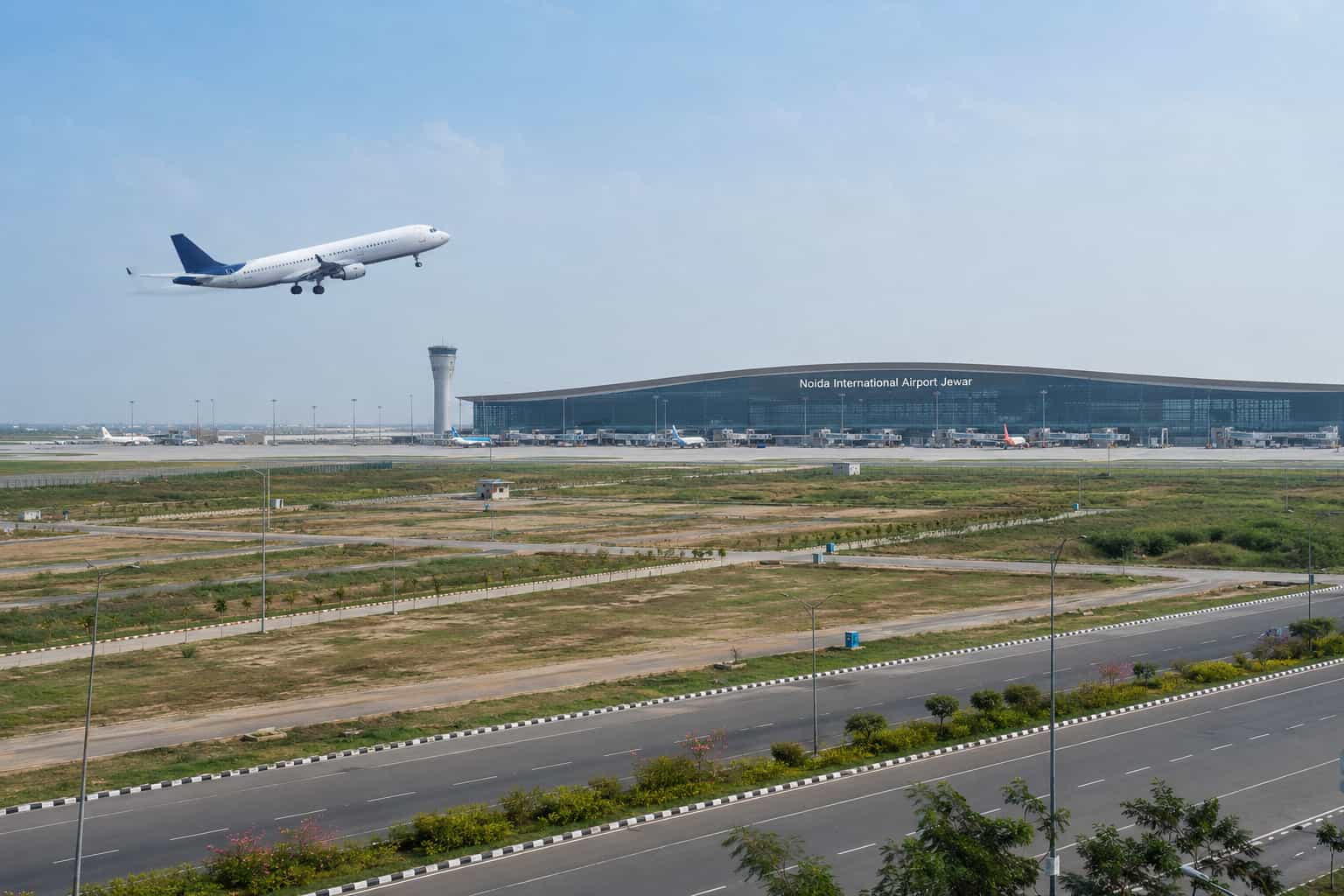
For many years, Jewar Airport was spoken about as a future promise. It was discussed in real estate meetings, government updates, infrastructure conversations and investment debates. People living along the Yamuna Expressway, Greater Noida, Noida, western Uttar Pradesh and the wider NCR region often heard one line again and again: once the airport starts, the region will change.


Now that story is moving closer to reality.
According to an IndiGo press release dated 07 May 2026, IndiGo will begin operations at Noida International Airport in Jewar, Uttar Pradesh, which is described as the third airport in the National Capital Region. The release says IndiGo will be the first airline to commence commercial flight operations from the newly inaugurated airport on 15 June 2026

This is important because an airport becomes real for passengers only when flights begin. Runways, terminals and announcements matter, but the actual turning point comes when passengers can book tickets, reach the airport, board flights and connect to other cities. That is why IndiGo becoming the launch carrier is not just an airline update. It gives Noida International Airport its first operational identity.
The press release says IndiGo will progressively introduce direct flights connecting Noida International Airport to more than 16 destinations across India. These include major metro cities such as Bengaluru and Hyderabad, along with tier-2 and tier-3 destinations such as Amritsar, Chandigarh, Dharamshala, Jaipur, Lucknow, Navi Mumbai, Pantnagar and Srinagar.
This route plan shows that the airport is not being positioned only as a symbolic launch point. It is being connected to a wider domestic network from the beginning. For passengers in western Uttar Pradesh and NCR, this can make a major difference over time.
The first-day flight schedule is also significant. The PDF lists special inaugural flights on 15 June 2026. The first sector shown is Lucknow to Noida, flight 6E 2278, departing at 07:05 and arriving at 08:05. The same flight number is then listed for Noida to Bengaluru, departing at 08:35 and arriving at 11:05. Later in the day, Bengaluru to Noida flight 6E 2279 is listed from 15:45 to 18:20, followed by Noida to Lucknow from 18:55 to 20:00.

The presence of Lucknow in the inaugural schedule is interesting because it gives the launch a Uttar Pradesh connection, while Bengaluru gives it a major metro and business-travel connection. In simple terms, the first-day schedule links Noida Airport with both the state capital and a major technology city.
From 15 June 2026, the release lists daily flights on the Hyderabad, Noida and Amritsar pattern. Hyderabad to Noida, Noida to Amritsar, Amritsar to Noida and Noida to Hyderabad are included in the schedule effective from 15 June.
From 16 June 2026, Bengaluru and Jammu are added through daily services. The schedule lists Bengaluru to Noida, Noida to Jammu, Jammu to Noida and Noida to Bengaluru.

The bigger expansion begins from 01 July 2026. The PDF lists routes connecting Noida with destinations including Navi Mumbai, Srinagar, Jodhpur, Dharamshala, Bhopal, Dehradun, Bareilly, Kishangarh, Lucknow, Jaipur, Pantnagar and Chandigarh.
This phased route expansion matters because airports do not grow only through one grand opening. They grow through route depth, frequency, reliability and passenger adoption. If these services stabilise, Noida International Airport can become a practical option for a large passenger base that currently travels to Delhi IGI.
The human impact is easy to understand. A family living in Greater Noida or along Yamuna Expressway may not want to travel across Delhi traffic for every flight. A business traveller from western Uttar Pradesh may prefer a closer airport if route options are available. Students, professionals, pilgrims, tourists and families visiting smaller cities may benefit if more direct routes operate from Jewar.
For someone in Aligarh, Bulandshahr, Mathura, Agra-side regions or parts of western Uttar Pradesh, Noida International Airport can become more than an NCR airport. It can become a regional gateway.

IndiGo’s Chief Strategy Officer, Aloke Singh, is quoted in the press release as saying that Noida International Airport is strategically positioned on the Yamuna Expressway and will be the new gateway for western Uttar Pradesh, alongside the NCR. He also says large metropolitan regions in India are maturing to support multiple airports and that IndiGo will serve all three in the NCR: IGI Airport, Hindon and NIA.
This is one of the most important parts of the story. Delhi-NCR is no longer being seen only through one airport. The region is moving towards a multi-airport model. IGI remains the main international and domestic hub. Hindon has served a specific regional role. Now Noida International Airport is being positioned as the airport that can serve Noida, Greater Noida, Yamuna Expressway and western Uttar Pradesh.
The airport’s location on the Yamuna Expressway is central to this story. Connectivity is the real value of an airport. If passengers can reach the airport more conveniently, then routes become useful. If industries, logistics parks, townships, education hubs and residential sectors grow around it, the airport becomes part of a larger development corridor.
This is where the real estate angle comes in, but it must be handled carefully.
Noida International Airport has already influenced interest around Jewar, Yamuna Expressway and nearby areas. Whenever an airport nears operations, land, housing, commercial activity and investor attention usually rise. But buyers should not make decisions only on excitement. Airport-linked growth can be powerful, but it also depends on actual infrastructure completion, road access, public transport, regulatory approvals, project delivery and long-term demand.
So the responsible message is not “prices will rise immediately.” The responsible message is that commercial flight operations can strengthen the credibility of the Jewar growth story. Once flights begin, the region moves from planning narrative to functional connectivity.
For homebuyers, this means Jewar and Yamuna Expressway should be studied more seriously, but not blindly. They should check builder track record, RERA status, physical construction progress, access roads, possession timelines, maintenance cost and surrounding infrastructure. For investors, the airport is one factor, not the only factor.
The press release also says Noida International Airport is among the largest greenfield airport projects in India and is set to emerge as a major gateway for domestic and eventually international travellers. It highlights the vision of integrated multi-modal connectivity supported by road and rail links connecting Delhi-NCR with wider western Uttar Pradesh.
This is the broader infrastructure story. An airport alone does not transform a region. But an airport combined with expressways, rail links, logistics, industrial zones, residential development and business activity can gradually create a new economic cluster.
For western Uttar Pradesh, this is especially important. Many districts around the NCR have long depended on Delhi for air connectivity, business movement and access to national networks. A functioning airport at Jewar can help distribute aviation demand and create a closer access point for many travellers.
The launch can also improve the image of the area. For years, many people saw Jewar only as a future development zone. Actual flight operations change that perception. Once people can search for flights, see routes, book tickets and use the airport, the location becomes more visible in everyday life.
That visibility matters for business. Hotels, transport services, food outlets, warehouses, office support services, rental housing and staff accommodation may gradually see stronger demand around the airport ecosystem. However, this will develop over time. It will not happen overnight.
The schedule also shows a mix of routes. Bengaluru and Hyderabad connect Noida Airport to major business and technology hubs. Lucknow and Jaipur support regional and state-level travel. Amritsar, Srinagar, Dharamshala and Dehradun can support tourism, family travel and seasonal movement. Pantnagar, Bareilly, Kishangarh and Jodhpur add smaller-city connectivity value.
This diversity is important because the success of a new airport depends on more than one passenger category. It needs business travellers, families, students, tourists, government travellers, local residents and regional users. A wide domestic network gives the airport a better starting base.
At the same time, one caution must be clearly mentioned. The PDF states that all timings are local and the schedule is subject to all regulatory approvals. That means responsible reporting should use words like “scheduled,” “set to begin” or “planned,” instead of presenting every flight as unconditional until all approvals and final operational processes are complete.
The biggest takeaway is that Noida International Airport is no longer only a future promise. With IndiGo scheduled as the launch carrier from 15 June 2026, Jewar is entering a new phase of connectivity. This can strengthen the growth narrative of Yamuna Expressway, Greater Noida and western Uttar Pradesh, but buyers and investors should still focus on facts, timelines and project fundamentals.
The airport story is now moving from maps to movement.
From 15 June 2026, if operations begin as scheduled, passengers will start seeing Noida International Airport as a real travel option. From July 2026, if the planned route expansion progresses, the airport can begin building its domestic network across more than 16 destinations.
That is why this news matters. It marks the shift from announcement to operation, from future promise to flight schedule, and from infrastructure headline to passenger reality.



Leave a Reply