

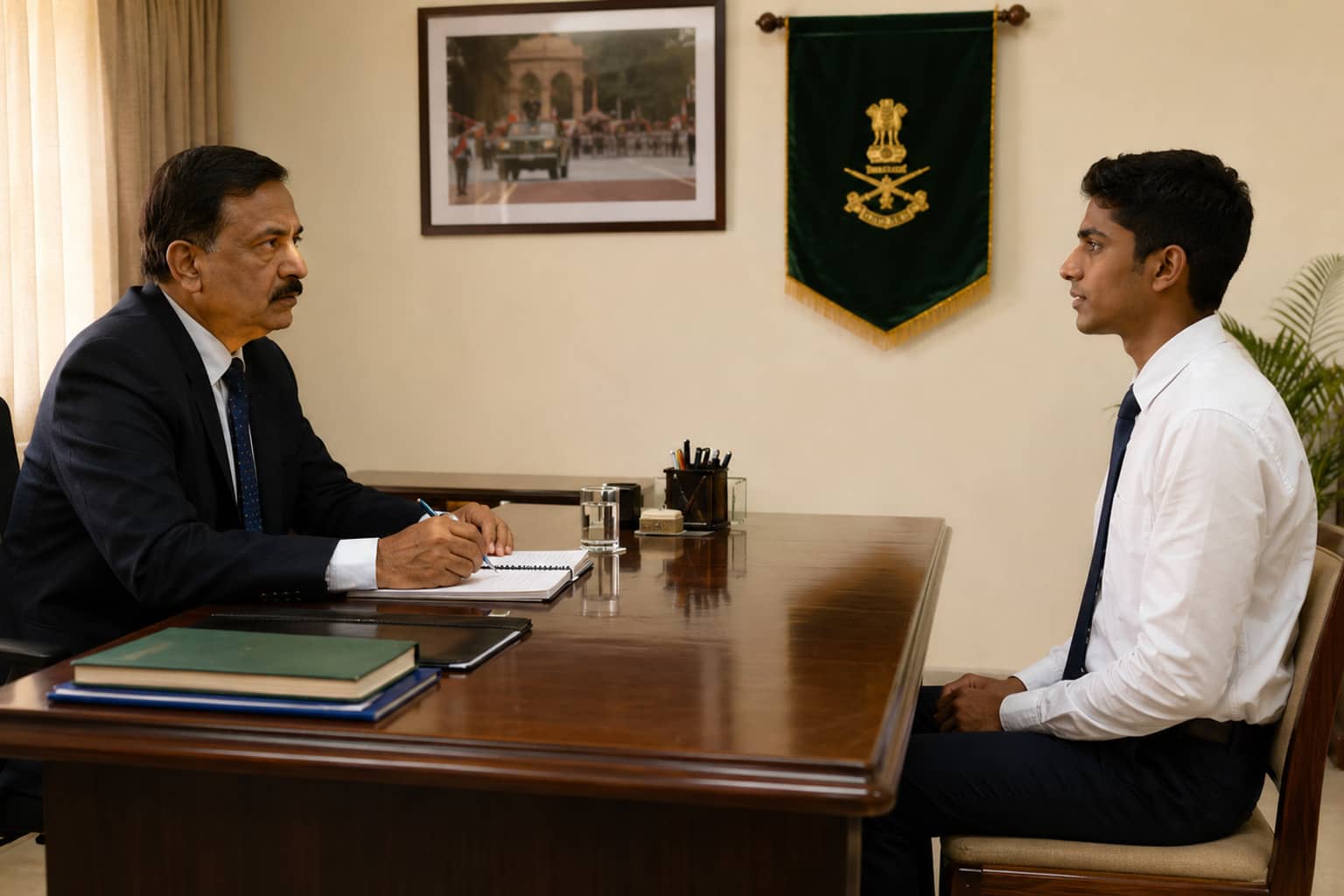
For thousands of defence aspirants, SSB is not just an interview. It is the final gate between a dream and the uniform. A candidate may clear NDA, CDS, AFCAT, TES, NCC Entry or another route, but the Services Selection Board is where the Armed Forces try to understand one serious question: does this candidate have the potential to become an officer?
In a detailed Sainik Welfare News podcast, Ex SSB President and Interviewing Officer Maj Gen Dr Anil Kumar Shukla, VSM, explained the SSB selection process in simple language. His message was direct: SSB is not about acting, memorising perfect answers or trying to impress the assessors. It is about showing your real personality, your thinking, your responsibility, your communication, your awareness and your behaviour under different situations.
This is an important lesson because many candidates enter SSB with fear and confusion. Some believe assessment begins from the railway station. Some think an officer’s child gets preference. Some believe recommendation calls can work. Some depend fully on coaching. Some fill the PIQ form casually and then get trapped by their own wrong details during the interview.
The first myth discussed in the podcast is the railway station myth. Many aspirants believe assessors start watching candidates from the railway station or bus stand. Such myths create unnecessary fear. A candidate who is already nervous may begin behaving unnaturally even before reaching the SSB centre. The better approach is simple: remain disciplined, respectful and normal everywhere, not because someone may be watching, but because that is how an officer-like person should behave.
The real assessment happens through a structured system. SSB uses different techniques to study the candidate from different angles. The broad process includes the interview, group testing tasks and psychological assessment. The Indian Territorial Army’s official selection centre information also describes psychological tests such as situation reaction, thematic perception, word association and self-description tests as part of the SSB schedule.
This is why candidates should understand that SSB is not a one-question interview. It is a personality assessment. The Interviewing Officer, GTO and Psychologist observe the candidate independently. Each assessor looks at behaviour, response, thought process and suitability from a different angle. A candidate cannot control all three by giving memorised answers. If the personality is fake, contradictions appear.
One of the most important parts of the podcast is the PIQ form. Many candidates treat the Personal Information Questionnaire as a formality, but it can shape the first impression before the interview begins. The Interviewing Officer may look at academic record, family background, responsibilities, hobbies, games, achievements and personal details written by the candidate. If a candidate writes fake hobbies, inflated achievements or careless information, the interview can expose it quickly.
This is where the famous line from the podcast becomes powerful: “छोटा सा सवाल, छोटा सा जवाब, Candidate fail.” It does not mean that a candidate fails because of one small answer. It means that a small question can reveal a big personality gap. For example, if a candidate writes a hobby but cannot explain anything about it, the problem is not the hobby. The problem is dishonesty or lack of self-awareness.
The same applies to games, responsibilities and achievements. If you write that you played football, you should know the basics of the game. If you write that you were a class leader, you should be able to explain what responsibility you handled. If you write that you read newspapers, you should know current issues. The IO is not looking for perfect English or dramatic answers. He is looking for truth, clarity and consistency.
Another important issue is over-coaching. Coaching can help a candidate understand the process, but it cannot manufacture personality overnight. The problem begins when aspirants copy standard answers, use artificial stories or try to behave like a “model candidate”. SSB assessors have seen thousands of candidates. Rehearsed responses can be identified.

This is why originality matters. A simple, honest and self-aware candidate is stronger than a candidate who speaks impressive lines but has no real substance. If the candidate has lived responsibly, helped at home, worked in a team, played sports, read regularly, stayed physically active and developed communication naturally, that personality will show during SSB.
The podcast also addresses the question of recommendation and pressure. Many candidates worry that defence background, references or recommendation calls may decide selection. Maj Gen Shukla’s message, as reflected in the description, is that SSB is an honest and transparent system. If ability is present, the candidate can be recommended. If ability is missing, pressure cannot make the candidate suitable.
This is important for parents too. Instead of searching for shortcuts, parents should help candidates build real qualities. Give them responsibility at home. Encourage them to speak clearly. Ask them to read. Let them handle small decisions. Teach honesty. Build confidence without arrogance. SSB preparation should not begin two weeks before reporting. It should begin when the candidate decides to join the Armed Forces.
The Services Selection Board is commonly described as a multi-day evaluation process that assesses suitability for officer roles through psychological tests, interviews and group tasks. A broad public description of SSB also notes that assessors include Interviewing Officers, Group Testing Officers and Psychologists, which matches the three-technique structure discussed in the podcast.
Another key message is that selection standards are not casual. NDA, CDS, AFCAT, technical entries, NCC entry and service entries may have different age profiles and backgrounds, but the core requirement remains officer potential. A young NDA candidate may be assessed with trainability in mind, while an older graduate may be expected to show more maturity. But in every case, the Armed Forces are looking for a person who can be trained, trusted and developed as an officer.
This is where OLQs, or Officer Like Qualities, come in. Many candidates treat OLQs as a list to memorise. But OLQs are not meant to be recited. They are meant to be lived. Practical intelligence, reasoning, expression, social adjustment, cooperation, responsibility, courage, stamina, initiative and honesty are visible in behaviour. A candidate who speaks of leadership but never takes responsibility in real life will struggle to prove it.
Communication also matters, but not in the way many candidates think. SSB does not require fancy English. It requires clear expression. A candidate should be able to explain thoughts logically. Whether in Hindi, English or mixed communication depending on the setting, the answer should be honest, structured and natural. Good communication comes from reading, observation and regular speaking practice.
Fitness is another foundation. A candidate may have good knowledge, but if he lacks basic physical readiness, confidence can suffer during GTO tasks. Fitness also reflects discipline. The Armed Forces need officers who can endure pressure, fatigue and field conditions. Regular exercise, sports and outdoor activity build both body and mind.
Knowledge is equally important. A candidate should know about his own life, family, education, city, hobbies, national issues and defence awareness. Many candidates fail not because they do not know the SSB format, but because they do not know themselves properly. If you cannot explain your own choices, strengths, weaknesses and responsibilities, the Interviewing Officer will quickly see the gap.
The podcast’s biggest lesson is that SSB preparation is life preparation. You cannot become original by memorising originality. You become original by living honestly. You cannot become responsible by saying “I am responsible.” You become responsible by doing work without being pushed. You cannot become a leader by repeating definitions. You become a leader by helping people, taking initiative and accepting accountability.
For defence aspirants, the practical message is clear. Fill the PIQ form carefully. Never write fake hobbies. Do not inflate achievements. Read newspapers. Build physical fitness. Improve communication. Participate in group activities. Take responsibility at home and college. Respect parents, teachers and friends. Stay honest about your background. Do not fear simple questions. Simple questions often reveal the real candidate.
For parents, the message is also important. Do not push children into shortcuts. Do not create pressure for selection at any cost. The Armed Forces are not only selecting a student. They are selecting a future leader who may one day command soldiers in difficult situations. Character matters.
In the end, SSB is not a stage performance. It is a mirror. It reflects what a candidate has built over years. Coaching may polish presentation, but it cannot replace personality. Confidence may help, but only when backed by substance. Knowledge may impress, but only when joined with humility and practical sense.
That is why Maj Gen Dr Anil Kumar Shukla’s message is so valuable for aspirants. The real secret of SSB selection is not a secret at all. Be genuine. Be aware. Be fit. Be responsible. Be honest. Build your personality before you try to present it.
For every NDA, CDS, AFCAT, TES, NCC Entry and service entry candidate, this is the most important takeaway: SSB does not select the best actor. It recommends the candidate who shows real officer potential.
Sources:-
https://www.facebook.com/SainikWelfareNews/posts/today-we-had-the-privilege-of-learning-from-maj-gen-dr-anil-shukla-vsm-retd-on-t/1317329620503668/
https://en.wikipedia.org/wiki/Services_Selection_Board
https://territorialarmy.in/page/1126


Leave a Reply