

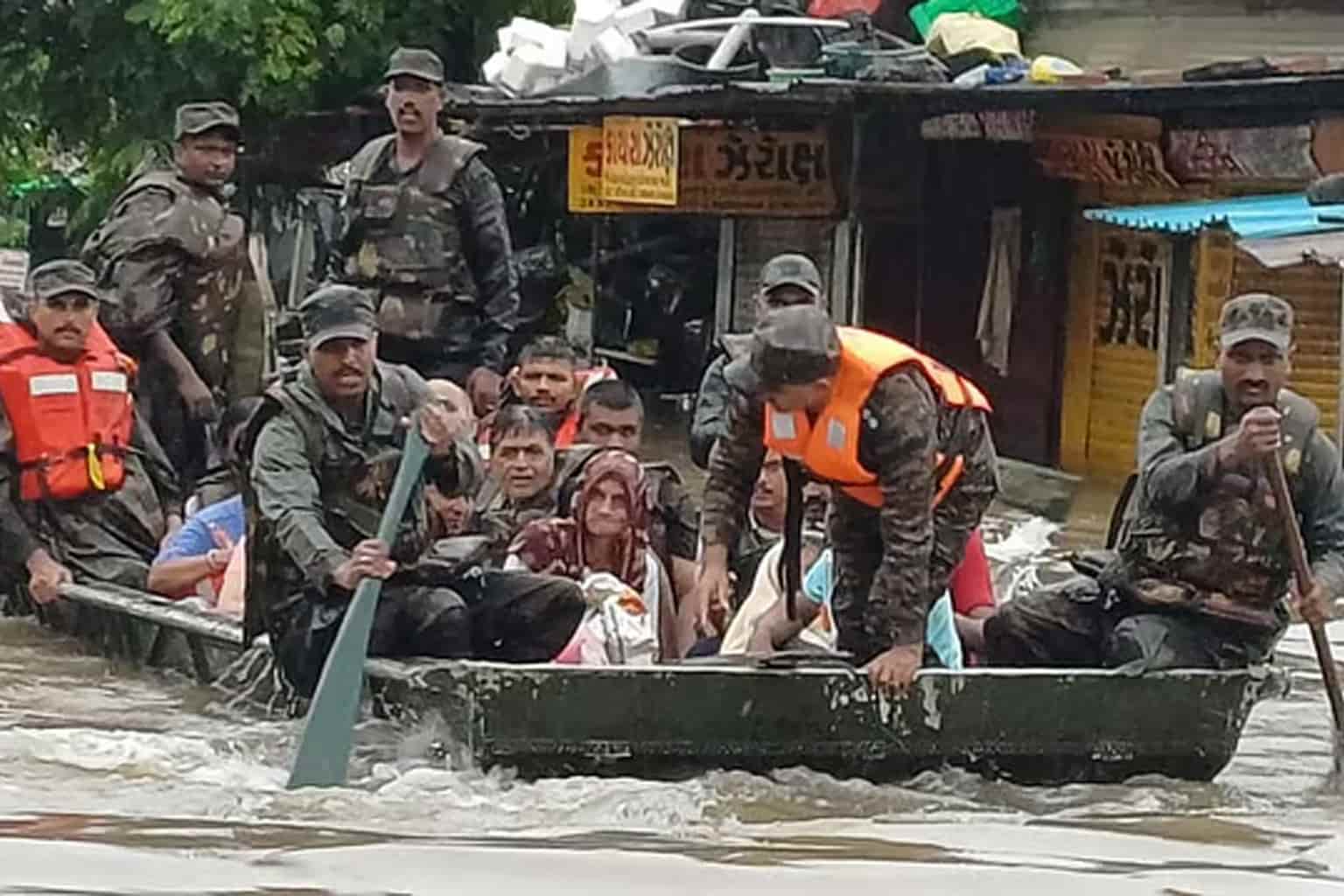
A woman in the final month of pregnancy needed urgent evacuation.
Passengers were trapped inside a bus surrounded by floodwater. Fishermen were stranded near a flooded riverbank. Families, workers and patients were cut off after roads disappeared beneath rising water.
Across Gujarat, Daman and Dadra and Nagar Haveli, each emergency was different. But the challenge was the same: normal access had failed.
Indian Army relief columns, Engineer teams, medical personnel and Indian Coast Guard rescuers entered flooded and inaccessible areas to assist the civil administration.
In its 25 July 2026 update, the Army reported evacuating 355 stranded civilians. In a separate release, the Coast Guard reported rescuing 170 people through 11 missions conducted amid persistent rain, swift currents and hazardous conditions.
These figures describe separate operations. They should not automatically be added and presented as 525 unique beneficiaries because the official releases do not rule out possible overlap.
Two uniformed forces, several different emergencies
The Army began its Humanitarian Assistance and Disaster Relief operations on the evening of 23 July 2026 under Southern Command.
Seven Relief and Rescue Columns—including Engineer and Medical teams—were deployed across the affected region:
- Two columns in Navsari
- One in the Valsad–Vapi region
- Three covering Ahmedabad city, rural areas and the Ahmedabad–Rajkot Highway
- One in Silvassa
Additional columns remained ready at Vadodara, Ahmedabad and Jamnagar in case new emergencies developed.
Army teams entered flooded buildings and isolated habitations, provided immediate healthcare and distributed food, drinking water and essential supplies to people awaiting evacuation or restoration of road access.
The Coast Guard’s operations had started earlier, during the night of 22–23 July. Its teams carried out 11 rescue missions across Daman, Dadra and Nagar Haveli and South Gujarat.

The people behind the rescue figures
Large rescue figures can hide the individual emergencies behind them.
The Coast Guard’s official account provides a clearer picture of the people waiting for help.
Five stranded people were first rescued from Khanvel in Silvassa. Three fishermen were then evacuated from a flooded riverbank near Kadaiya. In one of the largest missions, 60 people were removed from the Welspun Industrial Area after road connectivity was completely disrupted.
Subsequent operations included:
- Seven people rescued from a bus trapped in floodwater
- Ten people evacuated from Dongri
- Four people rescued by helicopter in the Valsad–Pardi area
- Eight people evacuated overnight near an industrial area
- Ten residents rescued from Avadh Society
- Thirty-three people airlifted from Mendar village in Navsari district
The Avadh Society group included a woman who was nine months pregnant and another woman experiencing respiratory distress. In Mendar village, a person suffering severe chest pain received urgent medical assistance during the evacuation.
These details show why disaster rescue cannot be treated as a simple transport exercise. A pregnant woman, a heart patient, fishermen and passengers inside a flooded bus each require a different approach.

Why the rescue of a pregnant woman required special care?
A person in the final stage of pregnancy cannot simply be moved like an ordinary passenger.
Rescuers must consider:
- Her physical condition
- The stability of the boat or vehicle
- Water current and weather
- Distance to medical care
- The safest method of lifting or seating
- Communication with the receiving facility
The official release confirms that the woman was rescued and given timely access to medical care. It does not disclose information about delivery or her later medical condition, so those details should not be assumed.
The same caution applies to the woman with respiratory distress and the individual experiencing severe chest pain. Public reporting should respect their privacy and remain limited to information officially released.
Why a flooded bus can become a serious rescue situation?
A bus surrounded by floodwater may appear stable, but several dangers can develop quickly:
- Rising water can enter the vehicle
- Strong currents can shift or overturn it
- Doors may become difficult to open
- Passengers may panic
- Elderly people and children may struggle to exit
- The road beneath the vehicle may become unstable
The Coast Guard reported rescuing seven people from a bus near Aero Fibre Pvt. Ltd. The release does not provide further details about the bus, its route or the passengers’ identities.
Why fishermen needed Coast Guard assistance?
Water-rescue skills are central to Coast Guard training.
Its personnel are familiar with:
- Boat handling
- Water navigation
- Search-and-rescue procedures
- Evacuation in difficult weather
- Helicopter coordination
- Medical transfer from isolated locations
These capabilities are useful not only at sea but also in coastal, riverine and heavily flooded areas where normal roads have become unusable.

What is an Army Relief and Rescue Column?
A relief column is an organised military team assigned to a specific disaster-response task or location.
Its exact composition depends on the emergency, but it may include:
- Trained soldiers
- Engineer personnel
- Medical staff
- Vehicles
- Boats or specialist rescue equipment
- Communication systems
- Food, water and emergency supplies
In this operation, the Ministry of Defence specifically confirmed the presence of Army Engineer and Medical teams.
The columns did more than remove stranded residents. They provided healthcare and distributed essential supplies to people who could not yet be evacuated.
This distinction is important: rescue moves someone away from immediate danger, while relief supports people who remain affected even after the immediate threat has reduced.
Why Army Engineer teams matter during floods?
Flooding can create technical obstacles that ordinary vehicles and local access systems cannot overcome.
Roads may disappear beneath water. Bridges may become unsafe. Buildings can become isolated. Communication routes may be cut, and rescuers may need to determine whether a path is stable enough to use.
Army Engineer teams can support:
- Route assessment
- Identification of safe access
- Positioning of rescue equipment
- Movement through damaged areas
- Restoration of basic connectivity
- Technical support to evacuation teams
The available release confirms the Engineer teams’ deployment but does not give a complete list of the engineering tasks they performed in each location. Those details should not be invented.

What does HADR mean?
HADR stands for Humanitarian Assistance and Disaster Relief.
It includes the organised response required when a disaster disrupts normal civilian life and local capacity needs reinforcement.
Military HADR operations may involve:
- Search and rescue
- Evacuation
- Emergency medical treatment
- Field hospitals
- Restoration of essential infrastructure
- Transportation of relief supplies
- Food and water distribution
- Communication and logistical support
A Government of India backgrounder describes the Armed Forces as supporting national resilience through humanitarian, medical and disaster-relief operations when civilian capacity is stretched. It also notes that the Army can deploy troops, establish field hospitals, restore essential infrastructure and deliver humanitarian assistance.
The military does not replace the district administration, NDRF, SDRF or police. It reinforces the wider disaster-response system with specialised manpower, equipment, medical support and logistics.

Inside the Sanduri village rescue
The Silvassa operation offers a useful example of how a flood-relief column works on the ground.
After heavy rainfall and a Red Alert in Dadra and Nagar Haveli, an Army column from the School of Artillery at Devlali was deployed to assist the civil authorities.
At around 1 pm on 24 July, authorities received a distress call concerning approximately 100 people stranded by rising water near Sanduri village in the Madhuban Dam area.
The Army evacuated 23 civilians, including:
- Seven women
- Four small children
They were moved to a safe shelter at Khanvel. Residents who remained in the village received food and rations, while an on-site medical camp treated injuries and illness. No casualty was reported in that particular operation.
This operation demonstrates that military flood relief can involve three parallel decisions:
- Who needs immediate evacuation?
- Who can remain safely with supplies?
- Who requires medical treatment at the location?
Not every person in a flooded area must necessarily be evacuated at the same time. Decisions depend on water levels, health conditions, access routes and the availability of safe shelters.
How Army, Coast Guard and civil agencies coordinate
A major flood response is not controlled by one uniformed organisation acting alone.
The official Army update states that the operations were conducted with:
- Civil administration
- NDRF
- SDRF
- Police
- Other stakeholders
The Coast Guard also stated that it was working closely with the civil administration.
A simplified rescue chain may look like this:
Distress call received
→ Location and urgency verified
→ Suitable agency assigned
→ Access and medical risks assessed
→ Evacuation conducted
→ Health screening completed
→ Shelter and relief support arranged
Different agencies bring different strengths.
NDRF and SDRF specialise in disaster response. Police control routes and public movement. Health departments manage medical facilities. Local authorities provide shelters, food and ground information. The Armed Forces add engineering, logistics, aviation, water-rescue and medical capabilities.

What is officially confirmed?
The official releases confirm that:
- The Army began HADR operations on 23 July 2026
- Seven Army Relief and Rescue Columns were deployed
- Engineer and Medical teams were part of the response
- The Army reported evacuating 355 civilians
- The Coast Guard reported rescuing 170 people
- The Coast Guard conducted 11 rescue missions
- Boats and helicopters were used in different operations
- Patients, workers, fishermen, women and children were assisted
- Civil authorities, NDRF, SDRF and police were involved in the broader response
What should not be claimed?
The available information does not establish that:
- Exactly 525 unique people were rescued
- All operations occurred at the same location
- Army and Coast Guard teams worked independently
- Every rescued person’s later medical condition is known
- The entire flood-relief operation had ended on 25 July
- Every affected district received the same level of assistance
These distinctions protect the article from exaggeration.

What should civilians do during severe flooding?
People living in flood-prone areas should:
- Follow official evacuation instructions early
- Avoid walking or driving through moving floodwater
- Keep medicines and identity documents in waterproof packaging
- Inform rescuers about children, elderly people, pregnant women and patients
- Share an accurate location and nearby landmark
- Avoid overcrowding boats or rescue vehicles
- Use verified government helplines
- Do not circulate unconfirmed rescue messages
- Move to higher ground when advised
- Switch off electricity only when it can be done safely.

Frequently asked questions
How many people did the Indian Army evacuate?
The Army reported safely evacuating 355 stranded civilians during the flood-relief operations covered by its 25 July update.
How many people did the Indian Coast Guard rescue?
The Coast Guard reported rescuing 170 people through 11 separate missions.
Were 525 different people rescued?
The two reported totals add up mathematically to 525, but the releases describe separate operations and do not explicitly confirm that there was no overlap. The safer approach is to report both figures separately.
What is HADR?
HADR means Humanitarian Assistance and Disaster Relief. It includes rescue, evacuation, medical care, logistics, engineering support and the delivery of essential supplies.
Why does the Army assist during civilian disasters?
The Army has trained manpower, engineering resources, medical teams, transport systems and logistical capabilities that can reinforce civilian authorities during severe emergencies.
Why was the Coast Guard involved in inland flooding?
Its expertise in water rescue, navigation, helicopters and emergency evacuation can support operations in coastal, riverine and heavily flooded locations.
Which areas were covered by Army columns?
The official Army release listed Navsari, Valsad–Vapi, Ahmedabad and Silvassa, with additional teams on standby at Vadodara, Ahmedabad and Jamnagar.
Conclusion
When floodwater cut off roads, buildings, factories and villages, different organisations brought different capabilities to the rescue effort.
Army personnel entered inaccessible areas. Engineer teams supported safe access. Medical teams treated vulnerable residents. Coast Guard crews used boats and helicopters to reach people stranded by water.
The rescue totals are important—but they are not the entire story.
Behind the figures were a pregnant woman, patients in medical distress, fishermen, industrial workers, bus passengers, children and families waiting for help.
These operations demonstrate that the role of India’s uniformed services extends beyond national defence.
During a disaster, military training, logistics and discipline can become a lifeline for civilians on the other side of the floodwater.


Leave a Reply