

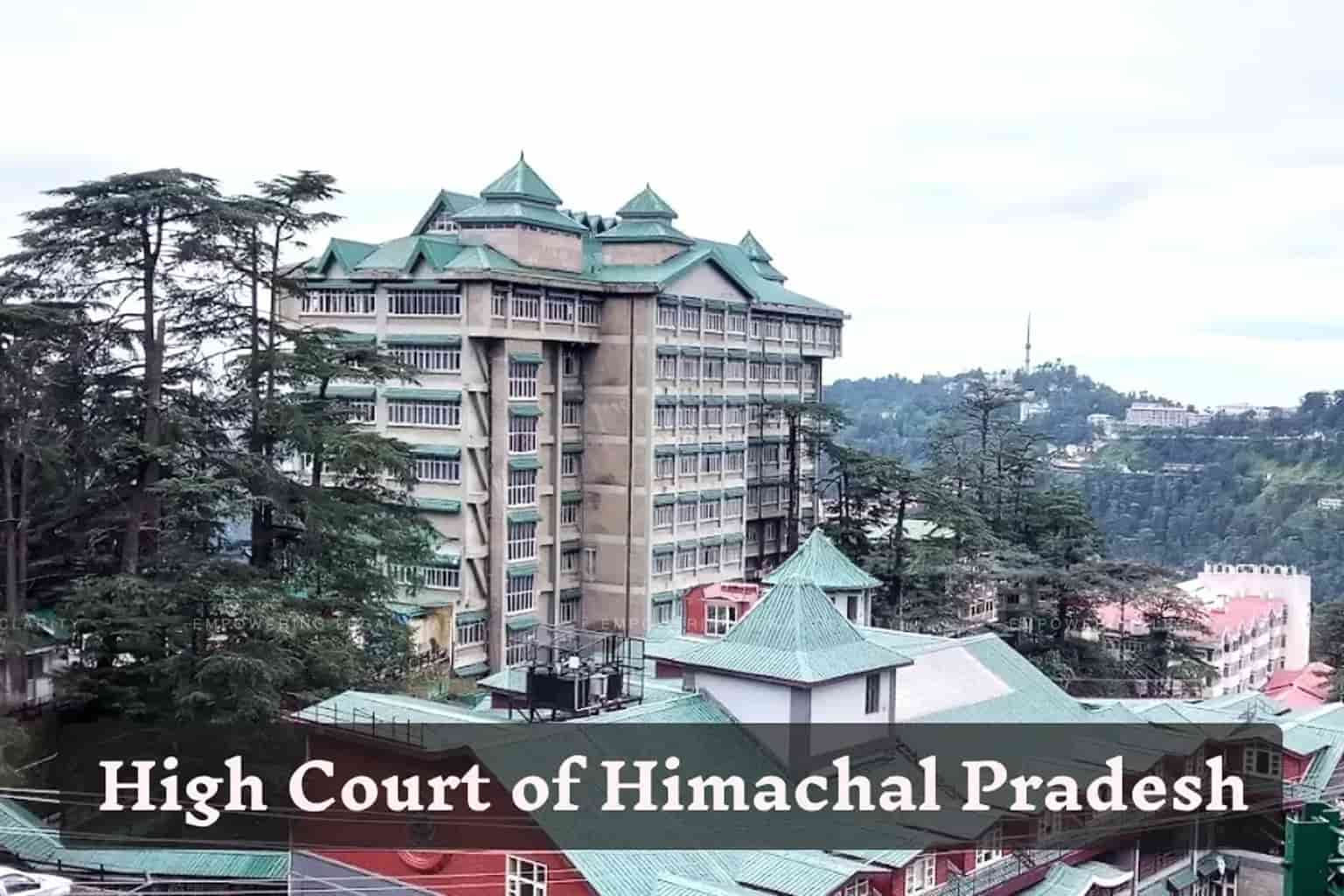
The Himachal Pradesh High Court has delivered an important judgment on restoration of commuted pension, refusing to reduce the existing 15-year restoration period but at the same time recognising that the economic and actuarial assumptions behind the rule deserve a fresh review.

In Bal Dev v. State of Himachal Pradesh & connected matters, decided on 16 September 2026, a Division Bench of Justice Vivek Singh Thakur and Justice Ranjan Sharma dealt with a large batch of petitions filed by retired Himachal Pradesh Government employees challenging the continuation of reduced pension for the full 15-year period.

Why did pensioners approach the High Court?
The petitioners had opted to commute part of their pension at retirement and received a lump-sum commuted value. Under Rule 10-A of the CCS (Commutation of Pension) Rules, 1981, the commuted portion is restored after 15 years.
The pensioners argued that, according to their calculations, the commuted amount along with interest was effectively recovered within about 10 to 12 years.
Their case was therefore simple:
If the Government has already recovered the commuted value with interest, why should reduced pension continue for the full 15 years?
They also argued that the commutation factor had fallen over time, interest conditions had changed and life expectancy had increased.
What exactly did the pensioners want?
The petitioners sought restoration of full pension before completion of 15 years and challenged the existing Rule 10-A framework.
They relied on several factors:
- the commutation factor for retirement around age 58 had reduced from 10.46 to 8.371;
- the amount paid as commuted value had consequently reduced;
- the effective financial recovery, according to their calculations, occurred in roughly 11–12 years;
- life expectancy had increased;
- continuing reduction after recovery was argued to be unfair to pensioners.
Their larger argument was that the old 15-year formula should be reconsidered in light of present-day financial conditions.

What was the Government’s defence?
The State and Union Governments argued that pension commutation is not a simple loan transaction.
A pensioner voluntarily chooses to commute a portion of pension and receives a lump sum immediately.
The Government pointed out that if the pensioner dies before the 15-year period is completed:
- the unpaid balance is not recovered from the family;
- family pension is not reduced for recovery;
- the Government bears the remaining financial risk.
Therefore, according to the Government, commutation has to be assessed through actuarial factors such as mortality, interest assumptions and long-term pension liabilities—not merely by comparing the lump sum paid with monthly deductions.
Did the High Court reduce the restoration period?
No.
This is the most important fact in the judgment.
The High Court did not order restoration after 10 years, 11 years, 12 years or 10 years 8 months.
It also did not strike down Rule 10-A.
The existing 15-year restoration period therefore continues.
The Court relied on earlier judicial decisions, including the Supreme Court’s decision in Common Cause, where the 15-year period had been accepted after considering the actuarial nature of pension commutation.
Why did the Court refuse to simply use the pensioners’ calculation?
The Court accepted the broader legal position that pension commutation is based on actuarial policy, not on a straightforward principal-plus-interest recovery calculation.
The judgment refers to factors such as:
- mortality risk;
- longevity;
- interest and discount assumptions;
- financial risk to the Government;
- future pension liabilities; and
- overall sustainability of the pension system.
Therefore, even if an individual pensioner’s calculation suggests that the lump-sum amount has been recovered earlier, that alone does not automatically invalidate the 15-year rule.
Then why is this judgment important for pensioners?
Because the Court did not stop at simply rejecting the petitions.
The Bench observed that considerable changes have taken place since the Supreme Court’s 1987 Common Cause judgment.
It specifically noted changes such as:
- reduction in the commutation factor;
- changes in interest/return conditions;
- increased life expectancy;
- reduction in the Government’s mortality-related risk.
The Court recorded that the life expectancy of Himachal Pradesh Government employees had been placed at around 77 years before it.
This is where the judgment becomes significant.
High Court says the issue deserves expert examination
The Court observed that the State should not function like a private “Sahookar” or money lender, but as a welfare State balancing the interests of the Government and retirees.
It said the issue should be examined objectively with participation from relevant stakeholders, including retirees, the Finance Department, Pay Commission and other concerned authorities.
Most importantly, the judgment states that an Expert Committee must be constituted to study the matter and submit its report/comments to the Government in a time-bound manner.
The Government should thereafter take the final policy decision as expeditiously as possible.

What happens to the petitions?
The High Court disposed of the connected petitions and also declined to interfere with the earlier Single Judge judgment that had rejected the claim for immediate reduction of the commutation period.
In practical terms, therefore:
The 15-year rule remains applicable unless and until the competent Government changes the policy.
The immediate development to watch now is the constitution and functioning of the Expert Committee and whether its recommendations eventually lead to any amendment in the restoration period.
Does this automatically apply to Central Government pensioners?
No.
The present batch concerned retired employees governed by service rules adopted by the Himachal Pradesh Government.
The judgment itself records the Union Government’s stand that Central pension rules are not automatically applicable to the State merely because Himachal Pradesh has adopted parts of the framework.
Therefore, the decision does not itself reduce the commutation restoration period for all Central Government pensioners.
What does it mean for Armed Forces pensioners?
The judgment discusses the Supreme Court’s Common Cause decision, which had also dealt with restoration of commuted pension for Armed Forces personnel.
However, the Himachal Pradesh High Court has not ordered any change in the commutation period for defence pensioners.
So, for veterans, the judgment is important as a policy-review development, but it should not be interpreted as an immediate reduction of the existing restoration period.

What pensioners should understand?
The most accurate reading of the judgment is:
15-year commutation restoration has not been abolished.
But the High Court has also recognised that the assumptions behind this decades-old formula may deserve re-examination because financial conditions, commutation factors and life expectancy have changed substantially.
That makes the next stage important.
If an Expert Committee is constituted and recommends a shorter restoration period, the Government will still have to examine and accept any policy change before it becomes effective.
Until then, the 15-year restoration rule continues.
Sources:-
High Court of Himachal Pradesh, Shimla — Bal Dev v. State of Himachal Pradesh & connected matters, CWP No. 15995 of 2024 and connected cases, Neutral Citation: 2026:HHC:39535, decided on 16 September 2026.
Official Himachal Pradesh High Court — Search Judgment by Case Number / Neutral Citation
You can also open the official case-search page directly:



Leave a Reply