

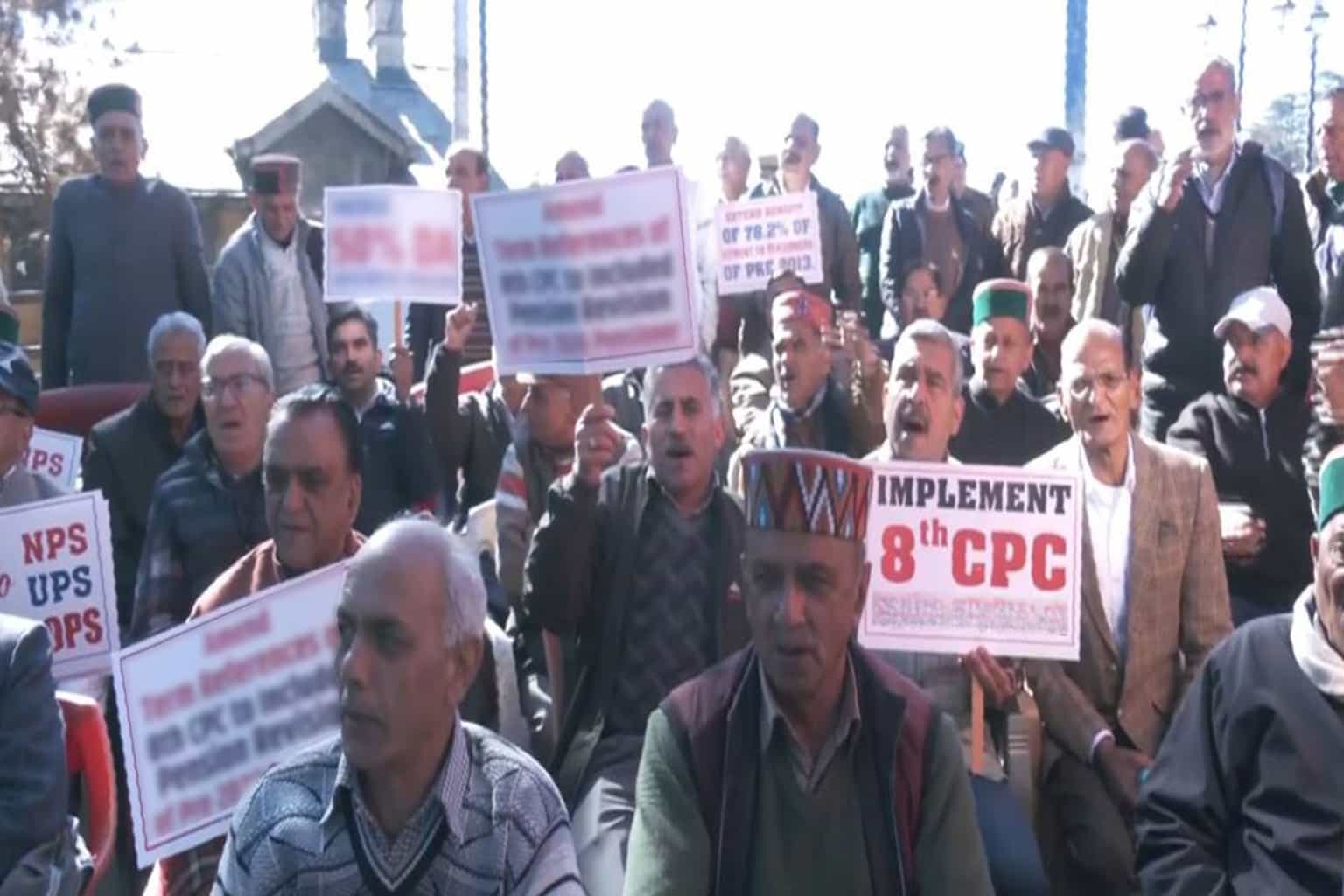
The 8th Central Pay Commission’s Chandigarh consultations have coincided with a fresh development concerning Central Government pensioners. A group of retired officers and pensioners has announced a demonstration in Chandigarh on 18 September 2026, raising a series of pension-related demands including 50% DA/DR merger, interim relief, pension revision under the 8th CPC and earlier restoration of commuted pension.

According to The Tribune, the demonstration has been called by the Association of Retired Officers of the Indian Audit and Accounts Department, Chandigarh, in collaboration with the Coordination Committee of the Central Government Pensioners’ Association, Chandigarh. It is scheduled for 11:30 AM near Sindhi Sweets in Sector 17, Chandigarh.
The timing is important. The 8th CPC’s official website confirms that the Commission is visiting Chandigarh from 16 to 18 September 2026 for stakeholder interactions.

Why is the 18 September protest important?
This is not simply another pensioners’ demonstration taking place independently of the Pay Commission process.
The protest falls on the final day of the 8th CPC’s three-day Chandigarh visit. The Commission had officially announced its Chandigarh programme for 16, 17 and 18 September, with stakeholders earlier invited to seek appointments for interaction with the Commission.
However, an important distinction should be maintained: the protest itself is not an official 8th CPC meeting. It is a demonstration organised by pensioners during the same period in which the Commission is holding consultations in Chandigarh.
What are pensioners demanding?
The pensioners have raised several issues that could become important during discussions around the 8th Pay Commission.
One of their prominent demands is the merger of 50% Dearness Allowance/Dearness Relief with basic pay and pension.
They have also sought interim relief pending implementation of the eventual recommendations of the 8th CPC.
Another significant demand concerns the scope of the Commission itself. Pensioners want the Terms of Reference of the 8th CPC to explicitly provide for pension revision of existing pensioners.
The reported charter also seeks pension parity and restoration of the commuted portion of pension after 10 years and 8 months instead of the existing restoration period applicable under current rules.

What does the 50% DA/DR merger demand mean?
DA is paid to serving employees while DR serves a similar inflation-compensation function for pensioners.
The protesters are seeking a situation where 50% DA/DR is merged with basic pay or basic pension rather than continuing entirely as a separate component.
At this stage, however, this is a demand placed by pensioners. The cited reports do not establish that the Government or the 8th CPC has approved a 50% DA/DR merger.
That distinction becomes particularly important because headlines around Pay Commission matters can easily be interpreted as announcing a decision when the development actually concerns a representation or demand.
Why is commutation restoration being discussed?
Government pensioners who commute a portion of their pension receive a lump sum in return for a reduction in monthly pension for the prescribed restoration period.
The Chandigarh pensioners are demanding restoration of the commuted portion after 10 years and 8 months.
Again, 10 years and 8 months is the period being sought by the pensioners, not a newly notified Government rule.
No source cited here establishes that the existing commutation-restoration rule has already been changed.
Pension revision under the 8th CPC is another major issue
A particularly important part of the representation is the demand that pension revision for existing pensioners should be clearly included within the 8th CPC Terms of Reference.
For pensioners, this issue goes beyond the possible fitment factor or the size of a future pension increase. Their demand concerns whether the mechanism for revising existing pensions is explicitly and adequately addressed during the Commission’s examination.
It therefore has a potentially wider relevance for Central Government retirees, although the final position will depend on the Commission’s recommendations and subsequent Government decisions.
A demand is not the same as an approved benefit
This is perhaps the most important point for readers following 8th CPC news.
At present, the reported developments establish that pensioners are seeking:
| Issue | Present status in this development |
|---|---|
| 50% DA/DR merger | Demand raised |
| Interim relief | Demand raised |
| Pension revision in 8th CPC ToR | Being sought |
| Pension parity | Demand raised |
| Commutation restoration after 10 years 8 months | Demand raised |
| Protest on 18 September | Scheduled/reported |
The reports cited here do not establish that these demands have already been accepted by the Government or approved by the 8th CPC.

What happens after pensioners submit such demands?
A representation or protest can bring an issue before the Pay Commission, but it does not by itself amend pension rules.
Broadly, an issue raised before a Pay Commission may be examined by the Commission. The Commission may subsequently make recommendations. Recommendations requiring Government action then have to be considered by the Government, and an actual rule change would require the appropriate official decision or order.
Therefore, readers should differentiate between four very different stages:
Demand/Representation → Examination → Recommendation, if any → Government decision/order, if approved
Until that process results in an official decision, the demand itself should not be presented as an implemented benefit.

Chandigarh has become an important 8th CPC interaction point
The broader context also makes the Chandigarh visit noteworthy.
The official Commission programme confirms stakeholder interactions in Chandigarh from 16 to 18 September 2026.
Separately, a four-member ex-servicemen delegation from Himachal Pradesh is also scheduled to meet the Commission on 18 September to present issues concerning serving defence personnel, veterans and their families. Their subjects reportedly include OROP anomalies, Military Service Pay, disability pension, widow pension, fitment factor and other service-related matters.
This indicates that Chandigarh is serving as an important consultation point for different employee and pensioner groups, although each organisation’s representation and demands should be treated separately.
What should pensioners watch next?
The immediate development to watch is the 18 September demonstration and whether pensioners subsequently issue a memorandum, statement or details of any interaction with the Commission.
More importantly, pensioners should distinguish between a demand being submitted and an issue being formally accepted.
For matters such as 50% DA/DR merger, interim relief, pension parity and reduction in the commutation-restoration period, an official Government order or an authoritative Commission document would be needed before any change can be treated as implemented.
For now, the Chandigarh development shows that pension organisations are attempting to place these issues prominently before the 8th CPC during its ongoing consultation exercise.
Sources
- The Tribune: Pensioners’ protest on September 18. Read The Tribune report
- 8th Central Pay Commission official website: Chandigarh visit on 16, 17 and 18 September 2026. View the official 8th CPC Chandigarh notice
- The Tribune: Himachal ex-servicemen delegation to meet the 8th CPC on 18 September. Read the related report



Leave a Reply