

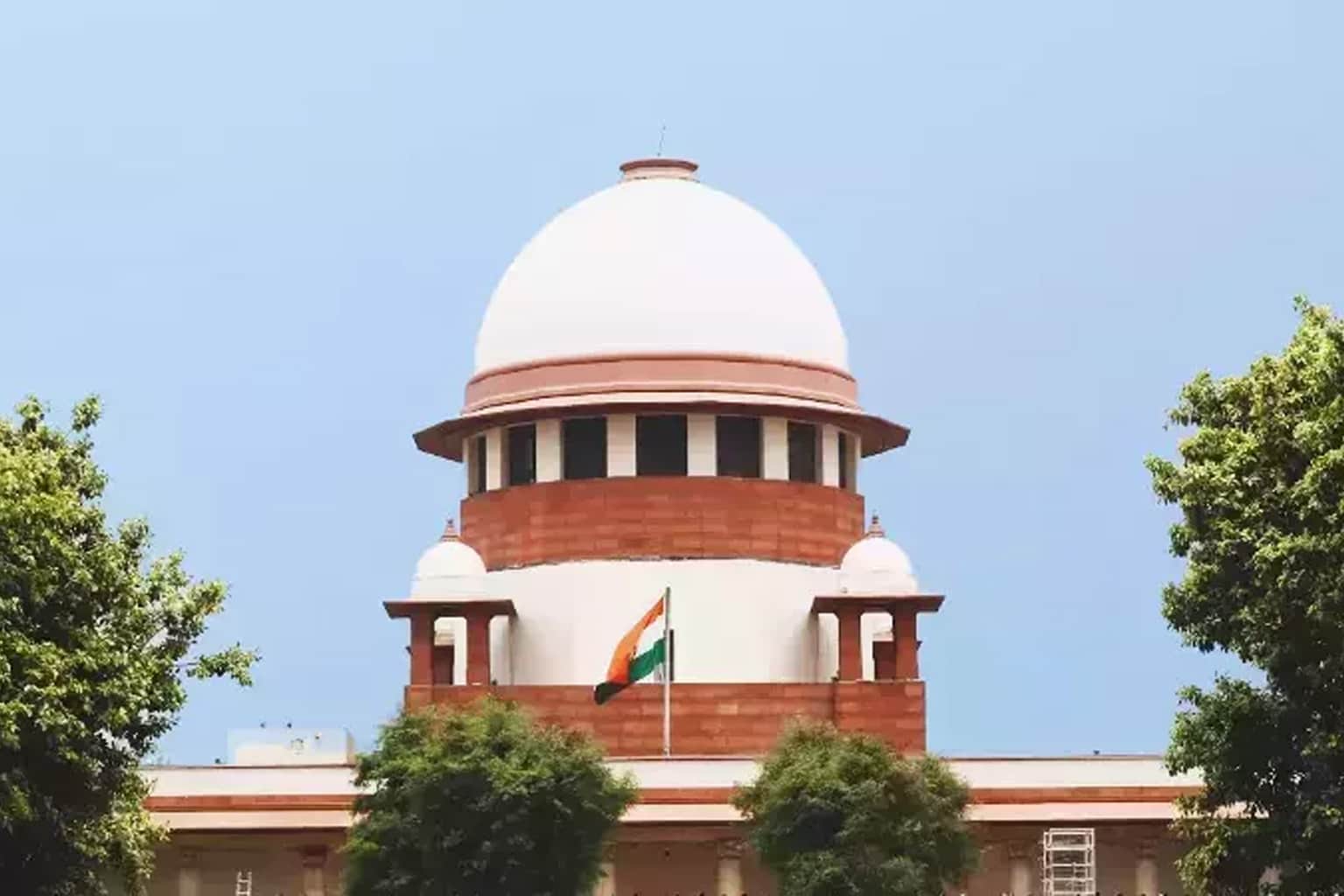
A Supreme Court case linked to the 8th Central Pay Commission (8th CPC) has opened an important debate over how judicial pay and service conditions should be reviewed in India.
The case is Maharashtra State Judges Association v. Union of India & Others, Writ Petition (Civil) No. 650/2026. The Maharashtra State Judges Association has challenged the inclusion of certain judicial officers within the Terms of Reference of the 8th CPC and has sought the creation of an independent National Judicial Pay Commission (NJPC).
On 2 September 2026, a Supreme Court Bench comprising Chief Justice of India Surya Kant, Justice Joymalya Bagchi and Justice V. Mohana issued notice in the matter. The case has been made returnable on 14 October 2026. At this stage, however, the Court has not accepted or rejected the Association’s arguments on merit.
This distinction is crucial because the case is already being discussed in the context of fitment factor, pension revision, interim relief and DA/DR. What the petition actually seeks is narrower in some respects—and institutionally much larger in others.
What exactly has happened in the Supreme Court?
The Supreme Court’s official cause list for 27 May 2026 records W.P.(C) No. 650/2026, Maharashtra State Judges Association versus Union of India and Others, before the Chief Justice’s Court as a matter “for admission.”
The significant development came on 2 September 2026, when the Court issued notice and fixed 14 October 2026 as the returnable date. Published reports on the proceeding reproduce the order as a brief direction to issue notice.
For readers, the present legal position can therefore be stated clearly:

Calling the case a final “Supreme Court decision against the 8th CPC” would therefore be incorrect at this stage.
Which part of the 8th CPC Terms of Reference has been challenged?
The Government of India constituted the 8th Central Pay Commission through its 3 November 2025 resolution.
Clause 2(a)(ix) specifically includes:
“Judicial officers of the subordinate courts in the Union Territories.”
The same resolution contains an important safeguard. It directs the 8th CPC, while dealing with judicial officers, to follow the principle laid down by the Supreme Court in the All India Judges’ Association judgment of 24 August 1993—that judges’ service conditions should not be linked to the administrative executive and must address the special requirements of the judiciary.
The Maharashtra State Judges Association is challenging the inclusion of subordinate judicial officers in Union Territories within the CPC mechanism itself. Its argument is therefore not merely about how much salary should be recommended, but also which institutional mechanism should determine judicial pay and service conditions.

What does the Maharashtra State Judges Association want?
The petition reportedly seeks the immediate constitution of a National Judicial Pay Commission capable of reviewing the broader compensation and service framework of the judiciary.
Its proposed scope includes:

The proposed Commission would cover judges of the Supreme Court, all 25 High Courts, and the District and subordinate judiciary in States and Union Territories.
18 months for the report and three months for implementation
The Association has also proposed a defined timeline.
According to the reported prayers, the proposed NJPC should submit its recommendations within 18 months of constitution, after which the Union and State Governments should implement the recommendations within three months.
Another significant demand is that a fresh judicial pay commission should be established every 10 years, instead of judicial pay revision depending on irregular interventions.
During the period between two commissions, the Association has reportedly sought adjustment of judicial pay in line with changes in Dearness Allowance applicable to Central Government employees.
This is where DA becomes relevant to the case—but this should not be confused with the separate employee demand for merging DA or DR with basic pay or basic pension.
What interim relief has been requested?
One of the most important prayers concerns the salaries of Supreme Court and High Court judges.
As an interim measure, the Association has sought revision of their salaries with effect from 1 January 2026, linking the proposed date to the 8th CPC cycle.
However, this is presently only a prayer made by the petitioner.
It is not an order of the Supreme Court.
No conclusion should therefore be drawn that salaries have already been revised from 1 January 2026.

Is this a Supreme Court case about the 8th CPC fitment factor?
No.
There is currently no basis to describe this petition as a direct Supreme Court challenge over the 8th CPC fitment factor for Central Government employees or Armed Forces personnel.
Likewise, it is not a case seeking general revision of every Central Government pension.
The petition does contain issues involving judicial pay, pension and interim salary revision, but those prayers concern the judiciary and the mechanism used for determining judicial service conditions.
Therefore, employees and pensioners should distinguish between the wider political and staff-side demands surrounding the 8th CPC and the specific legal dispute pending before the Supreme Court.
Is DA/DR merger with basic pay or pension being decided in this case?
No reported prayer in this case establishes a general claim for the merger of Dearness Allowance (DA) with basic pay or Dearness Relief (DR) with basic pension for Central Government employees and pensioners.
The DA connection in this petition is different.
The Association wants judicial pay to be adjusted between judicial pay commissions in accordance with revisions in DA applicable to Central Government employees.
That is substantially different from demanding that DA/DR itself be merged into basic pay or pension.
Could the Supreme Court stay the entire 8th Pay Commission?
At present, such a conclusion would be speculative.
The challenge identified in the petition concerns, among other things, Clause 2(a)(ix) covering subordinate judicial officers in Union Territories. The Court has so far only issued notice.
There is currently no reported Supreme Court direction staying the functioning of the entire 8th Central Pay Commission.
The legally accurate question is therefore not whether the “8th CPC has been stayed,” but whether the Court may eventually pass any direction concerning the treatment of judicial officers under the disputed Terms of Reference.
That question remains open.
Why does the 1993 Supreme Court judgment matter?
The current 8th CPC notification itself refers to the Supreme Court’s 24 August 1993 All India Judges’ Association judgment.
The underlying principle is that the judiciary cannot simply be treated as another branch of the administrative executive for determining service conditions.
The later judicial-pay framework resulted in specialised arrangements, including the constitution of the First National Judicial Pay Commission under Justice K.J. Shetty in 1996.
This history explains why the Association is objecting not merely to a particular pay figure but to judicial officers again being placed within part of a general Central Pay Commission exercise.
Why does this debate become relevant for Armed Forces personnel?
This is where an important institutional comparison emerges—but the comparison must be made carefully.
The judiciary and Armed Forces do not have the same constitutional position, and judicial independence creates constitutional considerations that cannot automatically be transferred to the military.
However, there is a legitimate historical question about how specialised services are represented in pay-review mechanisms.
The Seventh Central Pay Commission’s own report records earlier defence-specific mechanisms such as the Post War Pay Committee and the Raghuramaiah Committee, followed later by the Third Central Pay Commission approach.
A Parliamentary Standing Committee record also noted the Government’s position that since the Third Pay Commission, the practice has been to have a common Pay Commission for civil and Defence Services.
In other words, the Armed Forces did historically pass through specialised pay-review arrangements before becoming part of the common Central Pay Commission structure.

“Historical institutional comparison — not constitutional equivalence.”
The real defence question is representation, not judicial equivalence
The more useful question for veterans and serving personnel is therefore not:
“If judges get a separate commission, must soldiers automatically get one?”
There is no such automatic legal consequence.
The stronger policy question is:
If certain institutions require specialised examination of their service conditions, should the unique service conditions of Armed Forces personnel also receive a more specialised, adequately represented and institutionally distinct review mechanism?
That debate has existed for years.
After the Sixth Pay Commission controversy, even Parliament discussed the possibility of a separate mechanism for the Armed Forces. A July 2009 Lok Sabha discussion recorded the Government stating that a directive for a separate Armed Forces pay commission in the future had been issued from the Prime Minister’s Office.
Nevertheless, subsequent Central Pay Commissions continued to consider Defence Forces within the broader CPC framework.
The present 8th CPC Terms of Reference again expressly include “Personnel belonging to the Defence Forces.”
What the 8th CPC controversy does—and does not—mean for defence personnel
For Armed Forces personnel and veterans, this Supreme Court case does not currently provide a judicial direction for:
- a separate Defence Pay Commission;
- a specific fitment factor;
- revised military pension;
- DA/DR merger;
- interim relief; or
- a new effective date for defence pay revision.
But it does revive a wider institutional discussion.
If the judiciary argues that its unique service conditions require an independent mechanism rather than treatment through the ordinary CPC framework, it is reasonable for defence stakeholders to ask how adequately the unique conditions of military service are represented within the existing mechanism.
The two cases are constitutionally different.
The policy question about specialised representation, however, remains worthy of discussion.

What Central Government employees and pensioners should watch next?
The next important date is 14 October 2026.
The most important development will be the stand taken by the Union Government and other respondents.
Readers should watch for three questions:
- Whether the Government defends the inclusion of UT subordinate judicial officers under the 8th CPC.
- Whether the Court considers any interim direction concerning judicial pay.
- Whether the litigation affects only the judicial-officer component of the Terms of Reference or produces a broader principle regarding specialised pay-review mechanisms.
Until then, claims that the Supreme Court has stopped the 8th CPC or ordered a pay revision should be treated cautiously.
What readers should know?
The Maharashtra State Judges Association case is significant, but its significance should be understood correctly.
This is fundamentally a dispute over judicial pay, judicial independence and the institutional mechanism that should determine the service conditions of judges.
The Supreme Court has issued notice but has not yet decided the merits.
For Central Government employees, pensioners, Armed Forces personnel and veterans, the case does not presently change salary, pension, fitment factor or DA/DR rules.
Its wider importance lies elsewhere: it raises a larger question about whether specialised institutions with distinctive service conditions should always be examined through a common pay-review framework—or whether some may require specialised mechanisms.
For defence personnel, that remains a policy and representation debate, not an outcome already granted by the Supreme Court.
Sources
8th Central Pay Commission — Official Terms of Reference
Supreme Court of India — Daily Cause List dated 27 May 2026
LiveLaw — Supreme Court notice on National Judicial Pay Commission plea
The Tribune — Centre asked to respond on judicial pay commission plea
Government of India — Seventh Central Pay Commission Report
Parliamentary Standing Committee on Defence — Common and separate Pay Commission discussion
Lok Sabha Debates — Armed Forces separate Pay Commission discussion, 13 July 2009



Leave a Reply