

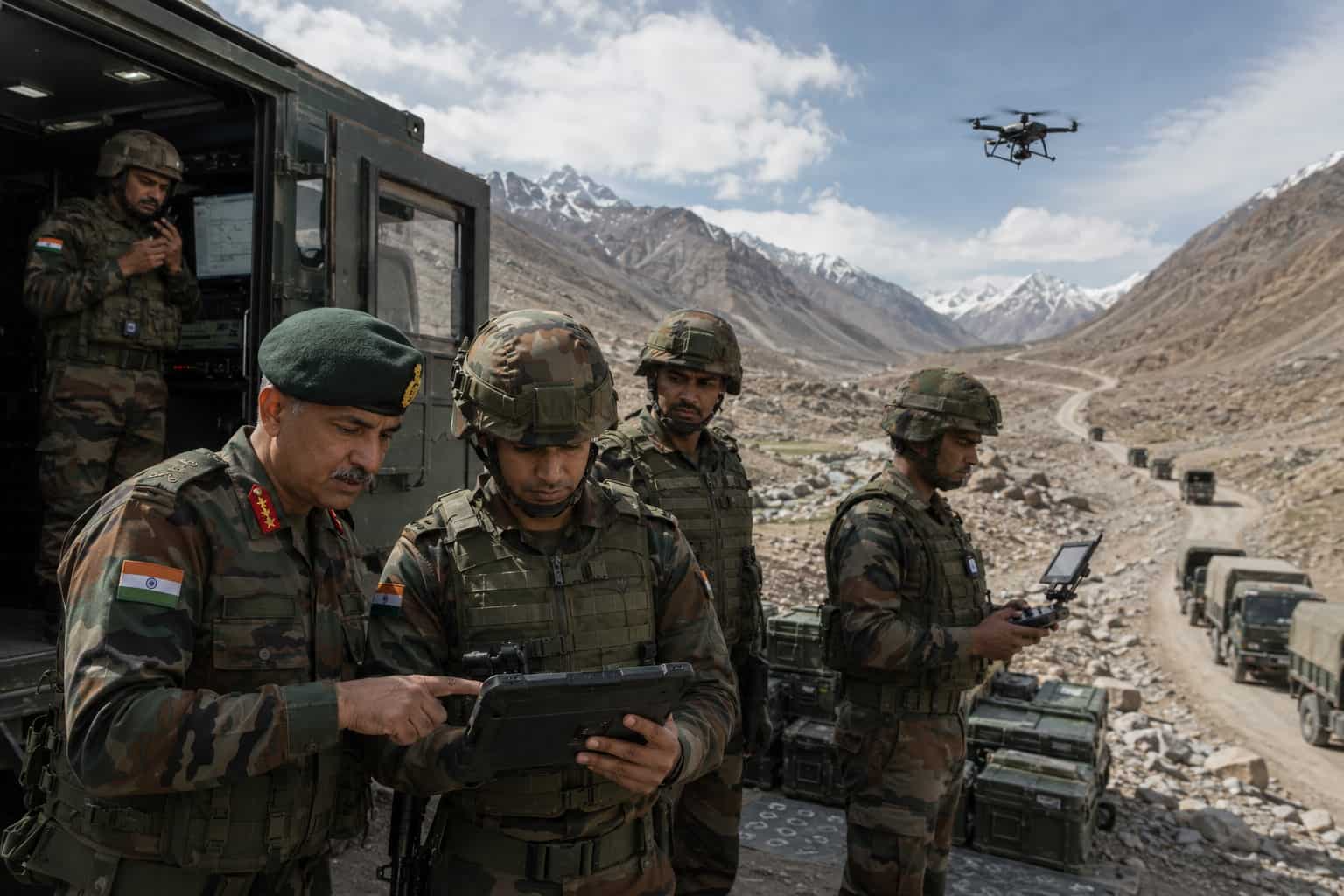
Modern warfare is no longer only about who has the bigger gun, the faster tank or the longer-range missile. Today, the side that receives information faster, understands it earlier and moves supplies on time can gain a serious advantage. For a soldier on the ground, this matters directly. A delayed supply column, unclear equipment status, slow data flow or scattered operational information can affect the tempo of an entire mission.
That is why the Indian Army’s reported launch of Kautilya and Q-FORCE is an important development.

According to media reports and Indian Army public information posts, the Army has introduced these two digital platforms to strengthen real-time decision support, logistics management and battlefield readiness. Times of India reported that Kautilya and Q-FORCE were launched on 25 May 2026 as part of the Army’s larger move towards AI-enabled and data-driven systems.
This should not be understood as machines replacing commanders. The real story is different. These platforms appear to be designed to help commanders, staff officers and units use information better. In simple words, the Army is trying to make data more useful, logistics more visible and decision-making faster.
Why this matters for a soldier in the field?
A soldier does not fight with courage alone. Courage is essential, but behind every soldier stands an entire system: ammunition, fuel, ration, medical support, transport, vehicle repair, communication, maps, equipment status and timely orders.
If this system is slow, the soldier feels the impact first.
Imagine a unit deployed in high-altitude terrain. Weather changes quickly. Roads may be limited. Supplies have to move through difficult routes. Equipment needs maintenance. Commanders need updated information. In such conditions, even a small delay in logistics can create pressure on the men at the front.
This is where digital systems can make a difference. If information from units, stores, transport networks and support elements is captured properly and visible in time, planning becomes better. The Army can move from waiting for updates to working with real-time or near-real-time information.
What Kautilya appears to do?
Kautilya is being described as an AI-enabled platform connected with structured data generation, analytics and decision support. Official Indian Army social-media posts describe Kautilya as an application that uses AI-enabled dashboards and NLP-powered interfaces to improve analytics, real-time decision-making and administrative efficiency.
In simple language, Kautilya may help convert scattered information into organised data that can be searched, understood and used by commanders and staff.
This is important because military information often comes from many sources: unit reports, equipment status, manpower details, operational inputs, logistics updates, terrain reports and administrative data. If all of this remains in separate files or disconnected systems, it takes time to form a clear picture.
Kautilya’s value appears to be in helping the Army build a more structured information environment. That means better visibility, faster analysis and improved situational awareness.
Why structured data matters in the Army?
For civilians, data may mean spreadsheets and reports. For the Army, data can mean operational readiness.
How many vehicles are serviceable? Which stores are available? What equipment is due for repair? Which unit needs urgent replenishment? What is the status of manpower? Which formation needs support first? Where is the bottleneck?
These questions are not theoretical. They affect real military functioning.
When data is structured, commanders can see patterns. When data is delayed, decisions slow down. When data is incomplete, planning becomes risky. AI-enabled dashboards can help by bringing important information into one view and allowing faster interpretation.
This does not remove human judgement. It supports it.
What Q-FORCE appears to do?
Q-FORCE is focused more on logistics and sustainment. News On AIR reported that the Indian Army launched Q-FORCE as an integrated application for logistics and sustainment management. The report says the application is meant to improve supply chain and transport management by integrating multiple logistics and inventory platforms.
Indian Army public information posts also describe Q-FORCE as an integrated application designed to streamline logistics and sustainment management.
For soldiers, this is extremely important. Logistics may not look glamorous, but it decides how long a unit can operate, how quickly it can move and how efficiently it can remain combat-ready.
In war and field conditions, logistics is not a back-office issue. It is battlefield strength.
Why logistics is the silent backbone of operations?
Every soldier understands one truth: a mission can suffer if supplies do not arrive on time.
Ration, ammunition, fuel, batteries, spares, winter clothing, medical stores, communication equipment and vehicle support are not optional. They are essential.
In desert areas, water and mobility become critical. In mountains, weather and road access become major challenges. In counter-insurgency areas, quick sustainment and coordination are important. In high-altitude locations, even routine movement requires planning.
Q-FORCE appears to target this exact challenge: making logistics more organised, integrated and responsive across varied terrain. If supply chain, inventory and transport information can be seen and managed better, the system supporting soldiers becomes stronger.

Why AI matters, but only as a support system?
AI should not be misunderstood. It is not a magic button. It cannot replace a commander’s experience, a junior leader’s judgement or a soldier’s courage. But it can help organise information faster.
In modern warfare, too much information can become a problem if it is not filtered and understood. Drone feeds, surveillance inputs, movement updates, logistics reports and operational signals can overwhelm decision-makers. AI-enabled systems can help sort, classify and present data in a useful way.
The right use of AI is not to let machines take command. The right use is to help commanders see clearly, decide faster and avoid being slowed down by fragmented information.
That is why Kautilya and Q-FORCE should be seen as support tools, not as replacements for military leadership.
Why this is important for Indian Army terrain?
The Indian Army operates in some of the most difficult conditions in the world. From icy heights to deserts, dense forests, riverine areas, plains and counter-insurgency zones, the Army’s terrain challenges are extremely diverse.
A logistics model that works in one region may not work in another. A supply delay in plains may be manageable, but the same delay in high-altitude terrain can become serious. A vehicle breakdown in a remote area may affect a patrol, a post or a convoy.
This is why data-driven logistics and decision support can help. If a formation can track requirements better, predict bottlenecks faster and coordinate support more efficiently, the soldier at the end of the chain benefits.
How this can change military administration?
Not every improvement is visible on the battlefield. Some of the biggest changes happen in administration.
A well-designed digital system can reduce duplication, speed up reporting, improve accountability and help senior leaders identify gaps. It can also reduce dependence on slow manual processes.
For a soldier, this may eventually mean quicker processing, better tracking of requirements and fewer delays in support systems. For officers and staff, it may mean better planning tools and clearer dashboards. For commanders, it may mean a sharper picture of readiness.
The real value will depend on implementation. A platform is useful only when it is adopted properly, updated regularly and connected with ground realities.
What should be watched next?
There are still important questions.
How widely will these platforms be rolled out? Which formations will use them first? How will data security be ensured? How will soldiers and staff be trained? Will these systems work smoothly in low-connectivity and field environments? How will they integrate with existing Army platforms?
These questions matter because military digitalisation is not only about launching an app. It is about building trust in the system.
If the data is accurate, the system is secure and users are trained well, such platforms can become powerful tools. If data entry is weak or systems are not updated, the impact may remain limited.
Why soldiers should care?
Some soldiers may think AI is only for headquarters or technical staff. But that is not correct. Any improvement in logistics, reporting, equipment tracking and decision support can affect the man in the field.
If a unit’s requirement is visible faster, support may move faster. If inventory status is clearer, planning improves. If commanders receive better information, operational decisions can become sharper.
The soldier may not see the dashboard, but he may feel the effect in the form of better support, timely movement and improved readiness.
The bigger message
Kautilya and Q-FORCE show that the Indian Army is preparing for a future where soldiers, commanders and digital systems will have to work together. Technology alone cannot win wars. But technology that supports trained soldiers can improve speed, clarity and coordination.
The Army’s strength will always come from its people. But in future warfare, the soldier will need smart systems behind him. Better data can support better decisions. Better logistics can support better endurance. Better integration can support better operations.
That is the real meaning of this AI push.
Conclusion
The reported launch of Kautilya and Q-FORCE is a strong sign of the Indian Army’s movement towards AI-enabled military modernisation. Kautilya appears focused on structured data, analytics and decision support, while Q-FORCE is linked to logistics, inventory, transport and sustainment management.
For soldiers, the value is practical. The future battlefield will demand fast information, reliable support and better coordination. These platforms may help the Army move in that direction.
The important point is simple: AI will not replace the soldier. It will support the soldier. It will not replace command. It will strengthen command.
For Sainik Welfare News readers, this is why the story matters. The Indian Army is not only modernising weapons. It is also modernising the systems that help soldiers fight, move, sustain and win.



Leave a Reply