

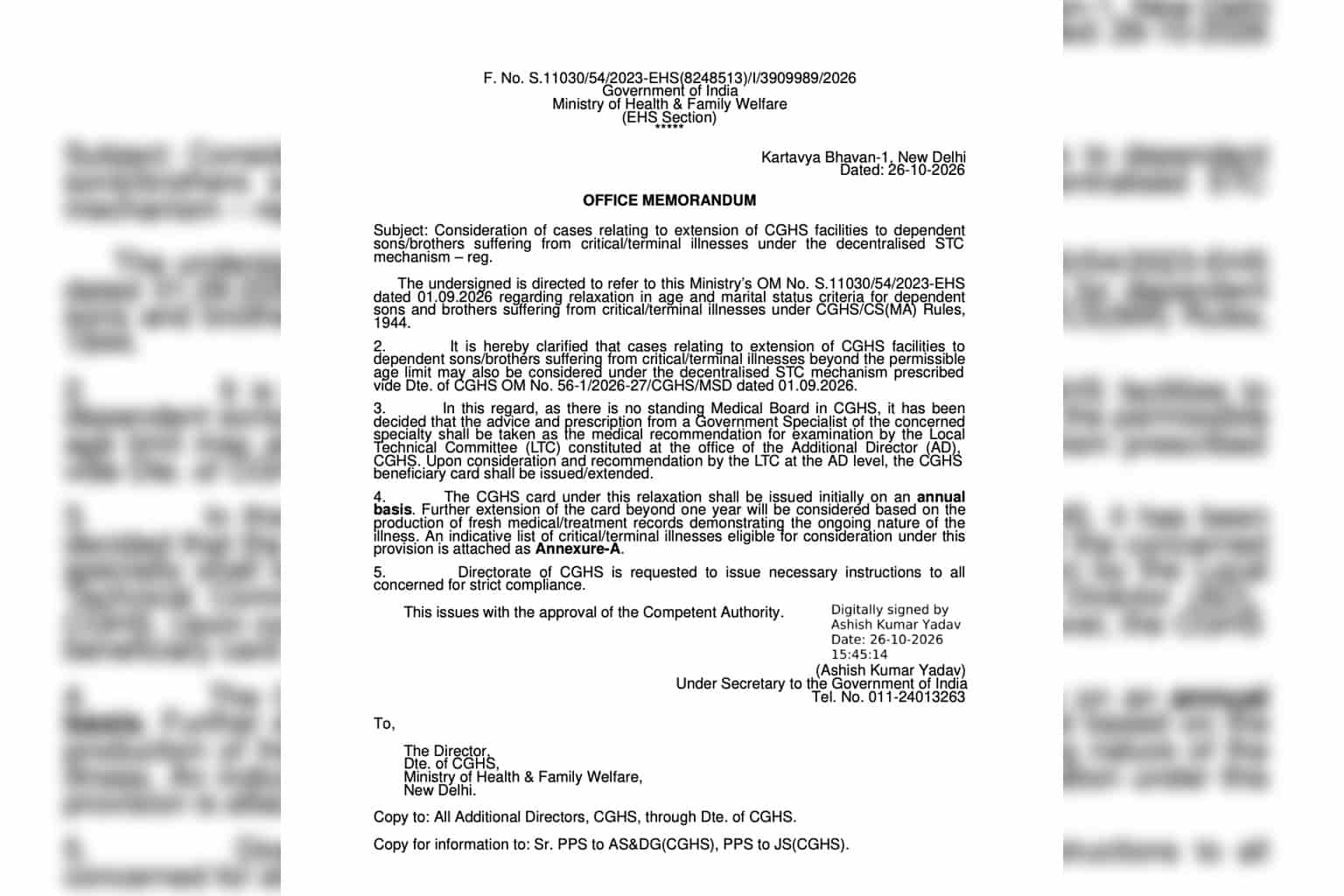
Download the official document
The Ministry of Health and Family Welfare has issued a new clarification allowing certain seriously ill dependent sons and brothers of Central Government Health Scheme (CGHS) beneficiaries to be considered for continued medical facilities beyond the normal age limit.
The Office Memorandum, dated 26 October 2026, explains how eligible cases will be examined, what medical recommendation is required and how CGHS cards will be extended.
The Government has also attached a list of 42 critical and terminal medical conditions that can be considered under this relaxation.
The clarification builds on the earlier Government instructions issued on 1 September 2026.

Can a dependent son receive CGHS benefits after crossing the age limit?
Yes. The Government has clarified that dependent sons and brothers suffering from critical or terminal illnesses may be considered for continued CGHS facilities even after crossing the prescribed age limit.
This relaxation is intended for eligible dependents who require ongoing medical treatment because of serious health conditions.
However, CGHS coverage will not continue automatically. Each case must undergo medical examination and approval through the prescribed process.
The 26 October order also refers to the earlier relaxation concerning age and marital status. Detailed marital-status eligibility must be read alongside the separate 1 September 2026 memorandum.
Is a Medical Board Certificate Required?
The Government has clarified that CGHS does not have a standing Medical Board.
Therefore, the advice or prescription of a Government Specialist from the relevant medical specialty will be accepted as the medical recommendation for examining these cases.
The Local Technical Committee (LTC), constituted at the office of the concerned CGHS Additional Director, will review the recommendation.
Once the committee recommends the case and the required approval is completed, the CGHS beneficiary card can be issued or extended.
This provides a defined local approval mechanism for eligible families.
How long will the CGHS card remain valid?
Under the new clarification, the CGHS card issued through this relaxation will initially remain valid for one year.
Further extension may be considered when the beneficiary provides fresh medical or treatment records showing that the illness continues.

Families should retain updated medical reports, specialist prescriptions and treatment records for future consideration.
Which 42 diseases are listed for CGHS age relaxation?
Annexure A of the Government order identifies 42 critical and terminal medical conditions for consideration.
The list includes serious diseases affecting the heart, kidneys, lungs, nervous system, immune system and other organs.
Some important examples are:

The complete annexure also includes conditions such as obstructive sleep apnea requiring CPAP treatment, chronic liver disease, chronic pancreatitis and specified bladder disorders.
The list is indicative. A diagnosis alone does not guarantee approval. The beneficiary must satisfy the applicable eligibility and medical-review requirements.
How will the CGHS approval process work?
The 26 October clarification brings these cases under the decentralised technical approval mechanism introduced on 1 September 2026.

The attached general STC instructions state that deficiencies in documents should ordinarily be communicated within three working days, while complete cases should ordinarily be decided within 15 working days.
These timelines belong to the general decentralised approval framework and should not be interpreted as guaranteed CGHS card-issuance deadlines for every application.
Does This Order Apply to ECHS Beneficiaries?
This Office Memorandum concerns CGHS and the related CGHS/CS(MA) framework, not the Ex-Servicemen Contributory Health Scheme (ECHS).
Therefore, defence veterans and their dependents covered exclusively under ECHS should not assume that this order automatically changes ECHS age limits or dependent eligibility.
CGHS beneficiaries should follow the relevant CGHS instructions, while ECHS beneficiaries must follow the rules applicable to their own scheme.
What Should Eligible Families Do?
Families with a dependent son or brother suffering from a serious ongoing illness should review the medical conditions listed in the Government’s annexure.
They should also keep the following records available:
- Current Government Specialist’s medical advice or prescription.
- Relevant diagnosis and treatment records.
- Existing CGHS beneficiary details, where applicable.
- Documents supporting dependency and eligibility.
- Fresh treatment records for any subsequent card extension.
The order does not prescribe a separate public application form or a universal document checklist for every case. Applicants should confirm the required procedure with their concerned CGHS office.
Conclusion
The Government’s 26 October 2026 CGHS clarification provides an important route for seriously ill dependent sons and brothers to seek continued medical coverage beyond the normal age limit.
Eligible cases can now be examined through the Local Technical Committee at the Additional Director level, using a Government Specialist’s recommendation.
With 42 medical conditions identified for consideration and an initial one-year card-validity provision, the order offers families a clearer process for requesting continued medical facilities.
However, eligibility remains subject to the applicable rules, supporting medical evidence and approval.
Sources
1. Ministry of Health and Family Welfare — Office Memorandum dated 26 October 2026
Subject: Consideration of cases relating to extension of CGHS facilities to dependent sons/brothers suffering from critical/terminal illnesses under the decentralised STC mechanism.
File reference: S.11030/54/2023-EHS(8248513)
2. Ministry of Health and Family Welfare — Office Memorandum dated 1 September 2026
Subject: Decentralisation of approval procedure for selected STC-related cases under CGHS.
File reference: 56-1/2026-27/CGHS/MSD
3. Annexure A — List of 42 Critical and Terminal Diseases
Attached to the 26 October 2026 clarification for consideration of dependent sons and brothers under the CGHS/CS(MA) framework.
Official Ministry of Health and Family Welfare Website
Source note: This article is based on the 26 October 2026 Office Memorandum and its attached annexures. The order clarifies the approval process; it does not grant automatic CGHS coverage to every dependent or introduce a new cash benefit.



Leave a Reply