

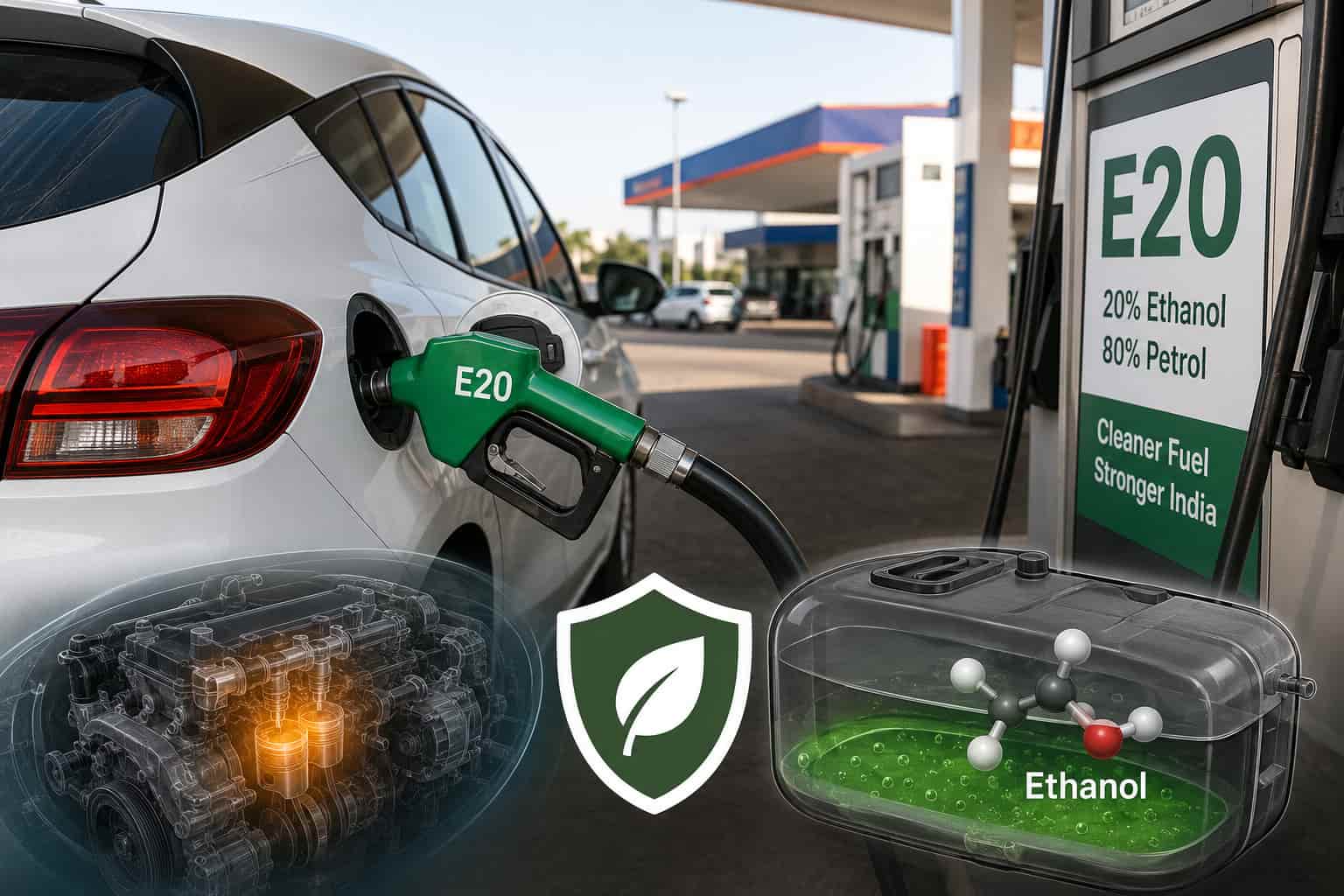
E20 petrol has become one of India’s most discussed automobile issues. Vehicle owners want to know whether ethanol-blended petrol reduces mileage, damages older engines or increases the risk of water contamination.
A detailed discussion with a retired Indian Air Force officer examined ethanol blending, engine technology, flex-fuel vehicles and viral social-media claims. The conversation supported ethanol as an energy-security measure while also recognising legitimate concerns about mileage, moisture and vehicle compatibility.
The reality is more balanced than most viral claims suggest. E20 is neither guaranteed to destroy every old engine nor completely free from practical limitations. Its impact depends on the vehicle’s design, age, materials, calibration and maintenance.
What is E20 petrol?
E20 is petrol blended with approximately:
- 20% ethanol
- 80% conventional petrol
Ethanol is an alcohol-based renewable fuel that can be produced using sugarcane, maize, damaged foodgrains and agricultural residue.
The letter E represents ethanol, while the number shows its approximate percentage in the fuel.
| Fuel type | Approximate ethanol content | Petrol content |
|---|---|---|
| E10 | 10% | 90% |
| E20 | 20% | 80% |
| E85 | Up to 85% | Remaining portion petrol |
E10 and E20 are conventional blended petrol grades. E85 contains a much higher proportion of ethanol and should only be used in a vehicle specifically certified as a flex-fuel vehicle.

Why is India promoting ethanol-blended petrol?
India depends heavily on imported crude oil. International conflicts, shipping disruptions and sudden increases in global oil prices can therefore affect domestic fuel costs and supplies.
Ethanol blending is intended to reduce this vulnerability.
The broader policy chain works like this:
Agricultural feedstock
→ Ethanol production
→ Blending with petrol
→ Lower crude-oil consumption
→ Foreign-exchange savings
→ Additional demand for farm produce
Ethanol can also create a market for sugarcane, maize, damaged grains and agricultural biomass that might otherwise have limited economic value.
For this reason, E20 is not merely an automobile-fuel programme. It is also linked to:
- national energy security;
- lower dependence on imported petroleum;
- support for domestic distilleries;
- additional income opportunities for farmers;
- diversification of India’s fuel supply.
The benefits, however, depend on responsible production. Water use, crop selection, land requirements and distillery efficiency must also be considered while measuring ethanol’s overall environmental impact.

Does E20 petrol reduce mileage?
A reduction in fuel efficiency is technically possible because ethanol contains less energy per litre than conventional petrol.
However, the effect is not identical in every vehicle.
Indicative estimates discussed in the NITI Aayog ethanol roadmap include:
- Older E0 or E10-calibrated four-wheelers: around 6–7% reduction;
- Older two-wheelers: around 3–4% reduction;
- E20-calibrated four-wheelers: around 1–2% reduction.
These are indicative ranges, not guaranteed results for every owner.
Actual mileage depends on:
- engine design;
- model year;
- E20 calibration;
- tyre pressure;
- traffic conditions;
- air-conditioner usage;
- driving style;
- fuel-system condition;
- servicing and maintenance.
A petrol blend containing 20% ethanol does not automatically result in a 20% mileage reduction.
Owners should also avoid judging mileage from one short journey. A more reliable comparison requires several full-tank cycles under similar driving conditions.

Does ethanol’s higher octane number mean more energy?
No.
This is one of the most common technical misunderstandings.
Octane rating measures a fuel’s resistance to engine knocking. It does not directly measure the total energy contained in one litre of fuel.
Ethanol has a relatively high octane rating. This can support higher compression ratios and improved combustion in an engine designed and calibrated for ethanol.
At the same time, ethanol contains less energy per litre than petrol.
Therefore, both statements can be true:
- ethanol has strong anti-knock properties;
- a vehicle may travel fewer kilometres per litre when the ethanol percentage increases.
Higher octane should not be described as proof that ethanol provides more energy than petrol.
Can E20 damage an old vehicle?
There is no universal answer covering every old car and motorcycle.
Compatibility depends on the materials and technology used in the vehicle, including:
- fuel hoses and pipes;
- rubber seals and O-rings;
- fuel-pump components;
- injector materials;
- metal parts exposed to fuel;
- engine-control software;
- manufacturer-approved ethanol limit.
A relatively new vehicle designed for E20 may handle the blend without difficulty. An older vehicle designed for lower ethanol percentages may not be equally optimised.
This does not mean that every older vehicle will immediately suffer engine failure. It means owners should check the approved fuel specification for their exact model and manufacturing year.
How can owners check E20 compatibility?
Use the following sequence:
- Read the vehicle owner’s manual.
- Check the label near or inside the fuel-filler cap.
- Visit the manufacturer’s official website.
- Ask an authorised service centre.
- Confirm the vehicle’s model year.
- Obtain the approved ethanol limit for that specific model.
A mechanic’s general opinion or a social-media post cannot replace manufacturer guidance.
Will cleaning the fuel tank make an old vehicle E20-compatible?
No.
Cleaning an old fuel tank and replacing a clogged fuel filter may be useful maintenance, particularly where rust, dirt or deposits are present.
Ethanol can loosen some deposits already accumulated in an old fuel system. A clean tank and filter may therefore reduce contamination-related problems.
However:
Cleaning the tank does not change the vehicle’s fuel-system materials, ECU calibration or manufacturer certification.
An incompatible vehicle does not become officially E20-approved simply because its tank has been cleaned.

Does ethanol absorb water?
Ethanol has a greater affinity for water than conventional petrol.
Small quantities of water may remain dissolved in an ethanol-petrol mixture. But when the amount of water exceeds the blend’s tolerance, the mixture can separate into different layers.
This process is known as phase separation.
In a simplified demonstration:
- the petrol-rich portion may remain in the upper layer;
- the water-and-ethanol-rich portion may settle below.
Temperature, ethanol concentration, storage conditions and the quantity of water all affect this process.
Does a viral bottle test prove that a petrol pump mixed water?
Not by itself.
A bottle showing two separate liquid layers may indicate water contamination or phase separation. But the clip alone does not establish:
- where the fuel was collected;
- whether the bottle was clean;
- whether water was added during filming;
- how long the sample was stored;
- whether the container was sealed;
- whether the sample actually came from the stated petrol pump.
A reliable complaint requires stronger evidence, such as:
- fuel-purchase receipt;
- pump and nozzle identification;
- sealed sample;
- authorised workshop report;
- documented vehicle symptoms;
- laboratory testing where required.
A social-media demonstration may raise a valid question, but it is not conclusive proof against a fuel station.
What should owners do after suspected contaminated refuelling?
Where a vehicle begins stalling, misfiring or refusing to start immediately after refuelling:
- Stop driving when it is safe.
- Preserve the fuel receipt.
- Record the petrol-pump location and nozzle.
- Inform the fuel station and oil company.
- Arrange an authorised workshop inspection.
- Document the drained fuel before repairs.
- Retain a sealed sample through a proper process.
Water contamination and E20 compatibility are separate issues. Contaminated fuel does not automatically prove that ethanol itself damaged the engine.

What is the difference between an E20 vehicle and a flex-fuel vehicle?
An E20-compatible vehicle is designed to operate on petrol containing up to approximately 20% ethanol.
A flex-fuel vehicle is engineered to use a wider range of ethanol-petrol blends, potentially including E85 where the manufacturer permits it.
E20-compatible vehicle
- Designed for fuel containing up to 20% ethanol;
- uses petrol-engine calibration suitable for E20;
- has materials compatible with the approved blend;
- cannot automatically be assumed safe for E85.
Flex-fuel vehicle
- Can operate on variable ethanol blends;
- uses ethanol-compatible pipes, seals and fuel-system parts;
- includes sensors or software to identify the blend;
- adjusts injection and ignition through the ECU;
- can use E85 only where manufacturer-approved.
Flex-fuel vehicles usually adjust automatically according to the fuel mixture. They should not necessarily be compared with CNG-petrol vehicles that require a manual fuel-selection switch.
Can a normal E20 vehicle use E85?
No, unless the vehicle manufacturer specifically certifies it as a flex-fuel model.
Using E85 in a normal petrol or E20-only vehicle may lead to:
- difficult starting;
- incorrect air-fuel mixture;
- warning lights;
- loss of performance;
- fuel-system deterioration;
- possible engine malfunction.
The term flex fuel should only be used for officially approved vehicles.

Common E20 myths and facts
Myth: E20 will reduce mileage by exactly 20%
Fact: Mileage impact varies according to engine design and calibration. The indicative reduction is generally much lower than 20%.
Myth: Every old car will immediately suffer engine damage
Fact: Compatibility varies by model, year, materials and manufacturer specification.
Myth: E20 and E85 are nearly the same fuel
Fact: E85 contains far more ethanol and requires a certified flex-fuel vehicle.
Myth: Higher octane means higher energy per litre
Fact: Octane measures knocking resistance, not total energy content.
Myth: Any separated bottle sample proves petrol-pump fraud
Fact: Controlled sampling and testing are required before reaching that conclusion.
Myth: Tank cleaning converts an old vehicle into an E20-compatible model
Fact: Cleaning may improve maintenance but does not change the manufacturer’s approved specification.
Practical advice for vehicle owners
Vehicle owners should take a cautious but evidence-based approach:
- check the owner’s manual and fuel-cap label;
- confirm compatibility for the exact model year;
- follow the manufacturer’s service schedule;
- replace fuel filters when required;
- use established fuel stations;
- preserve refuelling receipts;
- investigate sudden warning lights or mileage changes properly;
- compare mileage across several full tanks;
- never use E85 unless the vehicle is officially flex-fuel compatible.
A sudden mileage decline may also be caused by low tyre pressure, injector problems, clogged filters, traffic, air-conditioner use or aggressive driving.
Fuel should not be blamed without proper diagnosis.
Conclusion
E20 petrol is an important part of India’s strategy to reduce crude-oil dependence, strengthen domestic fuel production and support agricultural feedstocks.
Consumers nevertheless have valid questions about mileage, older vehicles, fuel labelling and moisture contamination.
The accurate position lies between two extreme claims:
E20 does not automatically destroy every engine, but it may not affect every vehicle in exactly the same way.
Its real-world impact depends on vehicle age, fuel-system materials, manufacturer approval, engine calibration and maintenance.
Owners should rely on model-specific guidance and technical evidence—not fear, viral claims or blanket assurances—before reaching a conclusion.



Leave a Reply