

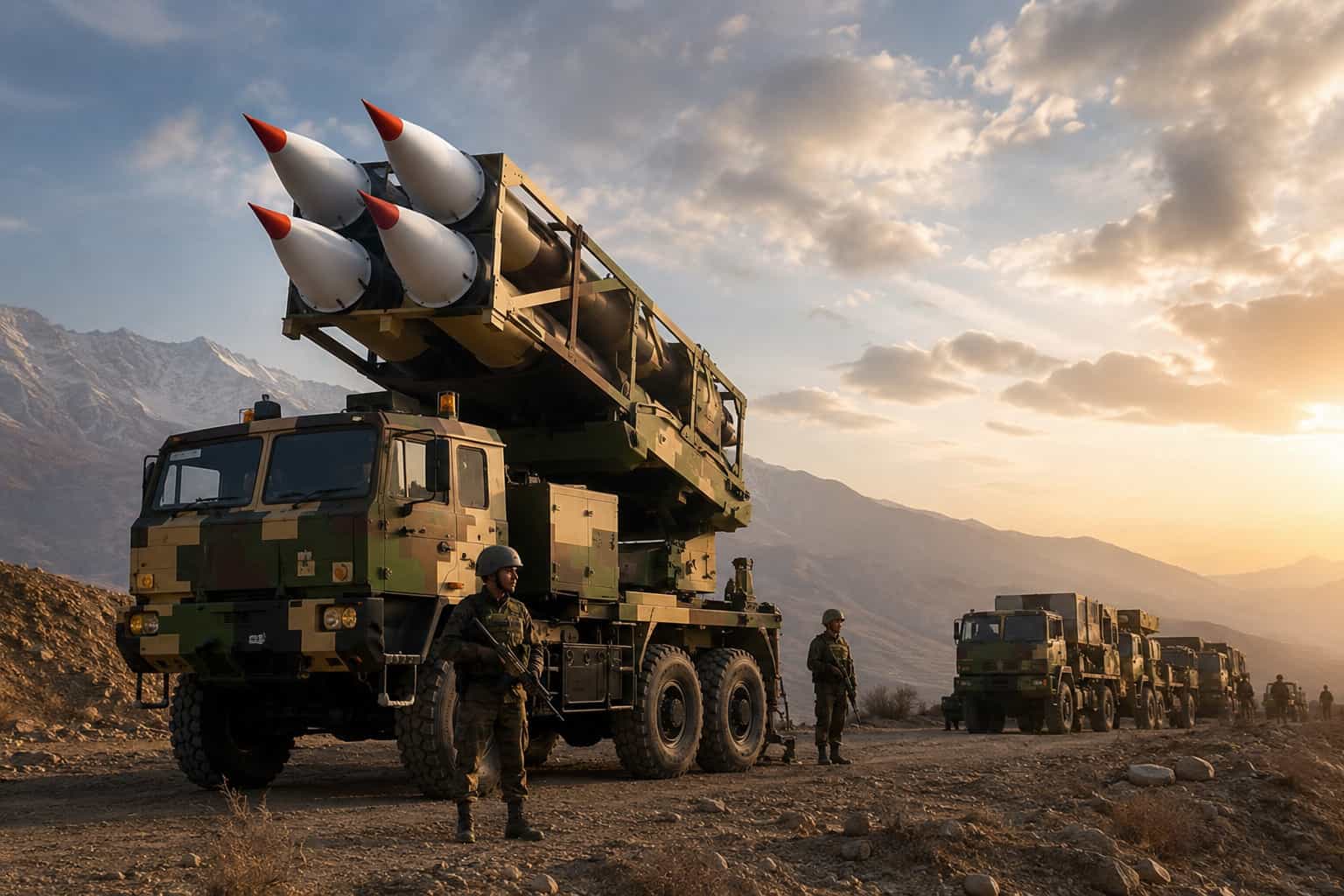
Modern wars are not decided only by the soldier standing at the frontline. They are also shaped by what happens far behind the enemy’s forward positions. Ammunition dumps, command centres, communication nodes, logistics convoys, air-defence points and staging areas often decide how long an enemy can fight. If these targets can be hit accurately from a long distance, the pressure on frontline troops can be reduced before the battle even reaches them.

That is why the reported test of the Suryastra rocket system is important for the Indian Army.
According to media reports and a company disclosure by NIBE Limited, the Pune-based defence firm successfully carried out firing demonstrations of Suryastra rockets at the Integrated Test Range, Chandipur, Odisha, on 18 and 19 May 2026. The system included rockets with reported strike ranges of 150 km and 300 km. Reports also say the demonstration is linked to an Indian Army procurement programme, making this more than a routine industry test. It becomes a story about Army modernisation, long-range precision firepower and India’s growing private defence manufacturing capability.
The most striking part of the report is the claimed accuracy. Economic Times reported that the Suryastra system is designed for long-range precision strikes and that the demonstration was connected to an Indian Army procurement order. Times of India also reported that NIBE Limited carried out firing demonstrations of the EXTRA and Predator Hawk rockets of 150 km and 300 km range respectively from ITR Chandipur.
For a normal reader, 300 km may sound like just a number. But in military terms, it is a major distance. A 300 km strike capability means a system can potentially engage targets deep inside hostile territory while remaining far from the immediate combat zone. This can give commanders more options during a conflict. Instead of waiting for enemy formations to come closer, long-range rockets can be used to disrupt the enemy’s ability to fight, move and resupply.
This is especially important in today’s battlefield environment. Drones, satellites, radars, electronic warfare and real-time surveillance have made movement more dangerous. Large troop concentrations, ammunition stocks and command posts can be identified and targeted faster than before. In such a battlefield, the Army needs weapons that are mobile, accurate and capable of firing from a safe distance.
That is where systems like Suryastra become relevant.
The report also highlights the growing role of the Indian private sector in defence. For many years, the public sector dominated India’s large defence manufacturing ecosystem. But the situation is changing. Private companies are now entering areas such as artillery systems, drones, armoured platforms, electronic warfare, missiles, vehicles and battlefield support systems. NIBE Limited describes itself as a defence manufacturing firm working on critical systems and components to support India’s self-reliance in defence production.
The Suryastra story also has an international technology background. In July 2025, Economic Times reported that NIBE Limited had signed a technology collaboration agreement with Israel’s Elbit Systems for manufacturing advanced universal rocket launchers. This background is important because modern rocket artillery is no longer only about firing a large number of rockets. It is about precision, range, flexibility, quick deployment and integration with battlefield targeting systems.
For the Indian Army, long-range rocket systems are part of a wider shift in firepower. Traditional artillery remains extremely important, but the modern battlefield demands more depth. Tube artillery can support troops at closer operational distances. Rocket artillery can cover larger areas and strike deeper targets. Precision rockets add another layer by allowing commanders to hit selected targets with less wastage and faster effect.

This is also why the Suryastra test should be seen in the context of Army modernisation. The Indian Army has been focusing on mobility, surveillance, drones, precision strike and rapid response. In mountain areas, deserts, plains and sensitive borders, a mobile long-range rocket system can help create deterrence. It tells the adversary that even rear areas are not fully safe if conflict escalates.
For soldiers, this matters directly. A soldier in a forward post depends on supply lines, artillery support, intelligence and operational planning. If long-range weapons can neutralise enemy launch sites, logistics dumps or command centres before they become a threat, the soldier at the front gains protection. In simple terms, precision firepower at 300 km can reduce pressure at 3 km.
Another important angle is “shoot-and-scoot” capability, which media reports associate with mobile launcher systems. In modern warfare, once a rocket or artillery system fires, the enemy may try to detect its location and respond with counter-fire. A mobile launcher that can fire and quickly move away improves survivability. This is important because the battlefield is now under constant watch from drones, sensors and radars.
However, this story must be reported carefully. As of now, I could not find a separate PIB or Ministry of Defence press release confirming the Suryastra test in the usual official government format. The strongest available confirmation is through NIBE Limited’s company disclosure and multiple media reports. Therefore, the responsible wording is: according to company disclosure and media reports, the system has been tested and linked to Indian Army procurement.
This distinction is important for public trust. Defence news often spreads quickly, especially when it involves rockets, missiles and Army procurement. But a responsible website should separate confirmed official information, company claims and media reporting. Until the Ministry of Defence or Indian Army releases its own statement, the procurement link should be written with careful language.
Even with that caution, the story remains significant. The Suryastra test points toward three major trends. First, the Indian Army is seeking deeper precision strike capability. Second, private Indian defence companies are becoming more active in serious weapon systems. Third, emergency procurement routes are being used to bring urgent battlefield capabilities faster than traditional procurement timelines.
The name “Suryastra” itself may attract attention, but the real story is not the name. The real story is the shift in battlefield thinking. India wants systems that can hit farther, move faster and operate with precision. This is exactly the kind of capability modern armies are now prioritising.
For Sainik Welfare News readers, the takeaway is simple. The reported Suryastra rocket test is not just about one company or one rocket. It is about the Indian Army’s need for long-range precision firepower in a battlefield where distance, speed and accuracy can decide outcomes. If such systems are successfully inducted and integrated, they can strengthen deterrence, support frontline troops and increase India’s ability to respond quickly to threats.
At the same time, readers should remember the caution: this is not yet backed by a separate PIB or MoD press release found in public search. The story should be presented as a company-disclosure and media-reported development linked to Indian Army procurement.
The best way to understand the Suryastra test is this: India is trying to build a battlefield where the soldier at the front is supported by weapons that can strike much deeper than the front. And in modern warfare, that depth can make all the difference.




Leave a Reply