

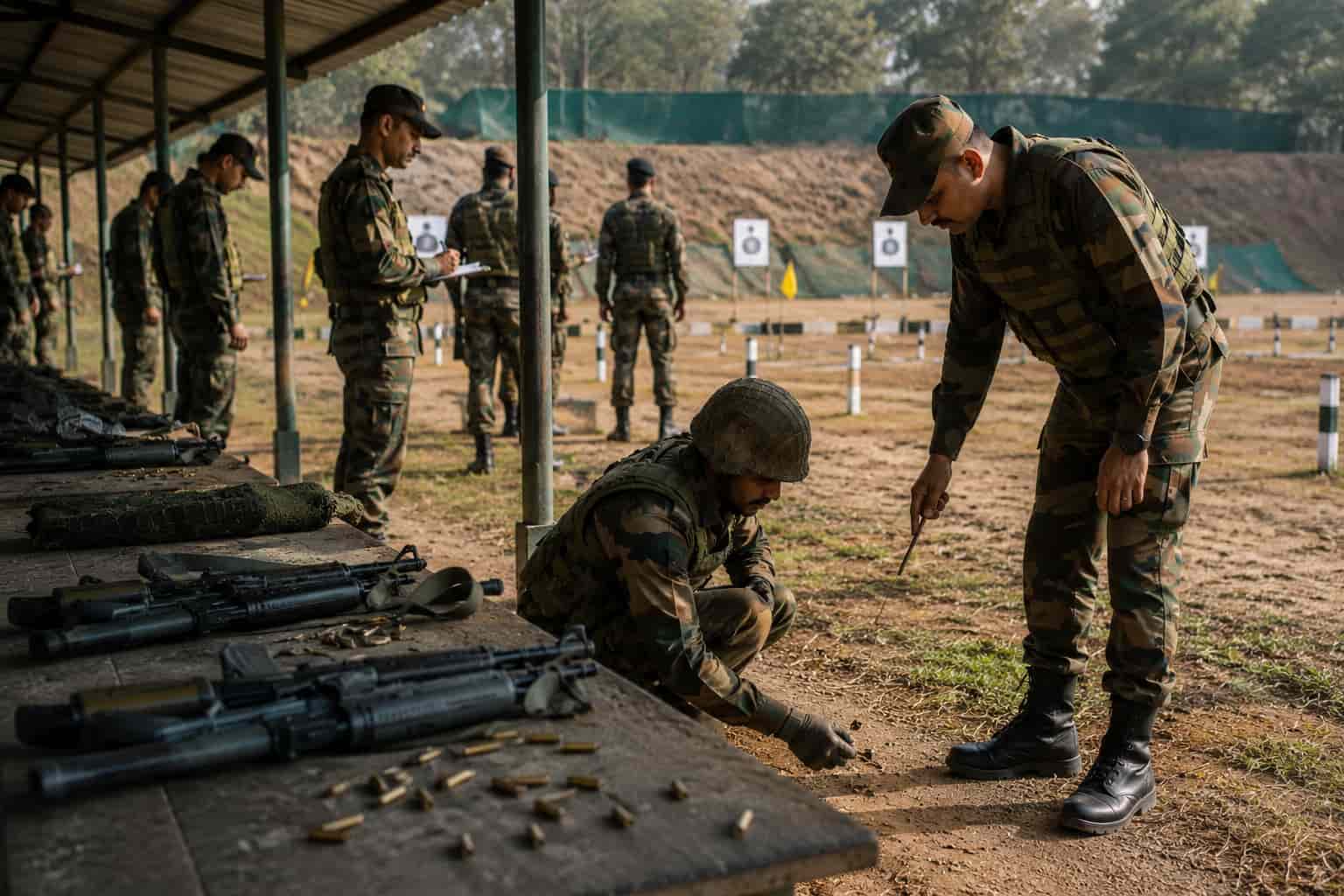
The Central Ammunition Depot, Pulgaon incident is a tragic and sensitive story. It involves the death of a Junior Commissioned Officer from the Defence Security Corps during a routine firing practice, serious allegations against an Army officer, and a police case that has now raised questions about firing range safety, jurisdiction and due process.
According to initial reports, Defence Security Corps Subedar Major Om Bahadur Khand died during firing practice at the Central Ammunition Depot, Pulgaon, in Maharashtra’s Wardha district on 15 May 2026. The Defence PRO statement described it as a firing accident during routine practice and said the matter was under investigation.
That first information was already serious because any death during a military firing practice demands a full safety and procedural inquiry. But the case became even more serious when later reports said Wardha police registered an FIR under Bharatiya Nyaya Sanhita Section 103(1), which deals with punishment for murder. Reports also said the accused officer was taken into custody and police sought formal custody for questioning.
At this stage, one thing must be clear. An FIR is not a final verdict. It is the beginning of a criminal investigation. The accused is not automatically guilty because an FIR has been registered. At the same time, a death at a firing range cannot be dismissed casually as only an accident without proper investigation. Both sides of this principle matter.
The name of the deceased, Subedar Major Om Bahadur Khand, must be remembered with dignity. A Subedar Major is a senior JCO rank and carries deep respect inside the military system. The Defence Security Corps also performs an important role in guarding sensitive defence establishments, often involving former soldiers who continue serving in a security role after their earlier service.
Pulgaon itself is not an ordinary location. CAD Pulgaon is a sensitive military installation connected with ammunition storage and defence security. That is why any incident inside such a location involves not only a crime scene inquiry, but also strict access control, operational confidentiality and military procedure.
This is where the legal complexity begins. Reports say the Army and police are both involved in the matter. The Army has its internal legal and disciplinary mechanisms, including inquiry and court-martial procedures where applicable. The police, on the other hand, investigate offences registered under criminal law. When a serving armed forces person is involved, the question of custody and trial route can become legally sensitive.
The Times of India reported that a custody question arose between Army authorities and Wardha police, with legal experts referring to BNSS provisions related to cases involving persons subject to Army law. For the public, the practical takeaway is simple: this case may move through both military and civil legal channels, but the final path will depend on law, evidence and competent authority decisions.
The most important investigative question is: what exactly happened at the firing range between the start of practice and the fatal shot? Investigators will likely examine witness statements, weapon handling records, range safety instructions, ammunition issue and return records, firing lane positions, distance, direction of fire, supervision, medical evidence and post-mortem findings.

Reports quoting the FIR say the incident took place during firing practice and that the JCO was allegedly shot with an INSAS 5.56 rifle. These details will have to be tested through forensic and ballistic examination. Weapon position, trajectory, number of rounds fired and range layout can help establish whether the firing was accidental, negligent, intentional or linked to some other factor.
This is why premature conclusions are dangerous. In sensitive defence cases, social media often jumps to one of two extremes. Some people immediately call it murder. Others immediately call it an accident. Both approaches are wrong before evidence is fully examined. A responsible public discussion must wait for the official investigation and inquiry findings.
At the same time, firing range safety must be taken seriously. Live firing is one of the most controlled activities in military training. Every firing practice normally works through range commands, safety supervision, weapon discipline, ammunition control and movement restrictions. If any safety chain fails, the result can be fatal.
A firing range incident raises several practical questions. Was the weapon pointed safely after firing? Were empty cartridge collection and movement being done according to procedure? Was the weapon cleared? Was the safety catch used? Were all personnel in authorised positions? Was the officer or soldier handling the rifle under stress, confusion or any medical issue? These questions are not meant to blame anyone immediately. They are meant to identify truth.
For families of soldiers and veterans, this case is painful because it involves a death inside a controlled military environment. A family sends a soldier to serve with faith in the system. When such an incident happens, the family deserves transparency, dignity, compensation as per rules, and a fair investigation.
For the Army, such a case is also deeply serious. Military discipline depends on trust. Soldiers must trust their officers. Officers must trust their men. Training areas must be safe. If any suspicion arises inside a firing range death, the institution must respond with fairness and transparency so that justice and discipline both remain strong.
For the police, the challenge is to investigate without sensationalism and without disturbing sensitive defence protocols unnecessarily. For the Army, the challenge is to cooperate with lawful investigation while also protecting operational security and military procedure. Both are possible if the process remains professional.
The public should also understand the difference between accountability and trial by media. Accountability means evidence-based inquiry, fair investigation and action if wrongdoing is proved. Trial by media means declaring guilt or innocence based on headlines, forwarded clips or incomplete reports. A disciplined society should demand accountability, not mob judgment.
This case also gives a wider lesson for all firing ranges, training centres and security establishments. Safety procedures should never become routine paperwork. They must be actively enforced every single time. Weapon handling discipline, range officer supervision, clear commands, post-firing checks and safe movement rules are not formalities. They save lives.
The CAD Pulgaon incident should therefore be followed carefully, but respectfully. The death of Subedar Major Om Bahadur Khand is a serious loss. The allegations against an Army officer are also serious. The FIR under BNS 103(1) makes the legal situation grave, but final conclusions must come only after investigation, evidence and due process.
For Sainik Welfare News readers, the key message is balanced and clear. Respect the deceased JCO. Avoid rumours. Do not sensationalise the Army. Do not dismiss the FIR. Let the Army inquiry and police investigation establish the facts.
In the end, justice in such a case has two responsibilities. First, the truth must come out. Second, the process must remain fair. Only then can the family get justice, the Army maintain discipline, and the public understand what really happened at CAD Pulgaon.



Leave a Reply