

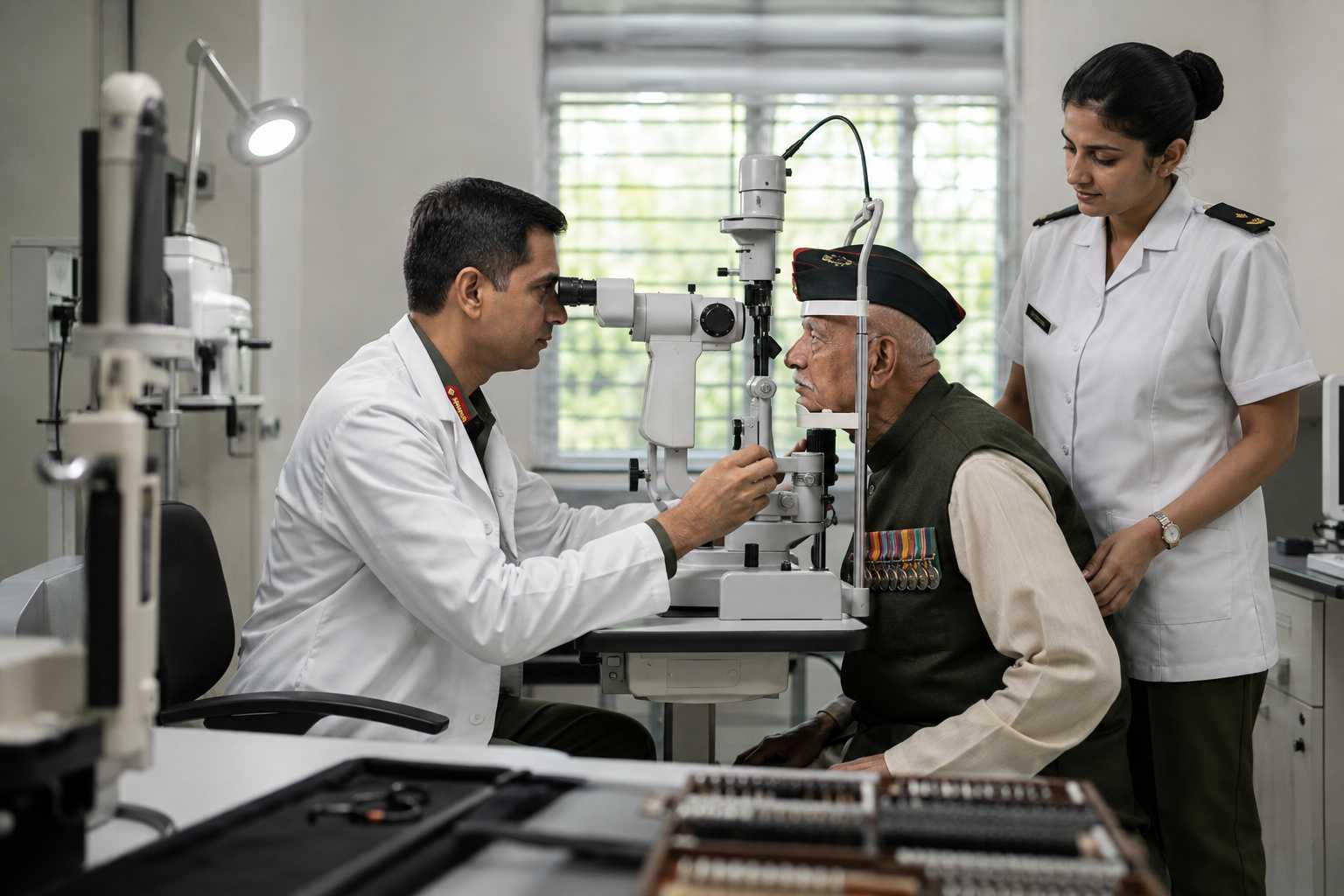
When people think of the Armed Forces, they often imagine soldiers on the border, aircraft in the sky, warships at sea and difficult operations in harsh terrain. But there is another side of the Armed Forces that deserves equal attention: military medicine. Behind every fighting force stands a medical system that protects soldiers, supports veterans, cares for families and often reaches civilians in remote areas where advanced healthcare is not easily available.

The AIOS–Armed Forces Ophthalmology Update 2026 in New Delhi is an important example of that wider service. This two-day conference was jointly organised by the Department of Ophthalmology, Army Hospital (Research & Referral), New Delhi, and the All-India Ophthalmological Society. The Ministry of Defence described it as a historic first for the Armed Forces Medical Services, bringing military ophthalmologists and civilian experts from India and abroad onto one academic platform.
This event matters because eye care is not a small issue in military life. A soldier’s vision is linked to field performance, weapon handling, night movement, driving, surveillance, map reading, aviation, naval duties and operational alertness. For veterans and elderly dependents, eye diseases such as cataract, glaucoma, diabetic retinopathy and retinal problems can seriously affect quality of life.
The conference was not only a formal medical gathering. It was designed as a knowledge-sharing platform for research, innovation and clinical excellence in ophthalmology. The event was expected to bring together nearly 200 ophthalmologists, more than 100 distinguished faculty members and leading experts from institutions such as AIIMS, PGI Chandigarh, LV Prasad Eye Institute, Sankara Nethralaya and Aravind Eye Care System.
For Sainik Welfare News readers, the bigger message is clear: military hospitals are not standing still. They are moving toward advanced equipment, research collaboration and modern treatment methods. This matters because the Armed Forces Medical Services have to serve a wide community that includes serving soldiers, veterans, Veer Naris, dependents and sometimes civilians in difficult regions.
Raksha Rajya Mantri Shri Sanjay Seth praised the role of doctors and healthcare professionals in nation building and humanitarian service. He also highlighted the service of Armed Forces medical teams in challenging geographies and complimented the recently inaugurated Advanced Centre of Ophthalmic and Visual Sciences at Army Hospital (Research & Referral), describing it as a world-class facility for military eye care and research.
This is where the story becomes more than a conference update. It connects directly with the Army’s medical outreach work in remote and border areas. In recent months, military ophthalmic teams have conducted advanced eye camps where large numbers of people were screened and treated. These efforts show how the Armed Forces medical system can combine discipline, technology and service to reach people who may otherwise struggle to access specialised care.
One major example was Op Drishti at Command Hospital, Northern Command, Udhampur, where more than 2,000 people were screened and over 400 surgeries were performed between 18 and 22 November 2025. The camp covered complex procedures for cataract, glaucoma and retinal ailments, and people came from far-flung areas of Jammu and Kashmir, including Udhampur, Doda, Rajouri, Poonch, Kishtwar and Ramban.

This kind of work has deep welfare value. For an elderly veteran living in a remote area, or a Veer Nari who cannot easily travel to a metro hospital, a military eye camp can restore more than eyesight. It can restore independence, confidence and dignity.
Another important example came from Gorakhpur in February 2026. A specialised ophthalmic team of Indian Army and Indian Air Force doctors performed over 100 surgeries on the first day of a Mega Advanced Surgical Eye Camp at 12 Air Force Hospital. The procedures included advanced cataract, minimally invasive glaucoma surgery and complex retinal procedures.
The Gorakhpur camp was led by Brigadier Dr Sanjay Kumar Mishra from Army Hospital (Research & Referral). The Ministry of Defence said world-class medical equipment was airlifted to the region through Indian Air Force aircraft, and more than 300 surgeries were scheduled during the camp period.
This is a powerful example of civil-military service. The military system has logistics, discipline and mobility. When that is combined with expert doctors and advanced equipment, high-quality treatment can reach areas where such care may otherwise be delayed or unavailable.
Eye care also matters because many diseases progress silently. Cataract can slowly reduce vision. Glaucoma can damage eyesight without early warning. Diabetic retinopathy can affect people with diabetes and may become serious if not detected in time. In soldiers, visual clarity is operationally important. In veterans, it is essential for daily life and independence.
The Armed Forces Medical Services have also moved toward technology-driven eye screening. In December 2025, AFMS, AIIMS and the Ministry of Health and Family Welfare launched India’s first AI-driven community screening programme for diabetic retinopathy. The platform, MadhuNetrAI, uses a web-based AI tool to screen, grade and triage retinal images captured through handheld fundus cameras.
This is important because early detection can prevent avoidable vision loss. The pilot phase was planned across seven locations, including Pune, Mumbai, Bengaluru, Dharamshala, Gaya, Jorhat and Kochi, covering metropolitan, rural, hilly, coastal and remote regions.
For the Armed Forces, such programmes can help serving personnel, families and veterans. For the country, they can become models for public health outreach. Military medicine has experience in working under pressure, reaching difficult locations and maintaining organised medical records. That makes it valuable for large-scale screening and treatment missions.
The AIOS–Armed Forces Ophthalmology Update 2026 also highlighted civil-military cooperation. International experts such as Prof Harminder Singh Dua from the University of Nottingham and Dr Colin Siang Hui Tan from Singapore participated in the event, bringing global expertise in corneal sciences, retinal imaging and AI-driven ophthalmic diagnostics.
This shows that military medicine is not isolated. It is engaging with national and international experts. That is good for young serving ophthalmologists, because they get exposure to advanced research and clinical practices. It is also good for patients, because better training and better research eventually lead to better care.
The presence of the Chief of Defence Staff, the three Service Chiefs and the Defence Secretary also gave the event a clear tri-service character. This matters because health challenges are common across the Army, Navy and Air Force. Whether a soldier is posted in high altitude, a sailor is at sea or an air warrior is in a technical environment, medical readiness remains essential.
For Sainik Welfare News, the most important takeaway is this: soldier welfare is not only pension, pay, canteen or ECHS cards. It is also the quality of medical care available to the soldier, veteran and family. Eye care is a vital part of that welfare.
The AIOS–Armed Forces Ophthalmology Update 2026 should therefore be seen as a meaningful step. It brings together military doctors, civilian experts, advanced technology, research and public service. It also reminds us that the Armed Forces serve the nation not only through combat readiness, but also through healing, outreach and human dignity.
In the end, military eye care is not just a hospital subject. It is a soldier welfare subject, a veteran dignity subject and a national service subject. When a military doctor restores someone’s vision in a remote area, the uniform is serving the nation in a different but equally powerful way.

Leave a Reply