

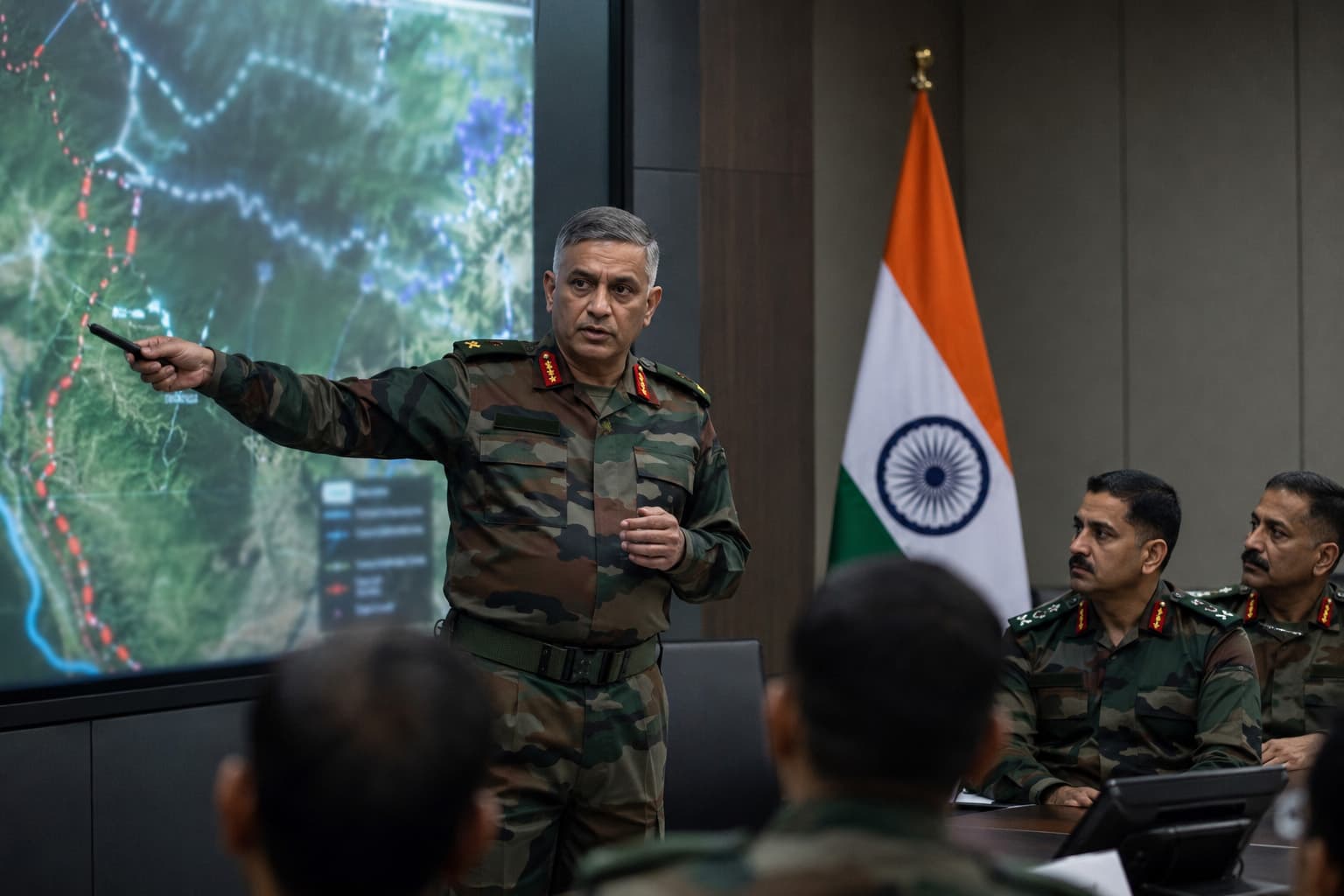
Indian Army Chief General Upendra Dwivedi has given one of the sharpest public messages to Pakistan after the first anniversary of Operation Sindoor. His words were direct, but the meaning behind them is even more important. India’s message appears clear: cross-border terrorism will not be treated as a routine security problem anymore.

According to reports, General Dwivedi was speaking at an interactive session at the Manekshaw Centre in New Delhi. When asked how the Indian Army would respond if the circumstances that led to Operation Sindoor were repeated, he said Pakistan must decide whether it wants to be part of “geography or history” if it continues to harbour terrorists and operate against India.
This statement should not be seen only as a headline. It reflects a larger shift in India’s security language. In earlier years, terror attacks were often followed by diplomatic statements, dossiers, warnings and international pressure. But after operations like Surgical Strikes, Balakot and Operation Sindoor, India’s posture has become more action-oriented.
Operation Sindoor remains important in this context. Reports describe it as India’s military response after the Pahalgam terror attack, and its anniversary has again brought attention to how India may respond to future terror-linked provocations.
For ordinary citizens, the key question is simple: what does this warning really mean?
It means India wants Pakistan to understand that terrorism cannot be used as a low-cost weapon while expecting normal relations on the other side. If terrorist infrastructure is allowed, protected or supported, India is signalling that the response may not remain limited to statements.
This is also a message of deterrence. Deterrence means making the other side think twice before taking an action. When the Army Chief says Pakistan must decide its future course, the purpose is not only to react to the past. It is to prevent the next provocation.
The timing also matters. The remarks came shortly after the first anniversary of Operation Sindoor, at a time when India and Pakistan are again being discussed in the context of terrorism, dialogue and regional stability. Reports also mention that Pakistan had recently expressed interest in dialogue, but India’s military message remains firm on terrorism.
This brings us to the most important point: dialogue and terrorism cannot run together comfortably. Any discussion between countries requires basic trust. If terror camps, infiltration networks or proxy groups remain active, trust collapses. India’s position has repeatedly been that terror and talks cannot move as normal parallel tracks.
For the Indian Army, such a statement also reflects operational preparedness. A military warning has meaning only when backed by capability, readiness and political will. The Indian Army, Air Force and Navy have increasingly shown that joint coordination matters in any future conflict scenario. Modern warfare is not fought by one service alone. It involves intelligence, surveillance, precision strike, air defence, cyber systems, drones, electronic warfare and ground readiness.

That is why Operation Sindoor is not only remembered as one operation. It is also remembered as a signal that India is willing to use calibrated force when national security is directly challenged.
However, this subject must be written carefully. A strong statement does not mean war is certain. It does not mean escalation is automatic. It means India wants to keep the cost of terrorism high for those who support or shelter it. The goal of deterrence is often to avoid war by making hostile action too costly.
For soldiers and veterans, this message carries emotional value as well. Every terror attack is not just a news event. It affects families, units, morale and national confidence. Soldiers on the front line pay the first price when the security environment becomes unstable. Therefore, a clear national response doctrine matters to them.
For citizens, the lesson is to understand national security beyond emotional shouting. A strong Army message should not become social media noise. It should be understood as part of India’s larger counter-terror strategy. The country needs military preparedness, diplomatic pressure, intelligence strength, border vigilance and public unity.
There is also an information war angle. After every major operation, both sides try to shape the narrative. Claims, counterclaims, edited clips, selective leaks and propaganda become part of the battle. In such situations, citizens should rely on verified updates from official sources and credible reporting rather than emotional forwards.
The Army Chief’s warning also shows that India wants to define the red line clearly. The red line is terrorism directed against India. If that line is crossed again, the response may not be predictable for the other side. Strategic ambiguity can itself become a tool of deterrence.
At the same time, India’s strength lies in responsible conduct. A professional military does not act out of anger. It acts through planning, intelligence, timing and national direction. That is why the Army Chief’s statement should be read as firm, not reckless. It is a warning rooted in security doctrine.
For Sainik Welfare News readers, the biggest takeaway is this: India’s response to terrorism has changed from passive patience to active deterrence. The message is that future provocations may invite consequences, and Pakistan cannot expect terrorism to remain a risk-free policy tool.
In the end, General Upendra Dwivedi’s warning is not just about Pakistan. It is about India’s changing national security mindset. The country is telling the world that terrorism will not be normalised, and those who enable it will be held responsible.
The real message is simple: peace is possible only when terror is stopped. Dialogue can have meaning only when violence is not used as pressure. And if Pakistan continues to shelter anti-India terror networks, India’s military leadership is making it clear that the next response may be stronger, sharper and more difficult to ignore.



Leave a Reply