

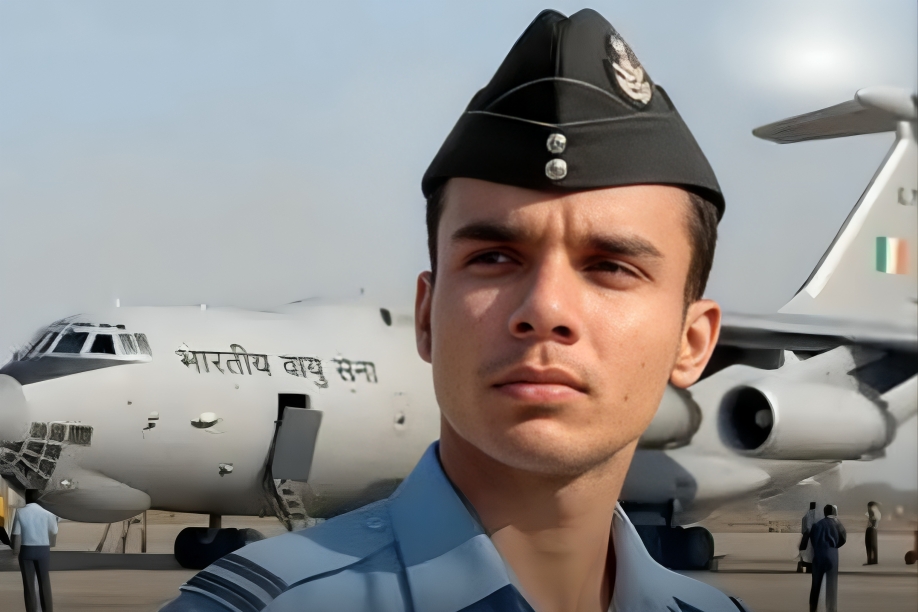
A family in Rajasthan’s Jhunjhunu district was waiting for its young son to return home for his birthday. Instead, his village received him wrapped in the national flag.
Agniveervayu Aryan Jhajharia, a 22-year-old Indian Air Force airman from Peepal Ka Bas village in the Mandawa area of Jhunjhunu, reportedly died following a drowning incident while posted at an Air Force establishment in Chennai.
Aryan was expected to turn 23 on 14 July 2026. However, only days before that date, his mortal remains reached his native village, where thousands of people joined his final journey and an Indian Air Force contingent paid military honours.
The tragedy has left behind not only a grieving family but also an important responsibility for the media and public: to remember the young airman with dignity while separating verified information from claims that have not yet received official confirmation.
Who was Agniveervayu Aryan Jhajharia?
Aryan Jhajharia belonged to Peepal Ka Bas village in Jhunjhunu, a Rajasthan district widely associated with military service.
Published reports describe Aryan as a disciplined and hardworking young man who wanted to serve in the Armed Forces. After completing his school education, he reportedly prepared for defence recruitment and was selected for the Indian Air Force under the Agnipath scheme.
Aryan was unmarried and had recently visited his village before returning to his posting. Amar Ujala reported that he had come home on leave approximately two months before his death.
Navbharat Times reported that Aryan was the only son of his parents and had two sisters. His family was preparing for his 23rd birthday, which was due on 14 July 2026. He was also reportedly expected to return home on leave during the same period.
These details make the loss especially painful. Aryan’s military journey had only recently begun, and his family expected many more homecomings, birthdays and milestones ahead.
What happened to Aryan Jhajharia in Chennai?
According to media reports, Aryan died on 5 July 2026 after drowning while posted at an Air Force establishment in Chennai.
Amar Ujala reported that Aryan drowned while bathing during his posting at an Air Force station. Navbharat Times carried a more specific version, stating that he was in a swimming pool when the incident occurred.
However, an important caution is necessary.
At the time of publication, a detailed Indian Air Force statement publicly explaining the exact location, circumstances and sequence of the incident could not be located. Therefore, claims about how Aryan entered the water, whether he slipped, what safety arrangements were present or whether any negligence occurred should not be presented as established facts.
The responsible description is:
Media reports state that Agniveervayu Aryan Jhajharia died following a drowning incident while posted at an Air Force establishment in Chennai. The precise circumstances have not been detailed in a publicly available official statement.
This distinction matters because an accidental-death report should not become a vehicle for speculation before the competent authorities establish what happened.
Aryan was an Agniveervayu, not a commissioned Air Force officer
Several social-media posts have referred to Aryan as a 22-year-old “Air Force officer.” Although the description may be used informally, it is technically inaccurate.
Aryan served as an Agniveervayu, which places him among the Indian Air Force’s airmen enrolled under the Agnipath scheme. He was not a commissioned officer holding a rank such as Flying Officer, Flight Lieutenant or Squadron Leader.
The Ministry of Defence has described Agniveervayu personnel as young men and women inducted into the Indian Air Force under the Agnipath scheme and trained as air warriors according to service requirements.
The accurate terms for Aryan are:
- Agniveervayu Aryan Jhajharia
- Indian Air Force airman Aryan Jhajharia
- 22-year-old IAF Agniveervayu from Jhunjhunu
Correct terminology does not reduce the value of his service. Instead, it respects his actual position and prevents misinformation.

From birthday preparations to an irreversible loss
The most heartbreaking part of Aryan’s story is the timing.
According to Navbharat Times, Aryan was born on 14 July 2003 and was due to celebrate his 23rd birthday shortly after the incident. His family expected him to return home on leave, and preparations for his arrival had reportedly begun.
Instead of welcoming their son for a celebration, the family received his tricolour-wrapped mortal remains.
For a military family, every period of leave carries special meaning. It is the time when a son or daughter temporarily returns from a life governed by postings, duties, training and distance. In Aryan’s case, that anticipated reunion was replaced by a final farewell.
The emotional value of this story lies not in dramatic language but in the contrast between what the family expected and what eventually happened.
Jhunjhunu gathers for Aryan’s final journey
Aryan’s mortal remains reached Jhunjhunu on 8 July 2026.
Navbharat Times reported that the body arrived in Mandawa by road after being brought from Delhi. It was kept at Ambedkar Park so that local residents could pay their respects before the final procession moved toward Peepal Ka Bas.
Thousands of residents, local representatives, officials and members of the Armed Forces reportedly joined the farewell.
The presence of such a large crowd showed that Aryan’s death was not experienced as the loss of one household alone. The grief extended across his village and the surrounding region.
His final journey became a public expression of respect for a young man who had left home to serve in the Indian Air Force and returned for the last time beneath the national flag.
Indian Air Force pays military honours
Before Aryan’s cremation, an Indian Air Force contingent reportedly gave him a ceremonial final salute.
Navbharat Times reported that the national flag covering his mortal remains was handed to his father. The last rites were then performed in the presence of family members, villagers, military personnel, administrative officials and public representatives.
Military honours at a funeral are deeply symbolic.
The folded national flag handed to a family represents:
- the individual’s service;
- the country’s acknowledgement;
- the finality of the loss; and
- the responsibility of the nation to remember the person behind the uniform.
For Aryan’s family, however, no ceremony can replace the son and brother they lost at only 22.
What do we know, and what remains unconfirmed?
A high-value report must clearly distinguish between consistently reported information and details that still require official confirmation.
| Detail | Current status |
|---|---|
| Aryan belonged to Peepal Ka Bas, Jhunjhunu | Consistently reported |
| He was 22 years old | Consistently reported |
| He served as an Agniveervayu in the Indian Air Force | Consistently reported |
| He was posted in Chennai | Consistently reported |
| He died following a drowning incident | Reported by multiple publications |
| The incident occurred on 5 July 2026 | Reported |
| His mortal remains reached the village on 8 July 2026 | Reported |
| He was due to turn 23 on 14 July 2026 | Reported |
| Exact swimming-pool location | Not confirmed through a publicly available IAF statement |
| Claim that his foot slipped | Media-reported sequence, not an official finding |
| Presence or absence of safety personnel | Not publicly established |
| Whether negligence was involved | Not established |
| Exact compensation payable to the family | Not publicly confirmed |
| Findings of any internal inquiry | Not publicly available |
This table is important because viral reports can quickly turn assumptions into apparent facts.
Why compensation figures should not be guessed?
Whenever an Agniveer or Agniveervayu dies during service, social media often begins circulating compensation figures immediately.
However, the final benefits payable to a family can depend on several factors, including:
- the official classification of death;
- service records;
- applicable insurance provisions;
- ex gratia rules;
- nomination details;
- whether the incident is classified as attributable to service; and
- other authorised entitlements.
No publicly available settlement order for Aryan’s family was found in the sources reviewed for this article.
Therefore, it would be irresponsible to announce a final compensation amount without documentary confirmation from the Indian Air Force, Ministry of Defence or the family’s authorised records.
The accurate position is:
The financial and service benefits payable to Aryan Jhajharia’s family will depend on the official classification of the incident and the applicable Agnipath and Indian Air Force provisions.
This does not mean that the welfare question should be ignored. It means that the answer should be based on official records rather than assumptions.
Why the exact cause of death matters for the family?
The circumstances in which a service member dies can affect more than the language used in news coverage.
They may influence:
- official documentation;
- service-attributability classification;
- insurance processing;
- ex gratia consideration;
- family claims;
- administrative assistance; and
- whether a formal inquiry identifies preventable safety failures.
That is why a clear official account of the Chennai incident would be valuable.
It could establish:
- where the incident happened;
- whether Aryan was engaged in an authorised activity;
- whether he received immediate assistance;
- what medical response followed;
- whether safety procedures were being followed; and
- whether any corrective measures are required.
Until such details become public, the article should honour Aryan without speculating about responsibility.
What does service as an Agniveervayu involve?
Agniveervayu personnel are enrolled into the Indian Air Force under the Agnipath scheme and receive military and stream-based training.
An official Ministry of Defence account of an Agniveervayu passing-out parade stated that trainees undergo physical, intellectual, moral and service-specific preparation to become air warriors.
Their role should not be viewed as ordinary short-term employment.
Even at a young age, an Agniveervayu enters a structured military environment involving:
- discipline;
- technical or trade responsibilities;
- physical standards;
- postings away from home;
- military regulations;
- operational readiness; and
- accountability associated with uniformed service.
Aryan’s story demonstrates the human reality behind such recruitment schemes. Every selected candidate is also someone’s son, daughter, sibling or future provider.
Jhunjhunu’s connection with military service
Aryan came from a region where joining the Armed Forces carries deep social respect.
His final farewell reflected that tradition. Villagers did not see him only as a young resident who had died away from home. They saw him as one of their own who had earned the opportunity to wear the Indian Air Force uniform.
That is why the grief extended far beyond the walls of his family home.
When a young service member dies, an entire military community is reminded of the risks, separation and uncertainty accepted by those who leave their villages for distant postings.
Why Aryan’s story deserves more than a viral headline?
The most shareable description of this tragedy may be that Aryan returned wrapped in the tricolour ten days before his birthday.
But high-value journalism must go further.
It should also tell readers that:
- Aryan was an Agniveervayu, not a commissioned officer;
- the drowning has been reported, but the exact sequence remains officially unclear;
- allegations of negligence cannot be made without evidence;
- compensation figures should not be circulated without documentary support;
- the family may require administrative and welfare assistance beyond the funeral; and
- Aryan should be remembered as a person whose service journey had only just begun.
This approach protects both the dignity of the deceased and the rights of the family.
Questions that still deserve official answers
The following questions remain important:
- What were the exact circumstances of the drowning?
- At which Air Force establishment did the incident occur?
- Was Aryan participating in an authorised activity?
- What emergency response was provided?
- Was an internal inquiry ordered?
- How has the death been officially classified?
- What welfare and financial assistance is being provided to the family?
- Has a designated Air Force representative been assigned to support the family through the claims process?
These questions are not accusations. They are legitimate matters of transparency and family welfare.
Final tribute to Aryan Jhajharia
Agniveervayu Aryan Jhajharia was only 22 years old.
He had achieved a goal that thousands of young defence aspirants work toward: earning a place in the Indian Air Force. His service journey had barely begun when it ended unexpectedly in Chennai.
His family was waiting for his birthday. His village was expecting him home on leave. Instead, Peepal Ka Bas gathered to receive him under the tricolour and bid him farewell with military honours.
Aryan’s story is not only about a young airman’s death. It is about an unfinished life, a family’s irreversible loss and a village that will remember the day its son returned home for the last time.
The most respectful tribute is not exaggerated language or unverified claims. It is to remember his name accurately, report the circumstances responsibly and ensure that the welfare of his family remains part of the public conversation.
Agniveervayu Aryan Jhajharia will be remembered as the 22-year-old son of Jhunjhunu who left home with a dream of serving the nation and returned to his village beneath the national flag.
Frequently asked questions
Who was Aryan Jhajharia?
Aryan Jhajharia was a 22-year-old Agniveervayu serving in the Indian Air Force. He belonged to Peepal Ka Bas village in Jhunjhunu district, Rajasthan.
How did Aryan Jhajharia die?
Media reports state that he died following a drowning incident while posted at an Air Force establishment in Chennai. A detailed public Indian Air Force account of the exact circumstances was not located at the time of reporting.
Was Aryan Jhajharia an Indian Air Force officer?
He was an Agniveervayu or Indian Air Force airman under the Agnipath scheme, not a commissioned officer.
When did the incident happen?
Reports state that the incident occurred on 5 July 2026.
When was Aryan’s funeral held?
His mortal remains reached his native village on 8 July 2026, where the final rites were conducted with military honours.
When was Aryan’s birthday?
He was reportedly due to turn 23 on 14 July 2026.
Has the compensation for Aryan’s family been announced?
No publicly verified final compensation order was found in the reviewed sources. The family’s entitlements will depend on official classification and applicable service rules.
Sources
- Amar Ujala: Initial report on Aryan Jhajharia’s death in Chennai.
- Navbharat Times: Detailed report on Aryan’s background, birthday and military funeral.
- Ministry of Defence through PIB: Official information explaining Agniveervayu training and induction into the Indian Air Force.
- Official Agniveervayu recruitment portal: Indian Air Force Agnipath information.


Leave a Reply