

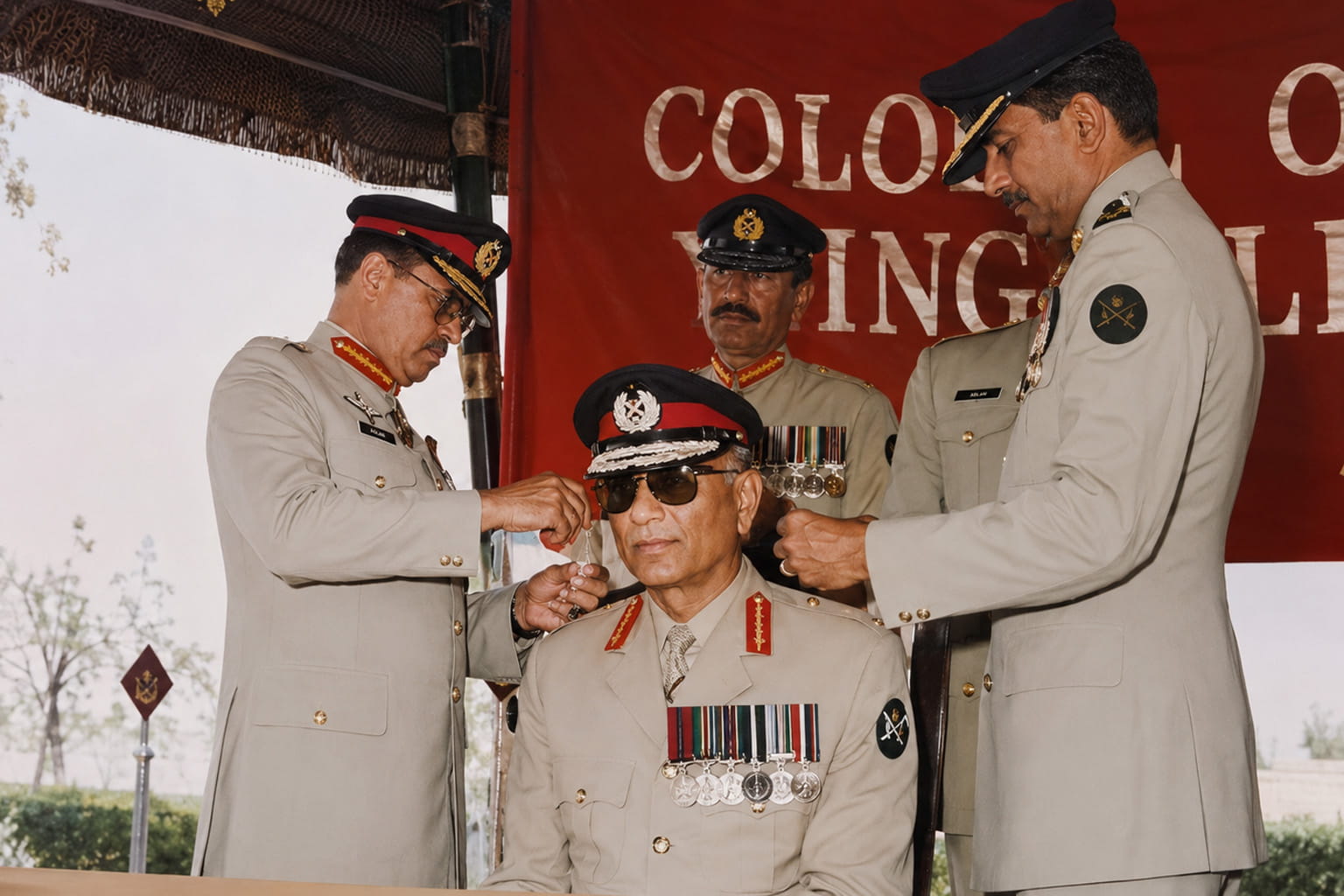
Lt Gen Vijay Oberoi, former Vice Chief of Army Staff, lost a leg in the 1965 Indo-Pak war but rose to the top ranks of the Indian Army and later worked for the dignity and welfare of war-disabled soldiers.

Lt Gen Vijay Oberoi remembered: A soldier who refused to be defeated
Lt Gen Vijay Oberoi’s life was not just a story of rank, uniform and command. It was a story of courage after injury, leadership after disability and service after retirement.
He was a former Vice Chief of Army Staff. He was a battle casualty of the 1965 Indo-Pak war. He lost his right leg as a young officer, but continued his military career with determination and rose to one of the highest appointments in the Indian Army.
After retirement, he became a strong voice for war-disabled soldiers and worked for the welfare, dignity and recognition of battle casualties through the War Wounded Foundation.
For Sainik Welfare News readers, Lt Gen Vijay Oberoi’s journey is important because it connects three powerful subjects: Indian Army leadership, war-disabled soldiers and veteran welfare.
Who was Lt Gen Vijay Oberoi?
Lt Gen Vijay Oberoi was a distinguished Indian Army officer who served as Vice subjects: Indian Army leadership, war-disabled soldiers and veteran welfare.
Who was Lt Gen Vijay Ober Chief of Army Staff before retiring from service in 2001.
Reports say he was commissioned into the Maratha Light Infantry in June 1961. He belonged to a generation of officers who saw the Army not merely as a career, but as a lifelong commitment to the nation.
His service included major command, operational and institutional appointments. He served as Director General of Military Operations, commanded Army Training Command, commanded Western Command and later became Vice Chief of Army Staff.
But what makes his life extraordinary is not only the appointments he held. It is the fact that he achieved all this after suffering a life-changing war injury.
The 1965 war injury that changed his life
During the 1965 Indo-Pak war, then Captain Vijay Oberoi was seriously wounded while fighting Pakistani infiltrators in Jammu and Kashmir.
Reports say he was injured in the Dachigam forests near Srinagar. His right leg was badly damaged and later had to be amputated.
At that time, he was still a young officer. Such an injury could have ended his career and forced him into a life of limitation.
But Lt Gen Oberoi refused to accept that his wound would decide his future.
This is the part of his story that every soldier, veteran and defence aspirant should understand. A war wound can change the body, but it does not have to defeat the spirit.
Lost a leg, but continued to serve the Army
After his amputation, Lt Gen Oberoi made a choice that defined his life. He chose to continue serving.
In a profession where physical toughness matters deeply, continuing after losing a leg required extraordinary mental strength. It required not only courage, but also self-belief, professional excellence and daily discipline.
He did not ask to be treated as less capable. He competed with his peers, took responsibility and kept moving forward.
His career later proved that disability does not automatically mean inability.
This message is especially important for battle casualties and disabled veterans. Lt Gen Oberoi’s life showed that a soldier’s worth is not measured only by physical perfection. It is measured by character, competence and commitment.
How he rose to become Vice Chief of Army Staff
The appointment of Vice Chief of Army Staff is among the highest military positions in the Indian Army.
For Lt Gen Vijay Oberoi to rise to that level after becoming a war-disabled officer was a powerful example for the entire Armed Forces community.
His rise was not symbolic. It was earned through decades of professional service, leadership and institutional contribution.
He held important appointments including Director General of Military Operations, General Officer Commanding-in-Chief of Army Training Command, Army Commander of Western Command and finally Vice Chief of Army Staff.
This journey made him one of the most inspiring examples of resilience in the Indian Army.
Why his story matters for war-disabled soldiers?
India often remembers martyrs with deep respect, and rightly so. But there is another group of soldiers whose sacrifice continues every day: war-disabled soldiers.
These are men who returned from battle alive, but with permanent injuries. Some lost limbs. Some suffered spinal injuries. Some carry lifelong wounds, pain or mobility challenges.
Their battle does not end when the firing stops. It continues through rehabilitation, medical care, prosthetics, employment challenges, social perception and dignity.
Lt Gen Vijay Oberoi understood this better than most people because he had lived that reality himself.
That is why his post-retirement work for war-disabled soldiers was not just social service. It was a continuation of soldierly duty.
War Wounded Foundation and his welfare mission
After retirement, Lt Gen Oberoi remained closely connected with the cause of disabled soldiers. He served as a leading figure associated with the War Wounded Foundation.
The War Wounded Foundation works for the welfare, dignity and rehabilitation of war-wounded personnel.
This is an important area of ex-servicemen welfare because disability after war is not only a medical issue. It affects identity, confidence, employment, family life and social respect.
Lt Gen Oberoi worked to change the way society looked at disabled soldiers. He believed that battle casualties should be recognised for their ability and courage, not reduced to their injuries.
This is a powerful welfare message.
War-disabled soldiers need dignity, not pity
One of the biggest lessons from Lt Gen Oberoi’s life is that disabled soldiers do not need pity. They need dignity, opportunity and recognition.
A soldier who loses a limb in battle does not become weak. He becomes a living example of the cost of national service.
But after the public ceremony ends, the real challenges begin. The soldier must adjust to a new body, new limitations, new medical needs and sometimes a new career path.
Families also face emotional and financial stress.
That is why veteran welfare systems must look beyond one-time respect. War-disabled soldiers require long-term support, smooth documentation, rehabilitation, accessibility and meaningful second-career opportunities.

Why his legacy is important for ex-servicemen welfare?
Sainik Welfare News readers follow issues related to pensions, disability benefits, ECHS, resettlement, family welfare, court cases and veteran dignity.
Lt Gen Oberoi’s life connects directly with these concerns.
He showed that welfare is not charity. Welfare is a national responsibility towards those who carried the burden of war.
His work reminds us that ex-servicemen welfare should include not only policy files, but also empathy, access and practical support.
A disabled soldier should not have to fight another battle for recognition after fighting for the nation.
A soldier-scholar and institution builder
Lt Gen Vijay Oberoi was also remembered as a soldier-scholar.
Reports mention his role in military thinking, doctrine and institution-building. He wrote on defence and strategic issues and remained active in military intellectual circles even after retirement.
This part of his profile is important because it shows that his contribution was not limited to command appointments.
He continued to think, write, speak and guide.
A senior veteran who uses his experience to shape military thought and welfare debate continues to serve the country even after leaving uniform.
What serving soldiers can learn from him?
Serving soldiers can learn from Lt Gen Oberoi’s example that the real test of courage often comes after the battlefield.
Injuries, setbacks and hardship are part of military life. But what matters is how a soldier responds.
Lt Gen Oberoi responded with discipline. He rebuilt himself, continued his service and rose to the highest levels of responsibility.
His life teaches that courage is not only shown in charging forward under fire. Courage is also shown in wearing a prosthetic leg, returning to duty and proving every day that a soldier’s spirit cannot be amputated.
What defence aspirants can learn from his journey?
For defence aspirants, Lt Gen Vijay Oberoi’s journey offers a deeper lesson.
The Army is not only about uniform, rank, parade and honour. It is also about sacrifice, uncertainty and lifelong responsibility.
Aspirants often prepare for exams, SSB interviews and physical tests. But they should also understand the emotional and moral meaning of service.
A soldier may face danger. A soldier may lose comfort. A soldier may be injured. But the spirit of service must continue.
Lt Gen Oberoi’s life is a reminder that the uniform demands more than ambition. It demands character.
Why society must remember war-wounded soldiers?
The public often honours soldiers during war, parades, funerals and national events. But war-wounded soldiers need respect throughout their lifetime.
Many of them live with artificial limbs, chronic pain, mobility limitations or medical complications. Some face difficulty in employment or social adjustment.
Their contribution should not be forgotten because they survived.
Survival does not reduce sacrifice.
In fact, war-disabled soldiers continue to carry the visible cost of conflict. Their families carry it too.
Lt Gen Oberoi’s welfare work brought attention to this truth.
The larger question: Are battle casualties remembered enough?
Lt Gen Oberoi’s life raises a serious question for society and policymakers.
Are war-disabled soldiers remembered with the same seriousness as they deserve?
Martyrs must always be honoured. But battle casualties who survive with lifelong disabilities also need strong national support.
Their compensation, medical care, mobility aids, pension matters, disability claims, employment options and social dignity must be handled with sensitivity and speed.
If a soldier can risk his body for the nation, the nation must ensure that he does not spend years fighting paperwork after injury.
A life beyond disability
One reason Lt Gen Oberoi’s story is powerful is that he did not allow disability to become his only identity.
He was a wounded soldier, but also a commander.
He was an amputee, but also a senior Army leader.
He was a veteran, but also a welfare advocate.
He was a battle casualty, but also an inspiration for others.
This is why his legacy should not be reduced only to the fact that he lost a leg.
The bigger truth is that he stood taller after losing it.
Why this story is relevant today?
This story is relevant today because India’s Armed Forces community continues to discuss disability pension, medical care, rehabilitation, ECHS facilities, documentation and the rights of battle casualties.
Whenever such issues arise, Lt Gen Oberoi’s life becomes a reference point.
He proved that disabled soldiers are not weaker citizens. They are national assets who deserve respect, support and meaningful opportunity.
For Sainik Welfare News, this is exactly the kind of story that combines emotion with policy relevance.
What should be the real tribute to Lt Gen Oberoi?
The real tribute to Lt Gen Vijay Oberoi should not be limited to remembrance.
The real tribute should be better support for war-disabled soldiers.
That means faster welfare processes, better awareness, accessible medical care, respectful public communication and stronger rehabilitation support.
It also means changing public attitude. Disabled soldiers should not be introduced only through their injuries. They should be recognised through their service, capability and courage.
Lt Gen Oberoi spent his life proving this point.
Final takeaway
Lt Gen Vijay Oberoi’s life was a rare example of courage, resilience and service.
He lost his leg in the 1965 Indo-Pak war, but he did not lose his purpose. He continued to serve the Indian Army, rose to become Vice Chief of Army Staff and later worked for the welfare and dignity of war-disabled soldiers.
His journey is important for every soldier, veteran, defence family and defence aspirant.
It tells us that a soldier’s strength is not only in his body. It is in his will, discipline and commitment to duty.
Lt Gen Vijay Oberoi’s legacy will be remembered not only because he became Vice Chief, but because he showed that a war-wounded soldier can still lead, inspire and serve the nation with unmatched dignity.
A true soldier does not stop serving when the battle ends.
Lt Gen Vijay Oberoi proved that.
Sources:-
Times of India — Lt Gen Oberoi remembered for grit on and beyond the battlefield
https://timesofindia.indiatimes.com/city/chandigarh/lt-gen-oberoi-remembered-for-grit-on-beyond-the-battlefield/articleshow/131751743.cms
Indian Express — Lt Gen Vijay Oberoi: Wounded in battle, undefeated in spirit
https://indianexpress.com/article/cities/chandigarh/lt-gen-vijay-oberoi-dead-10741024/
The Tribune — Lt Gen Vijay Oberoi, former Vice-Chief, passes away at 84
https://www.tribuneindia.com/news/defence/lt-gen-vijay-oberoi-former-vice-chief-credited-with-rewriting-army-doctrines-passes-away-at-84/
Indian Express — War-disabled should be treated on par with martyrs: Lt Gen Oberoi
https://indianexpress.com/article/cities/chandigarh/war-disabled-should-be-treated-on-par-with-martyrs-lt-gen-oberoi/
War Wounded Foundation — About the foundation
https://warwounded.org/about/


Leave a Reply