

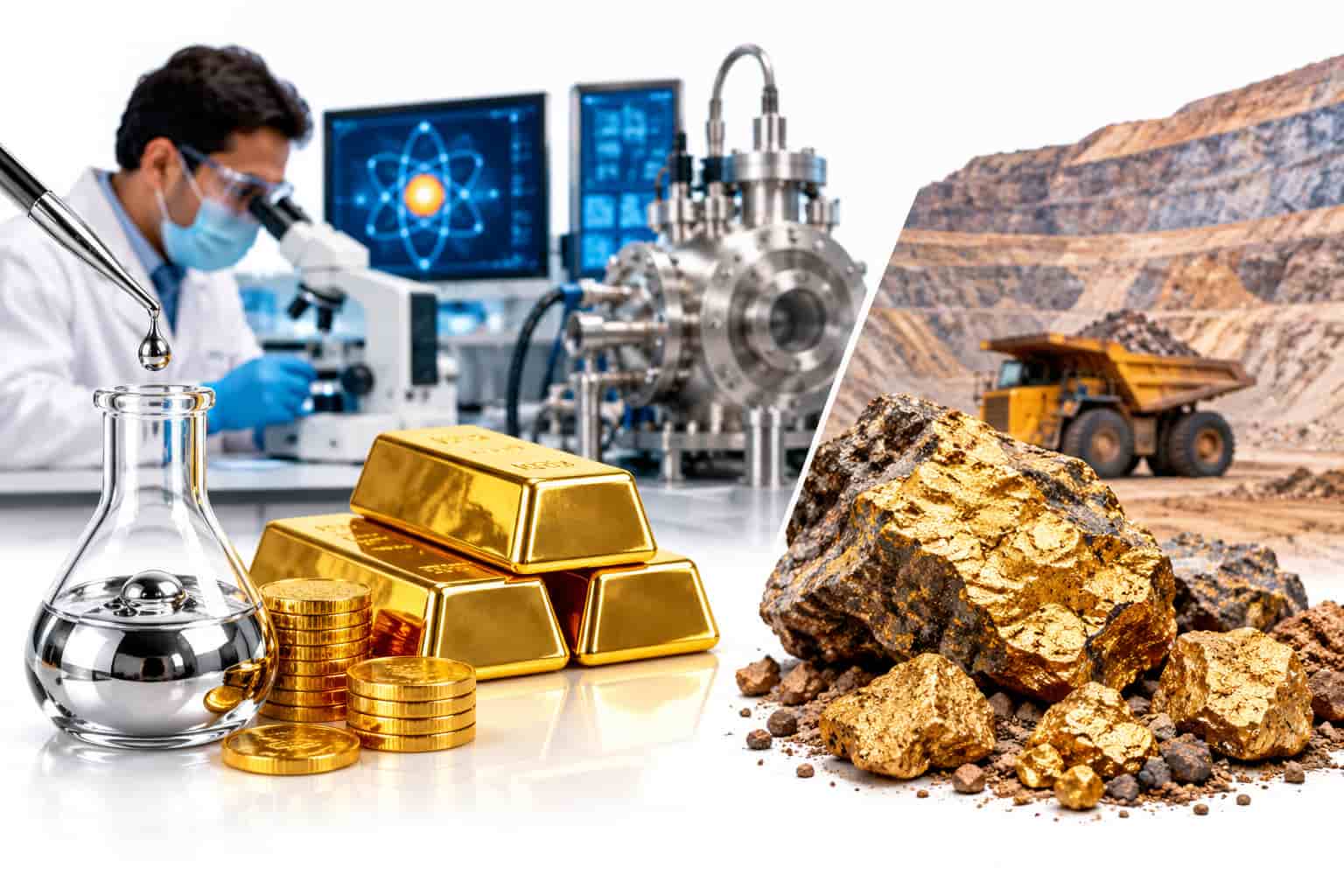
Scientists have proposed a technology that could potentially turn mercury into real gold using nuclear fusion. The development has attracted attention because laboratory-grown diamonds have already transformed the global jewellery market.
But can gold be produced in laboratories at an affordable cost? And could this technology eventually reduce gold prices in India?
A US-based company, Marathon Fusion, has proposed a method of producing gold from mercury using high-energy neutrons. While the underlying science is credible, large-scale commercial production has not been demonstrated.
The distinction is important for Indian families who hold gold as jewellery, savings or long-term financial security.
What Is Marathon Fusion’s Gold-Making Technology?
Marathon Fusion, a San Francisco-based nuclear fusion technology company, presented a research paper in July 2025 titled Scalable Chrysopoeia via (n, 2n) Reactions Driven by Deuterium-Tritium Fusion Neutrons.
The proposed method involves exposing a particular mercury isotope, mercury-198, to high-energy neutrons generated through nuclear fusion.
These nuclear reactions could ultimately produce stable gold-197.
Unlike ordinary gold-plating or chemical treatment, this process changes the atomic nucleus itself. Scientists call it nuclear transmutation.
Gold contains 79 protons, while mercury contains 80. Nuclear processes can transform one element into another by changing the composition of its nucleus.
If stable gold-197 is successfully produced, it is genuine gold with the same chemical properties as naturally occurring gold.
However, Marathon Fusion’s research presents a model of a possible production process. It does not establish that commercially viable gold production has begun.
Scientists Have Already Created Gold at CERN
Producing gold through nuclear reactions is not an entirely new scientific achievement.
In May 2025, the European research organisation CERN reported that its ALICE experiment had measured the transformation of lead nuclei into gold nuclei at the Large Hadron Collider.
Between 2015 and 2018, approximately 29 picograms of gold nuclei were produced across the LHC’s major experiments.
A picogram is one-trillionth of a gram.
The amount was therefore extraordinarily small, and the gold nuclei existed only briefly before breaking apart.
This experiment demonstrated that transforming one element into gold is physically possible. It did not demonstrate a practical method of manufacturing gold jewellery.

How Lab-Grown Diamonds Changed the Jewellery Market
The most interesting comparison comes from laboratory-grown diamonds.
Lab-grown diamonds are real diamonds with essentially the same chemical composition and crystal structure as natural diamonds. The difference lies in their production.
As manufacturing technology improved and competition increased, laboratory-grown diamond prices fell sharply.
According to The Diamond Report, published by De Beers in June 2026, wholesale prices of lab-grown diamonds declined by approximately 93% between 2020 and 2026.
To understand the scale of this fall, consider a hypothetical example.
If a lab-grown diamond had a wholesale value of ₹1,00,000 before a 93% decline, its value after that decline would be ₹7,000.
This calculation illustrates the percentage change. It does not mean every lab-grown diamond experienced exactly the same price decline.
Importantly, the 93% figure refers to lab-grown diamond wholesale prices, not an equivalent decline in natural diamond prices.

Could Lab-Grown Gold Become as Cheap as Lab-Grown Diamonds?
There is a major scientific difference between producing diamonds and manufacturing gold.
Diamonds consist of carbon atoms arranged in a particular crystal structure. Scientists can create this structure under controlled conditions.
Gold, however, is a chemical element. Producing it from another element requires nuclear reactions rather than simply rearranging atoms.
That makes the technological challenge substantially more complex.
Marathon Fusion’s 2025 research estimated that a suitably designed fusion facility with a thermal capacity of one gigawatt could theoretically produce approximately two tonnes of gold annually.
This figure comes from computer simulations, not a demonstrated commercial facility.
For comparison, the World Gold Council estimated global gold mine production at approximately 3,672 tonnes in 2025.
| Gold production comparison | Annual quantity |
|---|---|
| Global mine production in 2025 | Approximately 3,672 tonnes |
| Proposed fusion facility output | Approximately 2 tonnes |
| Proportion of annual mine production | Approximately 0.054% |
Even if one such facility achieved the modelled production level, its annual output would be small compared with existing global mine supply.
Moreover, gold prices are influenced by investment demand, central-bank purchases, currency movements, interest rates, jewellery consumption and existing gold inventories.

What Would Need to Happen for Gold Prices to Fall?
For laboratory-produced gold to significantly influence international prices, three conditions would need to be met.
Competitive production costs: Manufacturing gold would need to become commercially viable after accounting for reactor construction, operation, processing and other expenses.
Large-scale supply: Production would need to expand enough to make a meaningful difference to global gold availability.
Reliable commercial output: Producers would need to supply usable, stable gold while meeting the required safety and regulatory standards.
None of these conditions has yet been demonstrated at commercial scale for the proposed fusion-based process.
Therefore, a substantial fall in gold prices due to laboratory manufacturing remains a possibility for the future, not an established market forecast.
What Does This Mean for Indian Families and Pensioners?
Gold plays an important role in the financial planning of Indian households, including retired defence personnel, pensioners and senior citizens.
For many families, it represents accumulated savings, jewellery for important occasions and an asset that can provide financial flexibility.
However, reports of new gold-making technology should not become the sole reason for buying or selling gold.
The research does not establish that inexpensive laboratory-produced gold will enter the jewellery market in the coming months.
Before making financial decisions, families should consider their savings requirements, liquidity needs, investment diversification and exposure to gold-price fluctuations.
Conclusion: Will Gold Prices Crash Like Diamonds?
Science has demonstrated that gold can be produced through nuclear transformations. Marathon Fusion’s research proposes a possible pathway towards producing larger quantities.
However, there is still a substantial gap between a promising scientific model and affordable commercial manufacturing.
The sharp decline in lab-grown diamond prices shows how technology can change a market, but it does not establish that the same outcome will occur with gold.
For now, there is no verified basis for predicting a diamond-like collapse in gold prices solely because of this fusion technology.
The development is scientifically important, but the future impact on gold prices will depend on actual production costs, achievable output and global market demand.
1. Marathon Fusion — Scientific Research Paper, July 2025
Scalable Chrysopoeia via (n, 2n) Reactions Driven by Deuterium-Tritium Fusion Neutrons
https://arxiv.org/abs/2507.13461
2. CERN — ALICE Detects the Conversion of Lead Into Gold, 8 May 2025
https://home.cern/alice-detects-conversion-lead-gold-lhc/
3. De Beers Group — The Diamond Report, June 2026
4. World Gold Council — Gold Demand Trends, Full Year 2025
https://www.gold.org/goldhub/research/gold-demand-trends/gold-demand-trends-full-year-2025/supply
5. The Times of India report
https://timesofindia.indiatimes.com/life-style/fashion/jewellery/what-is-lab-grown-gold-how-is-it-made-and-why-it-matters/photostory/128748618.cms
6. Aaj Tak report
https://www.aajtak.in/trending/story/marathon-fusion-mercury-to-gold-making-claim-explained-tstsd-dskc-2678276-2026-10-23?utm_source=chatgpt.com
Editorial clarification: The proposed output of approximately two tonnes annually is based on a scientific simulation. It should not be described as gold already produced by Marathon Fusion or as proof of commercial manufacturing.



Leave a Reply