

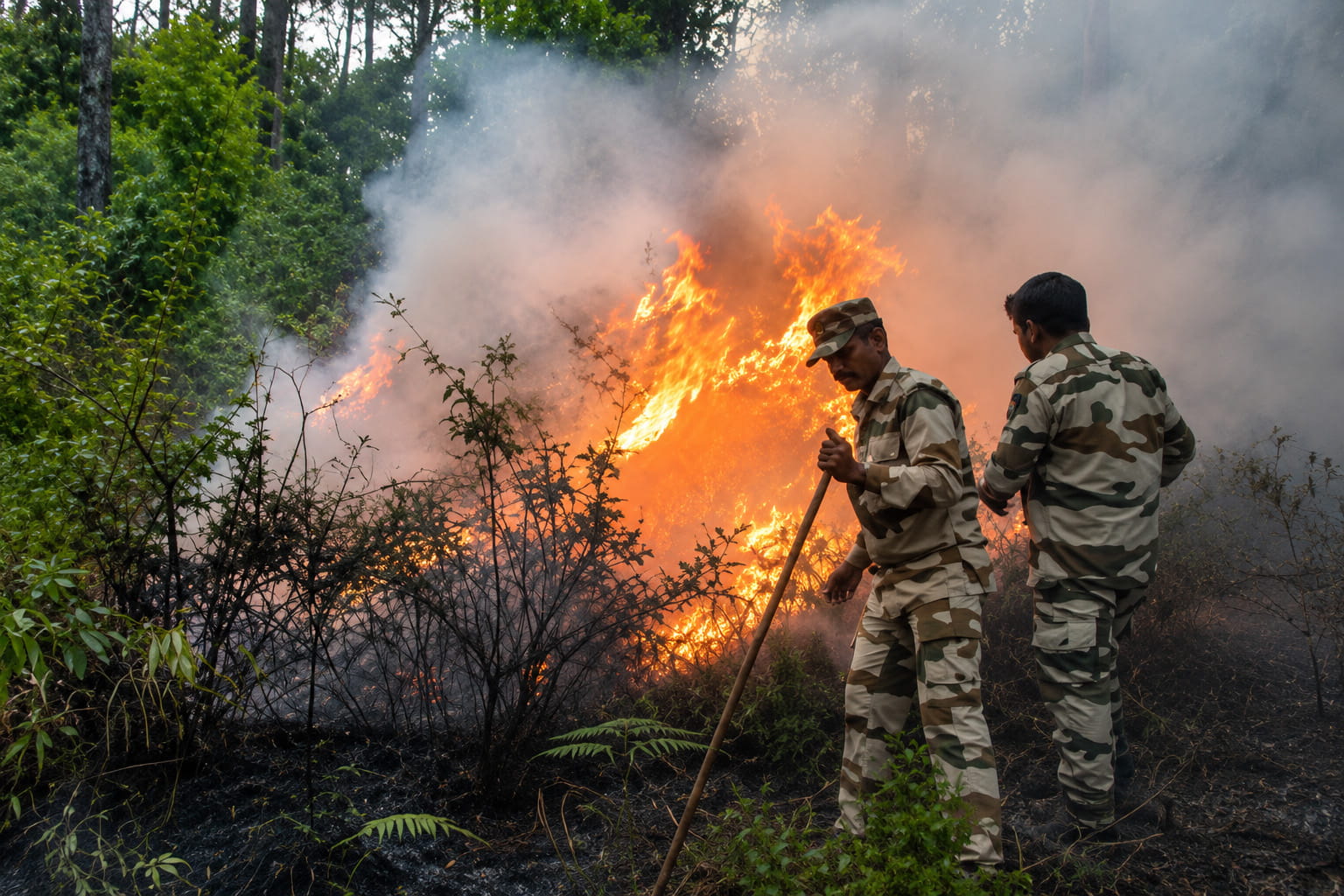
Kasauli is usually remembered for calm roads, pine forests, old hill charm and quiet walks around places like Gilbert Trail and Upper Mall. But on 26 May 2026, that calm hill station saw a very different scene. A forest fire broke out on the western slopes of Kasauli, and within hours, the danger was no longer just about trees burning on a hillside. It became a question of protecting people, property, heritage areas and vulnerable forest zones.

This is where the story becomes important.
At around 3 PM, when the fire started spreading through the difficult and densely forested terrain, the Indian Army’s Kasauli Brigade launched an immediate response. This was not a battlefield. There was no enemy across the line of control. But the situation still demanded speed, discipline, courage and coordination. The same qualities that define a soldier in combat were now needed to fight flames, smoke and unpredictable wind.
The Army did not work alone. The Indian Air Force, civil officials from Kasauli and Chandigarh administration, fire services and local agencies joined the effort. Together, they carried out a sustained operation that lasted over 15 hours and continued into the day. On the ground, Army personnel, fire tenders and water carriers worked through difficult conditions. In the air, IAF helicopters carried out Bambi Bucket sorties, lifting water from Sukhna Lake and dropping it over affected and inaccessible stretches.
For ordinary readers, this detail matters because it shows how complex such an operation can be. A forest fire in a hill area is not like a small local fire that can be controlled from one road. Flames move with wind. Dry pine leaves and forest material can help the fire spread quickly. Steep slopes make movement difficult. Some pockets cannot be reached easily by vehicles. That is why ground teams and aerial support both become necessary.
The affected areas included Gilbert Hill and Upper Mall. Reports also suggest that the fire had come close to sensitive parts of Kasauli, including the Ridge area, the Doordarshan tower, Kasauli Club and residences along the Ridge-line. That is why this operation cannot be seen as routine. Had the fire spread further, the damage could have been much more serious for the hill station and the people living there.
What stands out in this story is the timing of the response. The Kasauli Brigade moved quickly after the fire broke out. Army personnel created firebreaks, isolated vulnerable pockets and worked to douse residual hotspots so that the flames would not flare up again. These are not glamorous tasks. They require physical effort, patience and risk. A soldier may be trained for combat, but in such moments he also becomes a protector of civilians and the environment.
The Indian Air Force added another powerful visual to the operation. Helicopters using Bambi Buckets carried water from Sukhna Lake and dropped it over fire lines. For many people watching from the ground, this would have been a moment of relief. When a fire spreads across a hill slope and people are unable to reach some areas directly, the sound of helicopters above can become a sign that help has arrived from the sky.
The most important outcome was that no loss of life or injuries were reported among civilians or responders. In any emergency operation, this is the first measure of success. Property and forests matter, but lives matter the most. The fact that personnel and equipment remained safe while the operation continued under challenging conditions shows that the response was not only brave, but also disciplined and controlled.
There is another side to this story that should not be missed. Natural emergencies test not only courage, but coordination. The Army, Air Force, civil administration and local agencies had to work in one direction. In such situations, confusion can waste time. But when every agency understands its role, the response becomes faster and more effective. Kasauli’s fire operation shows why inter-agency coordination is not just a government phrase. It is the difference between a contained crisis and a bigger disaster.

Lt Gen Pushpendra Singh, Army Commander, Western Command, visited the affected area, reviewed the situation on the ground and recognised the personnel involved. He awarded On-the-Spot Commendation Cards to those who took part in the firefighting operation. This recognition matters because such work often happens away from the spotlight. The men who fight fire through smoke and heat may not always be seen by the public, but their effort protects lives and communities.
For Sainik Welfare News readers, the larger message is clear. The Indian Army is not only a combat force. It is also a national response force in times of crisis. Whether it is a flood, landslide, rescue operation, medical evacuation or forest fire, soldiers are often among the first organised forces to reach difficult areas and support civil authorities.
This Kasauli operation reminds us that service in uniform is not limited to borders. Sometimes it means standing between a burning forest and a town. Sometimes it means working overnight on a hill slope so that civilians can sleep safely. Sometimes it means doing hard, silent work without waiting for applause.
The Kasauli forest fire story should therefore be remembered not only as an incident of flames being controlled, but as an example of readiness. The Army responded on the ground. The Air Force supported from the sky. Civil agencies joined hands. Together, they prevented the fire from becoming a larger tragedy.
In the end, this was a story of protection. Protection of lives. Protection of property. Protection of forests. Protection of public confidence.
And that is why the Kasauli fire operation matters. It shows that when crisis comes, the uniform does not ask whether the threat is from across the border or from a burning hillside. It simply moves forward to serve.
Sources:-
PIB, Ministry of Defence official release:
Indian Army’s joint efforts contain forest fire in Kasauli
Indian Express report:
Army, IAF lead 15-hour operation to contain forest fire in Kasauli
Hindustan Times report:
Bambi Bucket ops: IAF steps in as Himachal battles massive forest fire in Kasauli



Leave a Reply