

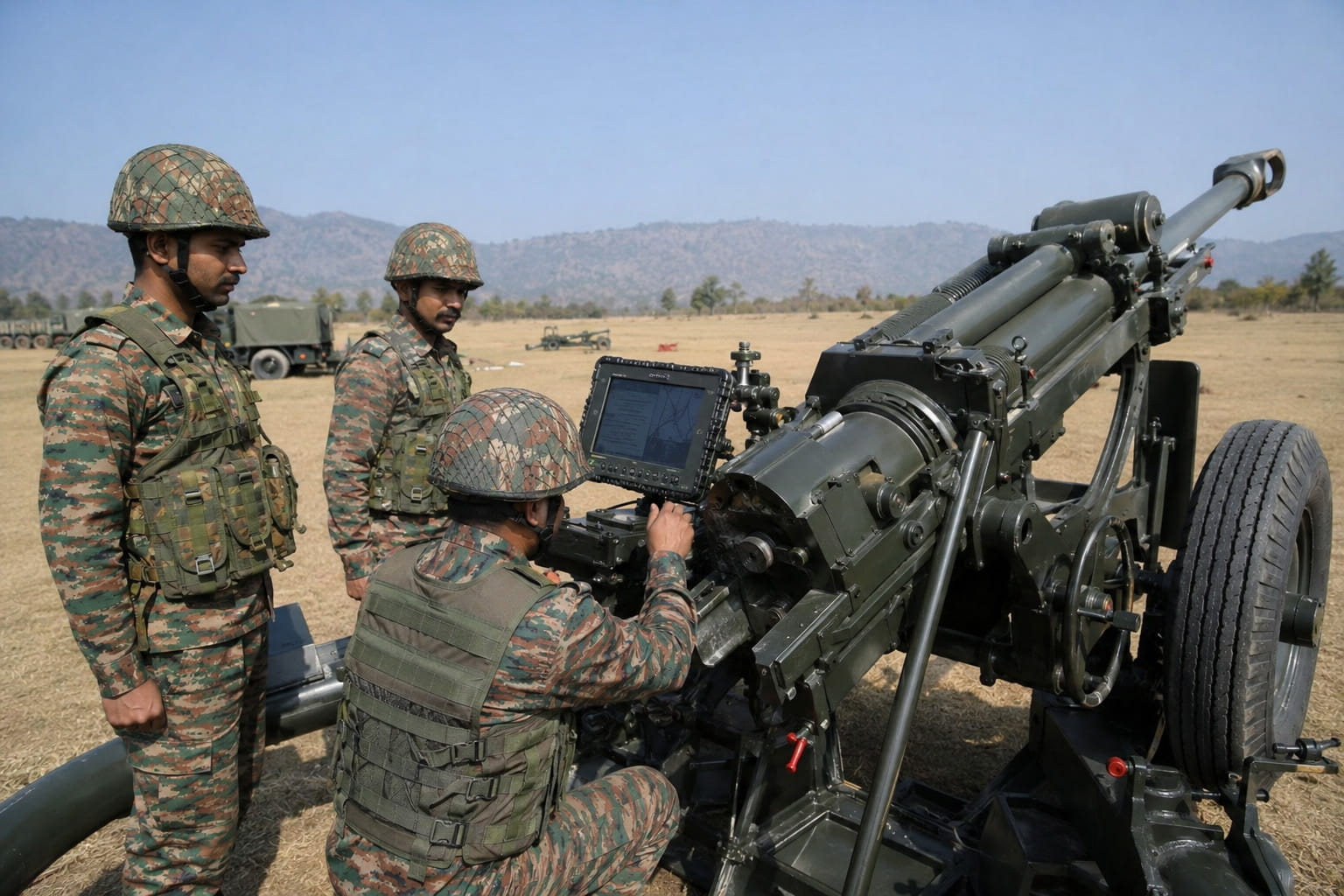
In war, a gun is not powerful only because of the shell it fires. It is powerful when it can be brought into action quickly, aimed correctly and used at the right moment. For artillery crews, speed and accuracy can decide how effectively a target is engaged. That is why the reported upgrade of the 105 mm Indian Field Gun with automatic aiming capability is an important development for the Indian Army.

According to media reports, the Indian Army has modified the 105 mm Indian Field Gun with an automatic gun-laying system. Earlier, the gun had to be laid on target through manual dial-based adjustments. The reported upgrade allows the gun to be aimed through a computerised system, helping the crew calculate firing solutions and make faster aiming corrections.
This may sound like a technical change, but for the soldier on the gun line, it can mean something very practical: less manual delay, faster response and better consistency in engaging targets.
The 105 mm Indian Field Gun is not a new weapon. It has been part of the Indian artillery ecosystem for decades. The gun has served in different roles and remains familiar to generations of Indian gunners. The important point is that instead of treating old systems as useless, the Army appears to be adding a modern digital layer to improve battlefield performance.
That is the real story.
Why this upgrade matters?
Artillery is often called the arm of firepower. Before infantry moves, artillery can soften enemy positions. During a battle, artillery can support troops, suppress enemy movement and shape the battlefield. In difficult terrain, timely artillery fire can give confidence to soldiers moving forward.
But artillery does not work only by pulling a trigger. It requires target location, firing data, gun positioning, elevation, bearing, corrections and coordination. Traditionally, many of these steps involved manual calculations, trained procedures and physical adjustments. Experienced gunners can do this with skill, but modern warfare demands faster engagement and quicker switching between targets.
That is where automatic gun laying becomes important.
A computer-assisted system can help reduce the time taken to lay the gun on target. It can support the crew in calculating firing solutions and making aiming adjustments. This does not remove the gunner from the process. It gives the crew better support.
In simple terms, the gun remains old, but the way it is aimed becomes smarter.
What changes for the artillery crew?
For an artillery crew, every second matters. If a target appears briefly, delayed response can reduce effectiveness. If the fire mission changes quickly, the crew must adjust fast. If multiple guns are firing together, consistency becomes important.
With automatic aiming support, the crew may be able to lay the gun faster and with improved accuracy. The system can reduce dependence on manual dial turning and help convert firing data into gun movement more efficiently.
This is especially important because modern artillery battles are becoming faster. Drones, surveillance systems, counter-battery radars and precision targeting have changed the rhythm of warfare. Guns must fire, shift and survive. A slow system can become vulnerable.
So even a legacy gun can remain relevant if its speed, data handling and targeting process are improved.
Old gun, new battlefield
The 105 mm Indian Field Gun has its own limitations. It cannot become a 155 mm howitzer simply because a computerised aiming system is added. Its calibre, range and shell weight remain those of a 105 mm field gun. Bharat Rakshak’s background profile lists the 105 mm IFG as a 105 mm artillery system with a maximum range of around 17,200 metres and a normal rate of fire of four rounds per minute.
This is why the upgrade should not be exaggerated. It is not a magical transformation of the weapon. It is a practical improvement in the laying and aiming process.
But such improvements matter.
Many armies across the world continue to upgrade older platforms instead of replacing everything at once. A vehicle may get better communication. A gun may get modern sights. A rifle may get better optics. A command post may get digital mapping. These upgrades extend usefulness and reduce the gap between old hardware and new battlefield requirements.
For India, where the Army has large inventories and diverse terrain commitments, such upgrades can be valuable.
How it fits into Indian artillery modernisation?
The Indian Army has been modernising its artillery arm through systems such as the K-9 Vajra, M-777 ultra-light howitzer, Dhanush, and other 155 mm platforms. The Times of India report notes that modern systems like the FH-77B Bofors, K-9 Vajra and M-777 already use comput.er-based laying or targeting support. The reported upgrade aims to bring the 105 mm IFG closer to that modern operating environment.
This is important because artillery modernisation is not only about new guns. It is also about creating a common culture of faster data use, better fire control and quicker execution.
If older 105 mm guns can be digitally assisted, they may remain useful in certain roles while the Army continues its broader shift towards heavier and longer-range artillery. The gun may not be the newest system in the inventory, but with improved laying capability, it can still support training, operational roles and specific battlefield needs.

Why soldiers should care?
A soldier in the field may not use the words “automatic gun laying” or “computerised firing solution,” but he understands the meaning of timely fire support.
When troops are moving, they need confidence that artillery can respond. When enemy positions need suppression, fire must arrive at the right place. When a crisis develops, the support system must be quick.
For the infantryman, artillery is not an abstract concept. It is the sound of support behind him.
That is why improving even an older gun can matter to the man on the ground. A faster and more consistent artillery system can strengthen the overall support chain.
The gun crew also benefits. Manual procedures require training and discipline, and they will continue to matter. But when technology reduces some repetitive or time-consuming steps, the crew can focus better on mission execution, safety and coordination.
Why the source caution matters?
This story has a strong modernisation angle, but it must be reported responsibly. I did not find a detailed official PIB, MoD or ADGPI document confirming this specific upgrade. PIB has older material showing the 105 mm Indian Field Gun as part of Army artillery exercises, but that is only background.
Therefore, the correct wording is:
According to media reports, the Indian Army has upgraded the 105 mm Indian Field Gun with automatic aiming capability.
The article should not say:
The Ministry of Defence has officially announced the upgrade.
This distinction protects credibility. A defence article should be strong, but it should also be accurate about the source of information.
The bigger message
This upgrade reflects a wider pattern in modern warfare. Battles are becoming more data-driven. Fire support is becoming faster. Old systems are being connected with newer methods. Technology is being used not only in drones, AI systems and missiles, but also in traditional weapons like field guns.
That is an important message for defence readers.
Modernisation does not always mean a shiny new platform. Sometimes it means improving what already exists, making it faster, more accurate and more compatible with modern battlefield needs.
For the Indian Army, this approach can be practical. It allows the force to modernise gradually while still using trusted equipment. It also helps artillery crews adapt to digital fire-control methods that are becoming standard across modern guns.
What should be watched next?
The next questions are important.
Will this upgrade be applied to a large number of 105 mm Indian Field Guns?
Which units will receive it first?
Who developed the automatic gun-laying system?
How will it integrate with artillery command-and-control systems?
Will the upgrade be used mainly for training, operational deployment or both?
Will official Army or MoD details be released later?
These questions remain open because detailed official information is not yet available in the public domain. If an official document comes later, the story can be updated with more clarity.
Conclusion
The reported automatic aiming upgrade for the 105 mm Indian Field Gun is a meaningful Army modernisation story. It shows how an older artillery system can be made more effective through computer-assisted gun laying and faster firing-solution support.
The upgrade does not change the gun’s basic calibre or range. It does not make a 105 mm field gun equal to a modern 155 mm howitzer. But it can improve the way the gun is aimed, reduce manual delay and help artillery crews respond more efficiently.
For soldiers, this matters because artillery is not only about machinery. It is about support, confidence and battlefield readiness.
For Sainik Welfare News readers, the takeaway is clear: the Indian Army is not only inducting new weapons. It is also making older systems smarter. In modern warfare, that combination of experience and technology can be powerful.
Sources:-
- Times of India report on automatic aiming upgrade:
https://timesofindia.indiatimes.com/defence/news/indian-army-makes-its-artillery-arm-more-lethal-by-giving-its-guns-automatic-aiming-capability/articleshow/131304886.cms - The Week report on 105 mm Indian Field Gun automatic targeting:
https://www.theweek.in/news/defence/2026/05/26/indian-army-gives-105-mm-indian-field-gun-a-high-tech-upgrade-with-automatic-targeting.html - PIB background on Exercise Sarvatra Prahar and 105 mm Indian Field Gun:
https://www.pib.gov.in/newsite/erelcontent.aspx?relid=134367 - Bharat Rakshak background profile on 105 mm Indian Field Gun:
https://www.bharat-rakshak.com/army/equipment/artillery/105mm-field-gun/



Leave a Reply