

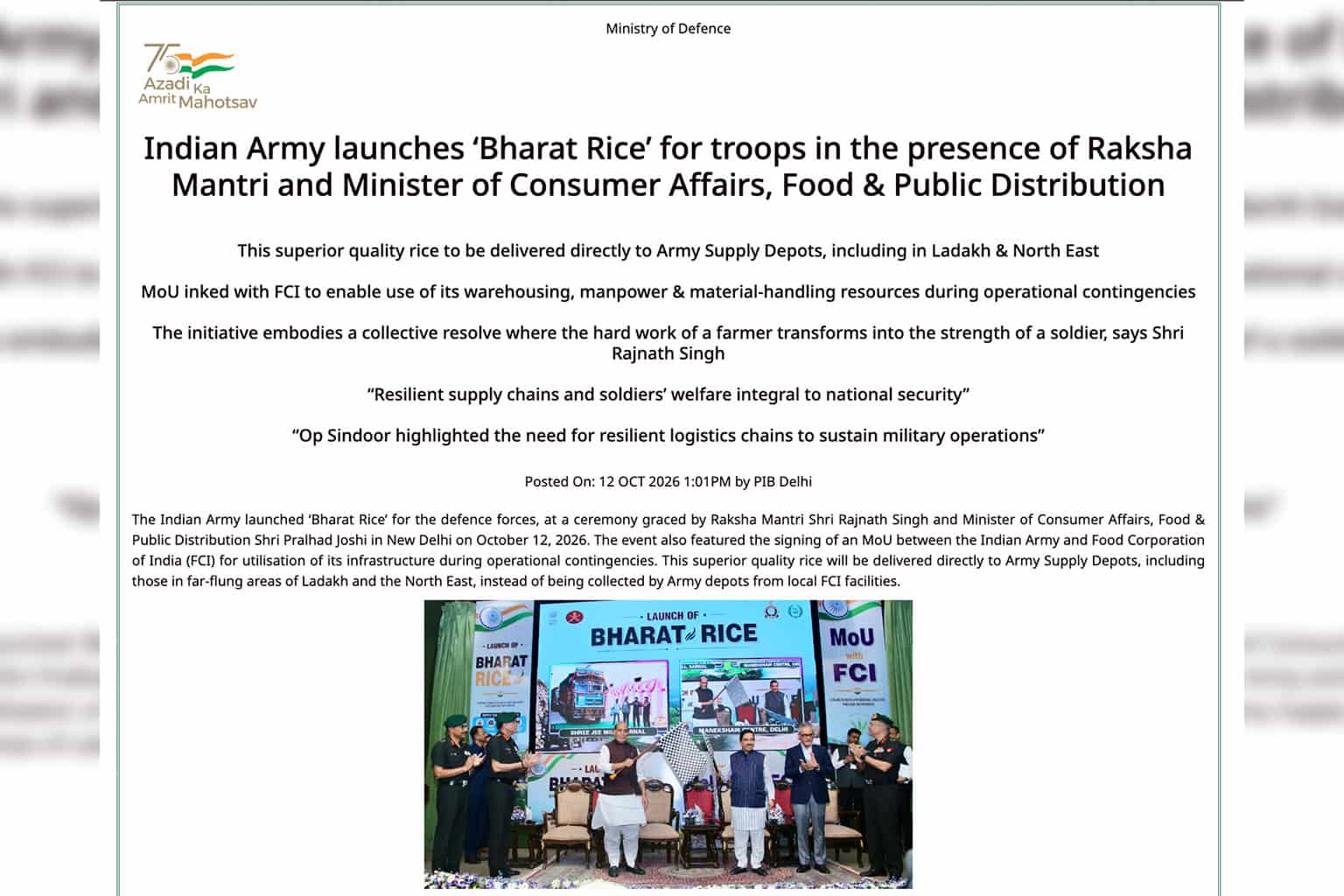
The Indian Army has introduced “Bharat Rice” for the defence forces, combining an improvement in troop ration quality with a significant change in the way rice will reach Army Supply Depots. Launched in New Delhi on 12 October 2026, the initiative will provide rice milled to prescribed defence specifications and supplied through NAFED during FY 2026-27.
At the same event, the Indian Army signed a five-year Memorandum of Understanding with the Food Corporation of India (FCI), allowing identified FCI warehousing, labour and material-handling resources to be used during operational contingencies.
The two developments together address both day-to-day soldier welfare and military logistics preparedness.

What exactly is Indian Army’s Bharat Rice?
Bharat Rice is an Army ration-quality initiative led by the Directorate General of Supplies and Transport.
According to the Ministry of Defence, the initiative has emerged from sustained feedback received from troops and is intended to improve the quality of rice supplied as part of military rations.
The rice will be milled according to prescribed defence specifications and undergo quality-control checks. The official announcement states that it will be:
free from foreign matter;
free from admixtures; and
contain minimum levels of broken, damaged and discoloured grains.
Supply during Financial Year 2026-27 will be routed through the National Agricultural Cooperative Marketing Federation of India Limited (NAFED).
This makes Bharat Rice more than a branding exercise. The stated objective is to address the quality of a staple food consumed by troops.
What changes in the Army rice supply system?
One of the most practical changes concerns delivery.
Under the earlier arrangement described by the Ministry, Army depots collected rice from their respective local FCI facilities.
Under the Bharat Rice arrangement, the rice will instead be delivered directly to Army Supply Depots, including depots located in remote parts of Ladakh and the North East.

Why are 10 kg and 30 kg bags important?
Bharat Rice will be procured in 10 kg and 30 kg bags.
This may appear to be a minor packaging change, but the Ministry specifically connects it with easier handling and transportation, particularly for forward posts.
Military ration movement does not end when food reaches a large supply depot. Supplies may subsequently have to move through smaller logistics nodes and difficult terrain before reaching troops.
Smaller and more manageable packaging can therefore become operationally relevant in areas where conventional bulk handling is difficult.

The initiative followed nearly 18 months of coordination
The official release states that Bharat Rice was developed after approximately 18 months of coordination among:
Indian Army;
Food Corporation of India;
NAFED; and
Department of Food & Public Distribution.
This is important because it shows that the initiative is part of a wider supply-chain arrangement rather than a standalone ceremonial launch.
Army and FCI also signed a five-year MoU
The second major development announced on 12 October is arguably as significant as Bharat Rice itself.
The Indian Army and FCI signed a formal MoU that will allow the Army to utilise identified FCI resources during operational contingencies.
These resources include:
FCI warehousing infrastructure
labour resources
material-handling equipment
The agreement will remain valid for five years and can be extended by mutual consent.

How will the FCI arrangement work on the ground?
The MoU is not intended to remain only at headquarters level.
The Ministry says coordination will take place at the formation level between:
Army Supply and Transport elements; and
FCI Regional and Divisional Offices.
The arrangement will also be incorporated into operational logistics plans.
This can allow existing civilian food-storage infrastructure to supplement military logistics when additional capacity is needed.
According to the official release, the arrangement can support:
additional storage;
rapid mobilisation;
dispersion of supplies; and
forward positioning of rations, stores and equipment closer to operational areas.
What is the Operation Sindoor connection?
The Ministry has directly linked the Army-FCI logistics arrangement with operational lessons, including those from Operation Sindoor.
The official release says Operation Sindoor highlighted the requirement for resilient logistics arrangements during contingencies that may arise at short notice and continue for prolonged periods.
Raksha Mantri Rajnath Singh also emphasised preparedness for scenarios where the warning period before an operation may be limited.
The important distinction is that the Ministry does not say that Bharat Rice itself was created because of Operation Sindoor.
The Operation Sindoor reference is specifically significant to the wider requirement for resilient military logistics and the Army-FCI contingency arrangement.

Why does this matter for soldiers’ welfare?
The official announcement places troop welfare and operational preparedness within the same framework.
Modern military readiness is not limited to weapons and equipment. A soldier deployed at a forward location also depends on reliable:
food supplies, clothing, equipment, transportation, and logistics support.
Bharat Rice addresses the quality of a daily ration item, while direct depot delivery aims to improve the supply process.
The FCI MoU deals with a different level of the same problem: ensuring sufficient logistics capacity when military requirements suddenly increase.
That is why this development should be understood as both a soldier welfare measure and a supply-chain reform.
Other Army ration reforms mentioned by the Government
The Ministry also referred to other measures being taken to improve ration scales and quality.
These include:
additional rations for Agniveer recruits; and
greater commonality in ration scales across the three Services.
The release also states that organic rations are proposed to be introduced.
This final point requires careful interpretation.
The Government has not said in this announcement that organic rations have already been implemented. It only says that their introduction is proposed.
What has not been announced?
The 12 October PIB release does not specify:
the total quantity of Bharat Rice to be procured;
the total expenditure involved;
a depot-wise distribution schedule; or
a date by which every Army location will receive the new rice.
Therefore, these details should not be assumed until separately announced by the Government.
What soldiers and defence readers should know?
The Bharat Rice announcement contains two separate but connected developments.
For everyday troop welfare: the Army is moving towards better-quality rice, defence-specific milling standards, quality checks, more manageable packaging and direct delivery to Army Supply Depots.
For operational preparedness: the five-year Army-FCI MoU creates a framework through which existing FCI warehouses, manpower and handling resources can support military logistics during contingencies.
The significance therefore goes beyond a new ration product.
It represents an effort to improve what reaches the soldier’s plate in routine conditions, while simultaneously strengthening the infrastructure that can keep troops supplied during short-warning and prolonged military operations.
Sources
Press Information Bureau, Ministry of Defence — 12 October 2026
Indian Army launches ‘Bharat Rice’ for troops in the presence of Raksha Mantri and Minister of Consumer Affairs, Food & Public Distribution
Official PIB release
DD News — 12 October 2026
Army launches ‘Bharat Rice’ for troops, signs FCI pact to strengthen operational logistics
Read DD News report



Leave a Reply