

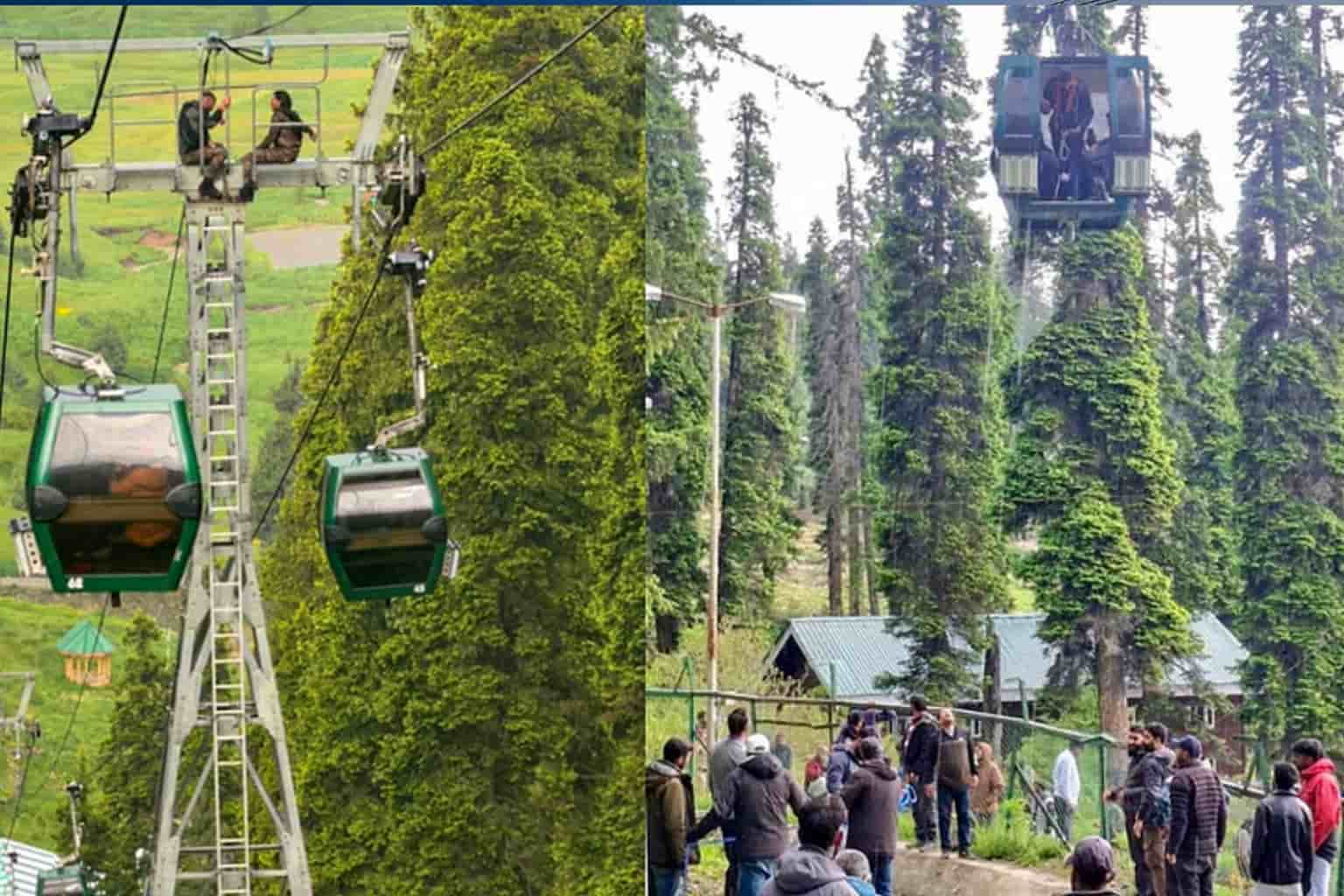
Gulmarg is known for snow, mountains, skiing, cable car rides and unforgettable tourist memories. For many visitors, the Gulmarg Gondola is not just a ride. It is the highlight of their Kashmir trip. Families, children, honeymoon couples and tourists from across India come here to experience one of the most beautiful cable car journeys in the country.

But when the same gondola suddenly stops mid-air, excitement can quickly turn into fear.
The recent Gulmarg Gondola crisis became a major public safety concern after a technical snag halted the cable car service, leaving more than 300 tourists stranded in cabins. According to News On AIR, over 300 tourists were trapped in 65 gondola cabins, with some cabins reportedly hanging nearly 500 feet above the ground. A joint rescue operation involving NDRF, SDRF, Jammu and Kashmir Police, Army’s Chinar Corps and local administration was launched, and all passengers were safely evacuated.
This is the most important relief in the entire incident: no lives were lost and tourists were rescued safely.
But the crisis also raises serious questions about tourist safety, technical maintenance, emergency preparedness and public confidence in major hill tourism infrastructure.
What happened at Gulmarg Gondola?
The incident began when the Gulmarg Gondola cable car service reportedly stopped due to a technical snag. Tourists who had boarded the cabins were left stranded mid-air. For anyone sitting inside a cable car cabin at height, even a few minutes can feel long. In this case, the situation continued for hours.
The scale of the incident made it serious. This was not one cabin or a small operational delay. News On AIR reported that more than 300 tourists were affected. The fact that 65 cabins were involved shows how quickly a tourist attraction can become an emergency situation when a technical system fails.
For tourists inside those cabins, the fear would have been real. Some may have been travelling with children. Some may have been elderly. Some may have been visiting Kashmir for the first time. In a place like Gulmarg, where weather and altitude already add to the challenge, being trapped mid-air can create panic.
This is why the rescue operation became extremely important.
How the rescue operation worked?
The response was a multi-agency effort. News On AIR reported the involvement of NDRF, SDRF, Jammu and Kashmir Police, Army’s Chinar Corps and local administration. Such incidents require coordination because cable car rescues are not simple. Teams need to manage height, cabin access, tourist safety, weather conditions, crowd control and medical readiness.
The role of the rescue teams deserves appreciation. In an emergency, speed matters, but safety matters even more. A wrong move can increase risk. The rescue teams had to bring people down carefully and ensure that panic did not turn into injury.
This incident also reminds us why disaster-response coordination is important in tourist areas. A scenic location may look peaceful, but when a technical failure happens, the area needs trained people, equipment, communication and emergency drills.
The successful rescue shows that the response system worked when it was needed. But the larger question remains: how can such a crisis be prevented in the first place?
Why the official closure notice matters?
After the incident, the Jammu and Kashmir Cable Car Corporation issued maintenance-related updates on its official website. The official website mentioned closure of Gulmarg Gondola services for technical maintenance and also announced refunds for affected bookings.
This official communication is important for two reasons.
First, it confirms that the system required technical maintenance after the incident. Second, it gives affected tourists clarity about ticket refunds. In any public safety incident, timely communication is critical. Tourists should not be left confused about whether the service is running, when it will restart, or what happens to their booking.
For a major tourist attraction like Gulmarg Gondola, official updates should be fast, visible and easy to understand. This builds trust.

Gearbox issue and safety audit angle
Follow-up reports by Times of India and Hindustan Times referred to a gearbox-related issue, temporary shutdown, repair work, probe and safety checks. Times of India also reported that a new gearbox was to be installed and a French firm audit was linked with the repair and safety process.
This part of the story is very important. Rescue is one side of the incident. Repair and accountability are the second side.
It is not enough to say that everyone was rescued. The system must also identify what went wrong, why it happened, whether warning signs were missed, how maintenance was being done, and what needs to change before full operations resume.
At the same time, we must be careful with wording. Until an official technical report is released, the final cause should not be declared with certainty. A safe line is:
Follow-up reports linked the incident to a gearbox-related problem, but the final technical cause should be understood through official inspection, probe or audit findings.
Why this matters for tourism safety?
Gulmarg Gondola is a major attraction, and Kashmir tourism depends heavily on visitor confidence. When tourists feel safe, they return. When families hear about successful rescue but also see strong safety checks, confidence can be restored.
But if incidents are treated casually, public trust can suffer.
Tourism infrastructure in hill stations needs extra care because the terrain is difficult, weather can change quickly, and rescue access is not always easy. Cable cars, ropeways, adventure sports and mountain transport systems require strict maintenance schedules, trained operators, emergency drills and transparent audits.
The Gulmarg incident should therefore be treated as a warning, not only as a one-day disruption.
Human side of the crisis
For the tourists trapped inside the cabins, this was not a technical report. It was a frightening personal experience. A family that had come to enjoy Kashmir suddenly found itself waiting in the air, uncertain about when help would reach.
This is where the human side becomes important.
When a tourist destination faces such a crisis, the emotional impact is wide. People inside the cabins experience fear. Their families on the ground experience anxiety. Rescue teams work under pressure. Local administration has to manage crowds and communication. The tourism department has to protect public confidence.
This is why the incident should be discussed with sensitivity. It should not be sensationalised, but it should not be ignored either.
What authorities should focus on now?
The first priority should be a clear technical review. Authorities need to identify the fault and ensure that repair work is complete before normal operations resume.
The second priority should be preventive maintenance. Major tourist infrastructure should not depend only on reactive repairs after a crisis. Maintenance records, inspection schedules and emergency systems should be reviewed regularly.
The third priority should be public communication. When tourists book tickets, they should be able to easily check official service status, closure dates, refund rules and safety updates.
The fourth priority should be rescue readiness. Tourist infrastructure operators must conduct regular emergency drills with police, SDRF, NDRF, Army where needed, medical teams and local administration.
The fifth priority should be accountability. If any maintenance gap or operational lapse is found, corrective action should follow.
Why Army’s role stood out?
The involvement of the Army’s Chinar Corps in the rescue operation matters because the Army often becomes the backbone of emergency response in difficult terrain. In Kashmir, where geography and weather can create unique challenges, Army support during rescue operations can make a major difference.
This does not mean every tourism crisis should depend only on the Army. Local systems must be strong. But when a major emergency happens, coordinated support from trained forces can help save lives.
The Gulmarg rescue again showed how uniformed teams, civil administration and disaster-response forces can work together in a high-pressure situation.
What tourists should learn?
Tourists also need to be aware when visiting mountain attractions. Before taking cable car rides, travellers should check official updates, weather conditions, service status and safety advisories. They should avoid relying only on social media posts or travel agents.
Families travelling with children or elderly members should keep basic medicines, water, warm clothing and emergency contact numbers ready, especially in high-altitude tourist areas.
This does not mean tourists should be afraid. Gulmarg remains one of India’s most loved destinations. But responsible tourism also means staying informed.
What this crisis teaches India’s tourism sector?
India is rapidly expanding ropeways, hill tourism, adventure tourism and mountain infrastructure. As more people travel, safety standards must grow with the same speed.
The Gulmarg Gondola crisis teaches a simple lesson: beautiful tourist infrastructure must also be reliable tourist infrastructure.
A cable car ride should give excitement, not fear. A tourist attraction should have strong backup systems, not only good views. A destination should be remembered for experience, not emergency.
The successful rescue is a positive story. But the technical snag is a reminder that maintenance, audits and emergency planning cannot be treated as routine paperwork.
Conclusion
The Gulmarg Gondola crisis was a frightening incident, but it ended with relief because all stranded tourists were rescued safely. More than 300 people were reportedly trapped after a technical snag halted operations, and a joint operation by NDRF, SDRF, Jammu and Kashmir Police, Army’s Chinar Corps and local administration ensured safe evacuation.
After the incident, the official cable car authority announced technical maintenance and refunds for affected bookings. Follow-up reports also pointed to repair work, gearbox-related concerns, safety audit and probe-related steps.
For tourists, the message is to stay informed and trust official updates. For authorities, the message is even stronger: tourist safety depends on regular maintenance, transparent communication and strong emergency preparedness.
Gulmarg’s beauty will continue to attract visitors. But this incident has shown that behind every beautiful experience, there must be a strong safety system. A successful rescue deserves appreciation, but a safer system should be the real goal.
Sources:-
- Jammu & Kashmir Cable Car Corporation official website:
https://www.jammukashmircablecar.com/ - News On AIR rescue report:
https://newsonair.gov.in/over-300-tourists-stranded-in-gulmarg-gondola-in-jk-rescued-after-technical-snag-halted-its-operations/ - Times of India initial report:
https://timesofindia.indiatimes.com/city/srinagar/hundreds-of-tourists-stranded-mid-air-after-technical-snag-hits-cable-car-in-gulmarg/articleshow/131307072.cms - Times of India follow-up report:
https://timesofindia.indiatimes.com/city/srinagar/gulmargs-gondola-shuts-for-a-week-over-repairs-french-firm-audit/articleshow/131335709.cms - Hindustan Times follow-up report:
https://www.hindustantimes.com/cities/chandigarh-news/gulmarg-gondola-shut-for-3-days-after-mid-air-gearbox-crisis-high-level-probe-ordered-101779786194599.html



Leave a Reply