

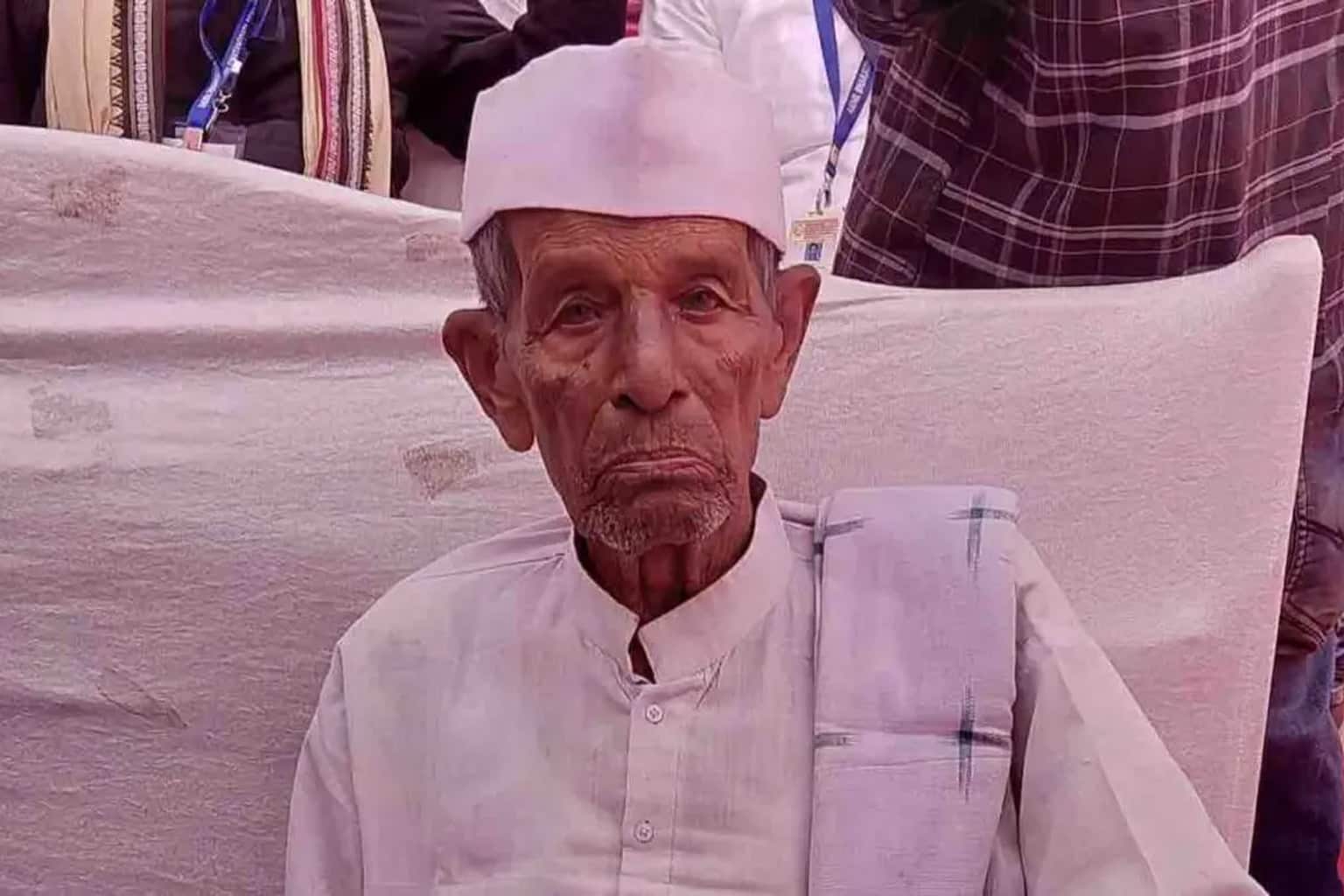
Bimbadhar Muduli was born when India was still under British rule.
He lived long enough to witness the freedom struggle, Independence, the establishment of the Republic and more than seven decades of national transformation.
On 24 July 2026, Odisha lost that living connection with history.
The 102-year-old veteran freedom fighter passed away while undergoing treatment at SCB Medical College and Hospital in Cuttack, according to his family.
His death is not merely the passing of a centenarian. It marks the loss of one of the remaining members of a generation that knew India before freedom became a reality.

Who was Bimbadhar Muduli?
Bimbadhar Muduli was a veteran freedom fighter associated with Odisha and was reported to be from Kendrapara district.
At the time of his death, he was 102 years old and had remained connected with the state’s freedom-fighter community. Reports also identified him as president of the Odisha State Freedom Fighters’ Association.
That leadership role carried considerable symbolic importance.
At an age when most people withdraw from public responsibility, Muduli continued to represent a generation whose sacrifices helped shape independent India.
However, currently available public reports provide only limited information about his specific participation in the freedom movement. They do not clearly establish the movement he joined, the year of his involvement or whether he faced arrest or imprisonment.
Those details should not be guessed or reconstructed without documentary evidence.

A life that began before Independence
To understand the significance of Muduli’s life, one must first understand the period into which he was born.
India was still governed by the British. Independence was not yet an annual celebration or a chapter in a school textbook. It was an unfinished struggle involving national leaders, regional organisations, students, workers, villagers and thousands of lesser-known volunteers.
Muduli belonged to that generation.
These men and women experienced colonial rule directly. They lived in a period when supporting the freedom movement could bring social pressure, official scrutiny or personal hardship.
Not every participant became nationally famous. Many remained known primarily in their districts, villages, associations and family records.
Their contribution was nevertheless part of the wider movement that eventually brought India freedom.
Odisha’s freedom struggle was built locally
India’s independence movement was national in purpose but local in participation.
In Odisha, political awareness spread through regional organisations, public meetings, student mobilisation, village-level campaigns and movements against colonial and princely-state systems.
The state’s contribution cannot be understood only through its most famous leaders. District-level activists helped carry political messages into communities where national organisations had limited direct reach.
People arranged meetings, mobilised residents, circulated ideas and preserved public support for independence.
Muduli’s passing therefore draws attention to a wider historical challenge: many regional freedom fighters are remembered with respect, but their detailed personal histories remain poorly documented.

A century of India through one lifetime
A life of 102 years covered an extraordinary period of Indian history.
Muduli lived during:
- British colonial rule;
- the independence movement;
- freedom in 1947;
- the adoption of the Constitution;
- the establishment of the Republic;
- the building of democratic institutions;
- decades of social and economic change;
- the emergence of modern digital India.
This does not mean he personally participated in every major event. It means his lifetime connected several very different eras of India.
When he was young, independence remained an aspiration.
By the final years of his life, India had become one of the world’s largest democracies, with generations born long after British rule had ended.
That historical span gives his death a deeper meaning. India has not only lost an elderly citizen; it has lost one more human witness to its transformation from a colony into a republic.

Why his association leadership mattered?
Muduli’s reported position as president of the Odisha State Freedom Fighters’ Association deserves more than a passing mention.
Freedom-fighter associations can serve several purposes:
- representing elderly members;
- raising pension and welfare concerns;
- participating in national commemorations;
- preserving names and records;
- supporting the dignity of surviving freedom fighters;
- connecting younger citizens with the independence generation.
For an individual aged 102, such a position was also symbolic.
It showed that Muduli remained part of the community responsible for protecting the memory of Odisha’s contribution to India’s freedom.
His role represented continuity between those who experienced the independence movement and generations who know it mainly through books, photographs and commemorative events.
His final days in Cuttack
Muduli was undergoing treatment at SCB Medical College and Hospital in Cuttack when he passed away, according to the family statement reported by PTI.
The hospital is one of Odisha’s major government medical institutions.
Public reports have not provided a detailed medical account, and there is no need to speculate about his condition. A respectful report should simply state that he died while receiving treatment at the age of 102.

Why the death of a freedom fighter matters
For younger Indians, the freedom movement is usually encountered through:
- textbooks;
- documentaries;
- memorials;
- government ceremonies;
- old photographs;
- stories narrated by grandparents.
For freedom fighters, however, colonial rule was not distant history. It was part of their lived experience.
They could remember local organisers, public gatherings, political tension and individuals whose names may never have entered national records.
Every time one of these witnesses passes away, some of that first-hand memory becomes more difficult to recover.
This is particularly serious in the case of regional activists whose experiences may survive only through family documents or association records.
Their deaths therefore raise an important question:
Have we documented their lives properly, or are we remembering them only after they are gone?

What remains incomplete about his public record?
The available news reports establish Muduli’s age, death, hospital treatment, Kendrapara connection and leadership association.
But they do not provide a detailed account of his independence-era activities.
A complete historical profile would need answers to questions such as:
- Which movement did he join?
- At what age did he become involved?
- Was he detained or imprisoned?
- Which local leaders worked alongside him?
- Are his recognition documents preserved?
- Did he give any recorded interviews?
- Do family members possess letters, photographs or certificates?
- Does the state association maintain a personal file about him?
Without such material, a major part of his story remains beyond public view.
Acknowledging these gaps does not diminish his contribution. It protects the article from converting respect into unsupported claims.
What should now be preserved?
Muduli’s passing should lead to an organised effort to preserve his life story.
The following materials would be particularly valuable:
- an officially verified biography;
- freedom-fighter recognition documents;
- pension or government records;
- family photographs;
- letters and certificates;
- newspaper clippings;
- public speeches;
- association records;
- interviews with relatives;
- recollections from other freedom-fighter families.
The Kendrapara district administration, Odisha State Archives, freedom-fighter organisations, historians and his family could collectively help build an authenticated record.
Even a carefully recorded family interview may reveal names, events and local experiences absent from existing publications.

A responsibility beyond tribute
Political condolences and ceremonial tributes are meaningful, but remembrance should not stop there.
The most lasting tribute would be to ensure that Bimbadhar Muduli’s story is accurately recorded and made available to future generations.
Regional freedom fighters deserve more than a name in an obituary.
They deserve:
- verified biographies;
- accessible archives;
- educational recognition;
- preserved oral histories;
- inclusion in local museums and district records.
That is how respect becomes historical preservation.
Conclusion
Bimbadhar Muduli belonged to a generation that did not inherit freedom as an established reality.
It lived through the period in which freedom had to be imagined, demanded and achieved.
His death at 102 closes a remarkable life spanning colonial India, Independence and the rise of the modern Republic.
But it also leaves an unfinished responsibility.
The facts of his contribution, the memories held by his family and the records maintained by freedom-fighter organisations should now be collected and preserved before they are lost.
India has remembered Bimbadhar Muduli as a veteran freedom fighter.
The next step is to ensure that future generations can understand not only his title, but his complete story.
Sources:-
- ThePrint / PTI
https://theprint.in/india/veteran-freedom-fighter-bimbadhar-muduli-dies-at-102/2995457/
This report confirms that he died at the age of 102 while undergoing treatment at SCB Medical College and Hospital in Cuttack. It also mentions his Kendrapara connection and recent election as president of the state freedom-fighters’ association. - Orissa Post / PTI
https://www.orissapost.com/veteran-freedom-fighter-bimbadhar-muduli-dies-at-102/
This report carries the same core PTI information regarding his age, death and hospital treatment. - Sambad English
https://sambadenglish.com/latest-news/centenarian-freedom-fighter-bimbadhar-muduli-passes-away-at-102-12192844
This source identifies him as a veteran freedom fighter and president of the State Freedom Fighters’ Association. - The Tribune / PTI
https://www.tribuneindia.com/news/india/veteran-freedom-fighter-bimbadhar-muduli-dies-at-102/
This report confirms his death during treatment at SCB Medical College and Hospital and provides the PTI account of the news. - Prameya News
https://www.prameyanews.com/veteran-freedom-fighter-bimbadhar-muduli-passes-away-at-102
This report mentions his Kendrapara roots and describes him as president of the State Freedom Fighters’ Association. - Odisha Bytes
https://odishabytes.com/centenarian-freedom-fighter-bimbadhar-muduli-passes-away-at-odishas-scb/
This regional source confirms his age, association role and death at SCB Medical College and Hospital. - Hindi report — ThePrint / PTI
https://hindi.theprint.in/india/freedom-fighter-bimbadhar-muduli-passes-away/1004312/
This Hindi version confirms that he was from Kendrapara district, suffered from age-related ailments and had recently been elected president of the Odisha State Freedom Fighters’ Association.


Leave a Reply