

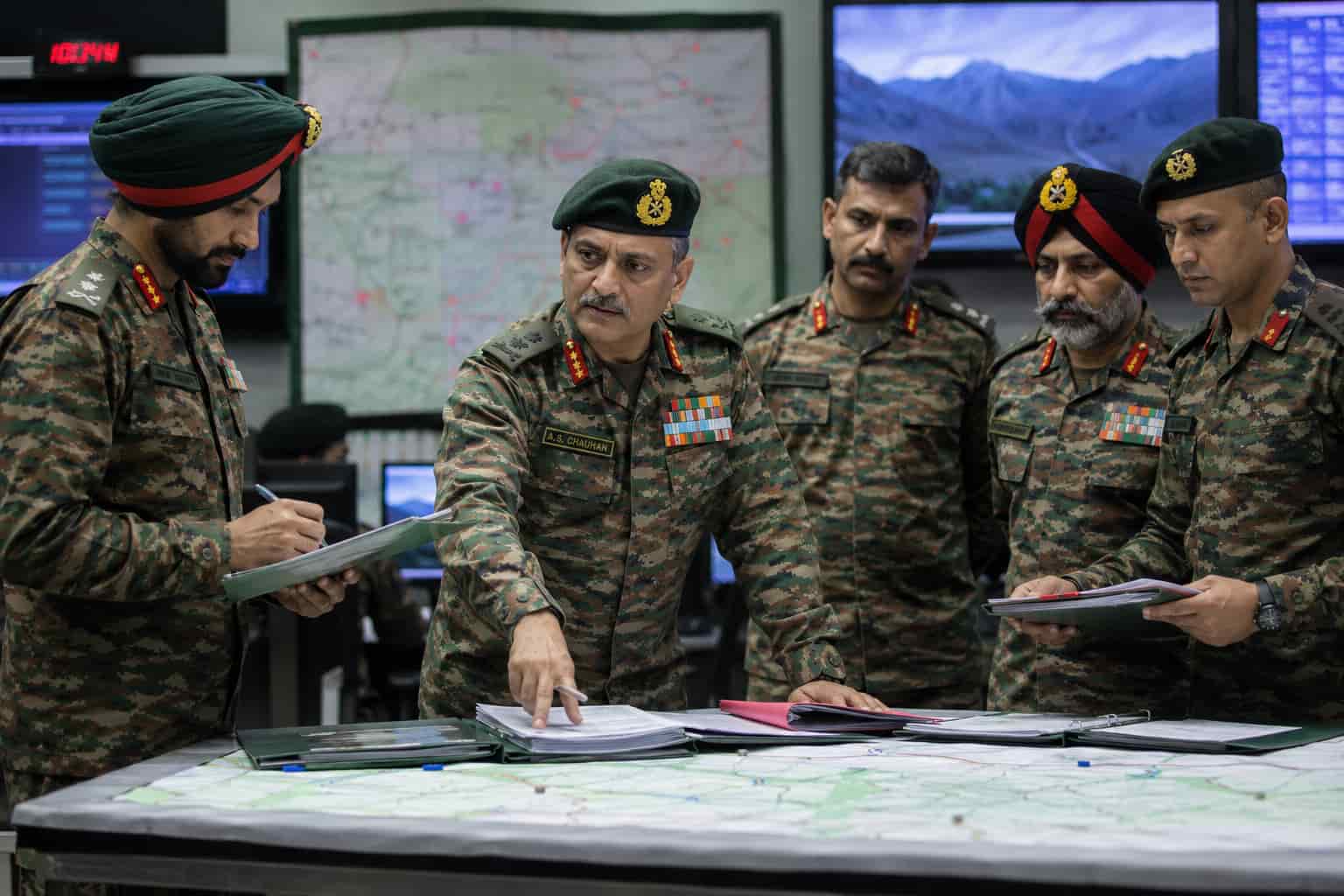
For any soldier posted in a field area, readiness is not just about courage. It is also about whether the right equipment, resources, repairs, medical support and operational requirements reach on time. Many times, the real challenge is not only what the Army needs, but how quickly that need can move through the approval system.
This is why the latest decision of the Ministry of Defence is important.

Raksha Mantri Shri Rajnath Singh has released the revised Delegation of Financial Powers for the Defence Services 2026. In simple words, the financial powers of field commanders have been increased so that they can take faster decisions for operational needs, procurement, works projects, medical requirements and other service-related requirements.
For the common reader, this may sound like a technical government order. But for the Armed Forces, it is a practical step. It can directly affect how quickly urgent requirements are processed, how fast contracts are concluded and how efficiently projects are executed.
What has changed in financial powers?
The Ministry of Defence has approved a major enhancement in financial powers for field commanders. According to the official release, the enhancement has been made up to 100%, and in some cases even more than double.
This means commanders at different levels will now have higher authority to approve spending within their delegated limits. The purpose is to reduce delay, improve operational efficiency and ensure that resources become available when the Defence Forces need them.
The revised financial powers are not limited only to weapons or equipment. The official release clearly mentions that the revised Delegation of Financial Powers for the Defence Services includes medical and works projects as well. This makes the order wider in scope because defence readiness is not only about frontline combat equipment. It also includes infrastructure, maintenance, medical support, operational sustenance and timely execution of projects.
Why this matters for Army readiness?
In military life, delay can become a serious problem. A unit may need urgent repairs, replacement equipment, communication support, infrastructure work, medical facilities or service-level procurement. If every requirement has to move through a long approval chain, the response becomes slower.
Higher financial powers can help field commanders act faster within authorised rules. This is especially important for formations deployed in sensitive areas, difficult terrain, forward locations and operationally active zones.
For Army personnel and veterans, the real meaning is simple: decisions linked to ground requirements may become faster and more practical.
A commander who understands the local operational situation can often judge the urgency better than someone sitting far away from the field. When such commanders get higher financial authority, it can improve local-level decision-making and reduce unnecessary waiting.
More than ₹1.25 lakh crore procurement through revenue route
The official release says that the revised financial delegation will support procurement of more than ₹1.25 lakh crore through the revenue route, based on current year budgetary allocations.
This is an important figure because revenue procurement includes many recurring and operationally necessary items. These are not always big-ticket capital acquisitions like aircraft, tanks or ships. Many times, revenue-route procurement is connected with day-to-day military functioning, maintenance, spares, services, repairs and operational support.
For a large force like the Indian Armed Forces, timely revenue procurement is extremely important. Even the best equipment needs maintenance, support systems, spares and repair backing. A delay in smaller but necessary items can affect larger operational readiness.
That is why this revised delegation should be seen as a readiness reform, not just an accounting change.
Impact on contracts and project execution
The Ministry of Defence has clearly stated that the increase in financial powers is expected to lead to faster conclusion of contracts and faster execution of projects.
This is one of the most important lines for the public to understand.
In defence administration, a requirement becomes useful only when it is converted into action. A proposal, file or procurement plan does not help a soldier until the actual item, service or facility reaches the ground. By increasing delegated financial authority, the government is trying to reduce the time taken between requirement and delivery.
This can help in works projects, operational purchases, medical support and service requirements where speed matters.

Boost for indigenisation and Aatmanirbhar Bharat
Another major part of this decision is linked to indigenisation and Research & Development.
The official release says that financial powers for indigenisation and R&D within the military ecosystem have been doubled. The aim is to boost Aatmanirbharta in defence and reduce dependency on foreign original equipment manufacturers.
This has a direct connection with India’s long-term defence strategy. The Armed Forces need faster access to modern systems, but India also wants to reduce over-dependence on foreign suppliers. When financial powers for indigenous development and R&D are increased, commanders and services may have better ability to support Indian solutions, local innovation and faster adaptation.
For the Army, this is important because battlefield requirements are changing quickly. Drones, counter-drone systems, surveillance tools, communication systems, electronic warfare support, mobility equipment and soldier-level technologies are now becoming essential. Many of these solutions may need faster testing, field feedback and procurement support.
If the financial system becomes more flexible, Indian defence innovation can move closer to real field requirements.
Joint service procurement gets a push
The revised powers also include new provisions for Joint-Service procurement by the Lead Service. This means that where Army, Navy and Air Force have common or similar requirements, one service may take the lead in procurement with enhanced powers.
This is a major point because modern warfare is becoming more joint in nature. Future operations will not depend on one service alone. Land, air, sea, cyber, space, drones, intelligence and communication systems are now increasingly connected.
Joint procurement can reduce duplication, improve coordination and help the three services move together on common requirements. It can also support better standardisation and faster decision-making in areas where the services need similar capabilities.
For a country preparing for future warfare, jointness is not optional. It is necessary.
Why the revision was needed now?
The official release says that financial powers were last notified in 2021. The latest revision was needed because force levels have expanded and expenditure on operations and sustenance has increased.
This is a practical reason. The cost of equipment, maintenance, services, technology and operational support has changed over time. A financial limit that was sufficient earlier may not remain enough after five years.
If commanders are expected to handle modern requirements with old approval limits, delays naturally increase. The revised delegation tries to match financial authority with present-day operational needs.
The government has also linked this change with the revised Defence Procurement Manual notified in October 2025. Together, these steps are expected to support quicker defence procurement and timely availability of resources.
What this means for soldiers and veterans?
For serving soldiers, the importance lies in faster support to the field. A soldier may not read financial delegation documents, but he feels the result when equipment, maintenance, infrastructure or support systems arrive on time.
For veterans, this update is important because it shows how defence administration is changing to match operational realities. Many ex-servicemen understand from experience that timely resources can make a major difference in unit efficiency.
For defence families and citizens, this decision shows that readiness is not built only through big announcements. It is also built through administrative reforms that allow commanders to act faster.
What should not be misunderstood?
This decision does not mean that every procurement will become instant. It also does not mean that all defence requirements will automatically be solved. Financial powers still operate within rules, procedures, budget limits and audit systems.
The correct understanding is this: commanders will now have higher delegated authority, which can reduce delay and improve decision-making where the requirement falls within their powers.
So the real impact will depend on how efficiently the new powers are used, how clearly procedures are followed and how fast the procurement ecosystem responds.
Why this is a strong Army story?
This is a strong Army story because it connects directly with operational efficiency. In field conditions, speed matters. In forward areas, readiness matters. In modern warfare, quick adaptation matters.
The Indian Army operates in deserts, mountains, high-altitude zones, counter-insurgency areas and sensitive border regions. Every location has different requirements. A centralised system cannot always understand the urgency of every local situation in real time.
By increasing financial powers, the government is giving field commanders more room to respond to ground realities. This can help in faster procurement, better maintenance, quicker project execution and stronger operational sustenance.
Final takeaway
The revised Delegation of Financial Powers for Defence Services 2026 is not just a financial order. It is a readiness-focused reform.
It gives higher financial authority to field commanders, supports procurement worth more than ₹1.25 lakh crore through the revenue route, doubles powers for indigenisation and R&D, and promotes Joint-Service procurement.
For the Armed Forces, this can mean faster contracts, quicker project execution and timely availability of resources. For soldiers on the ground, the real value of any reform is simple: the right support should reach at the right time.
That is why this decision matters.
It strengthens the link between command responsibility and decision-making power. And in a modern military, that link is essential for operational readiness.
Sources:-
Official PIB source, main source
https://www.pib.gov.in/PressReleasePage.aspx?PRID=2268807
Economic Times, supporting source
https://m.economictimes.com/news/defence/defence-ministry-doubles-financial-powers-of-field-commanders/articleshow/131515771.cms
Times of India, supporting source
https://timesofindia.indiatimes.com/defence/news/rajnath-singh-enhances-financial-powers-of-field-commanders-procurements-worth-rs-1-25-lakh-crore-to-get-faster-clearance/articleshow/131505335.cms
The Week, supporting explainer source
https://www.theweek.in/news/defence/2026/06/04/indian-military-gets-more-spending-power-to-buy-equipment-faster-understanding-revised-delegation-of-financial-powers.html



Leave a Reply