

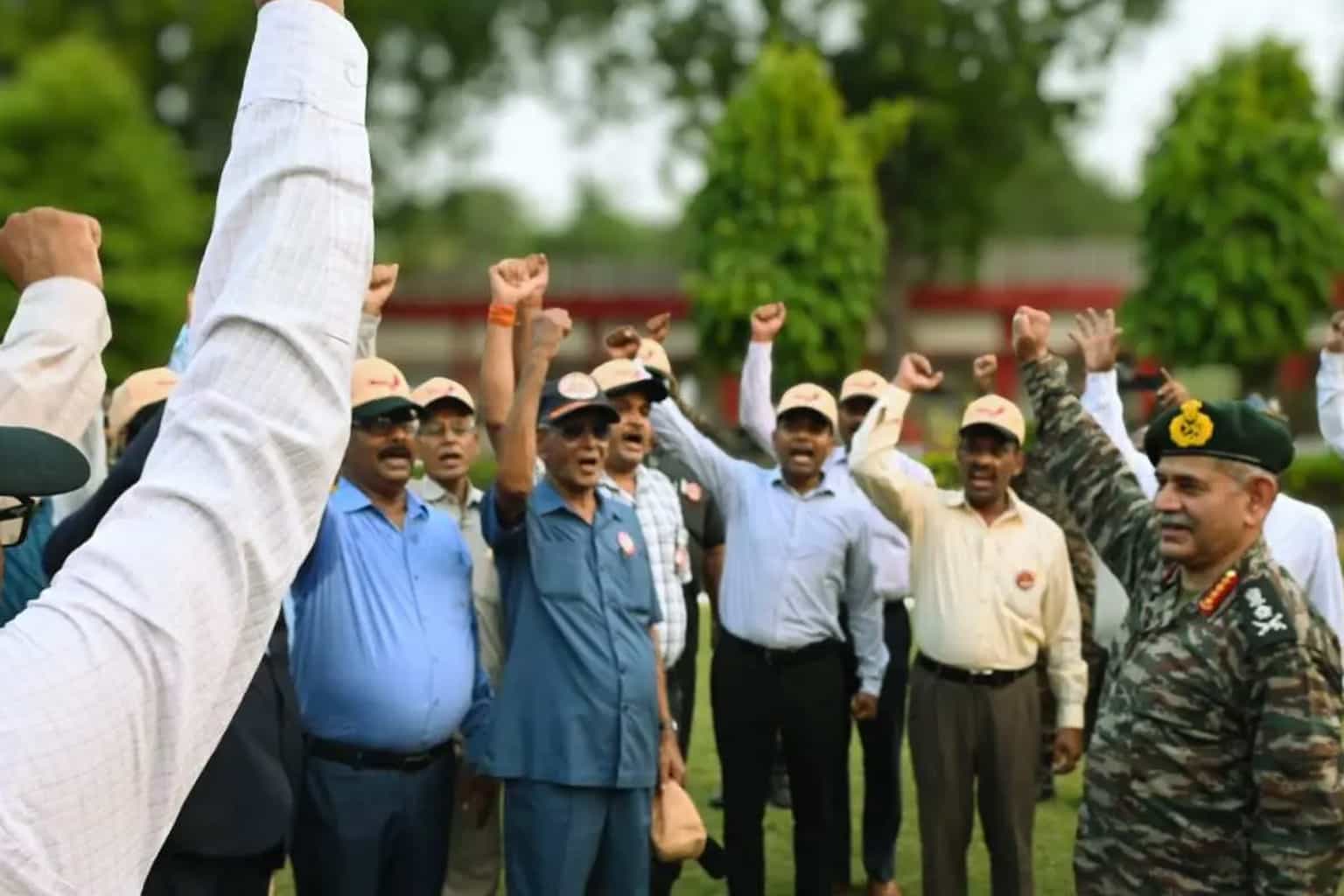
For many ex-servicemen, retirement is not the end of service-related responsibilities. It is the beginning of a new phase involving pension paperwork, family documentation, children’s education, financial assistance, employment and welfare claims.
In a detailed interaction with Wing Commander (Retd) Ranjan Mukherjee, a former Zila Sainik Board official in Nadia district, West Bengal, Sainik Welfare News discussed how District Sainik Welfare Offices can help veterans, widows and Veer Naris navigate these issues.
The central message from the conversation was simple: many welfare benefits exist, but lack of awareness and incomplete documentation often prevent families from receiving them on time.
What does a Zila Sainik Board actually do?
Wing Commander Mukherjee explained that a Zila Sainik Board acts as an important link between ex-servicemen, their families, the State Government and the Armed Forces welfare system.
According to him, its practical responsibilities can include:
- checking retirement and pension documents;
- guiding veterans about welfare benefits;
- assisting with employment-related coordination;
- helping widows and families with documentation;
- liaising with Army, Navy and Air Force authorities;
- facilitating access to legal aid where applicable; and
- helping families understand which benefits they may be entitled to.
He stressed that the need for assistance often becomes even greater after the death of an ex-serviceman because family members may know very little about military documentation or welfare procedures.

Financial assistance for non-pensioner ex-servicemen
One of the major welfare measures discussed was the Penury Grant.
Wing Commander Mukherjee stated that financially weak non-pensioner ex-servicemen may receive this assistance after attaining the prescribed age, and he referred to the current amount as ₹8,000 per month from age 65, subject to eligibility. He also said that eligible widows may continue to receive assistance after the veteran’s death.
He also referred to other assistance that may be available for medical equipment or treatment-related needs in eligible cases.
Applicants should always check the latest Kendriya Sainik Board and Department of Ex-Servicemen Welfare rules, as grant amounts and eligibility conditions can change.
PM Scholarship Scheme and Education Grant are different
The podcast also highlighted an important distinction between the Prime Minister’s Scholarship Scheme (PMSS) and the Education Grant.
According to Wing Commander Mukherjee, PMSS is primarily meant for eligible children pursuing recognised professional courses such as engineering, medicine, management, B.Ed and similar programmes.
He stated that the scheme generally requires at least 60% marks in Class 12 and referred to around 5,500 fresh scholarships annually across the Armed Forces and Coast Guard. He also cited annual scholarship amounts of ₹36,000 for girls and ₹30,000 for boys.
By contrast, he described the Education Grant as support for eligible children from Class 1 up to graduation, subject to rank and family-related eligibility conditions. He said it can apply to the first two children in eligible families and is not based on competitive marks in the same way as PMSS.

How Zila Sainik Boards help widows and Veer Naris?
A major part of the conversation focused on widows and Veer Naris.
Wing Commander Mukherjee recalled a case involving the family of a soldier who died during an operational period. He explained that coordination began from receiving the mortal remains and continued through district administration liaison, documentation and guidance regarding benefits.
He also referred to the Veerangana Sewa Kendra system as a mechanism through which eligible families can receive coordinated support and information about applicable benefits. Pasted text
His broader point was that a bereaved family should not be expected to independently understand every form, pension category or service procedure immediately after a death.

Family pension cases require careful understanding
The discussion also touched upon different forms of family pension, including:
- Ordinary Family Pension;
- Special Family Pension; and
- Liberalised Family Pension.
Wing Commander Mukherjee explained that the nature and circumstances of death can affect the category of pension applicable to a family.
Because pension entitlement depends on detailed service rules, cause of death, attributable/aggravated conditions and other factors, families should not rely only on informal explanations. The applicable PPO, service records and current Government rules should be checked before drawing conclusions about entitlement. Pasted text
What documents should an ex-serviceman keep ready?
One of the most practical parts of the conversation was the documentation checklist.
For an ex-serviceman approaching a Zila Sainik Board, Wing Commander Mukherjee highlighted documents such as:

Small document mistakes can create major pension problems
Perhaps the strongest practical warning in the podcast concerned document mismatch.
Wing Commander Mukherjee said that differences in:
- name spelling;
- spouse’s name;
- date of birth;
- Aadhaar records;
- Discharge Book;
- PPO; or
- bank records
can create serious delays after the veteran’s death.
He advised serving personnel to correct discrepancies while still in service wherever possible, because fixing them later can become much harder for the family.
This is particularly important because the person who understands the service documents best may no longer be available when the family eventually needs to claim pension or welfare benefits.
Why every veteran should brief the family before it is too late?
Another strong message from the discussion was that veterans should not keep pension and welfare information only to themselves.
Wing Commander Mukherjee recommended that veterans explain to their spouse or family:
- where the PPO is kept;
- which bank account receives pension;
- where the Discharge Book is stored;
- which insurance or bank benefits are available;
- who should be contacted after death; and
- how to reach the local Zila Sainik Board.
He also suggested maintaining written records so that the family is not left searching for basic information during an emergency.
The biggest problem may be awareness, not absence of schemes
The discussion repeatedly returned to one issue: many Government welfare letters and policy changes do not effectively reach older veterans, widows or families who are not active on social media.
Wing Commander Mukherjee recalled a disturbing case of a widow who had reportedly gone seven years without receiving pension because of documentation and awareness problems. An ex-servicemen association eventually brought her to the welfare authorities for assistance.
The case illustrates why simply issuing a welfare order is not enough.
Information must actually reach the beneficiary.
Could WhatsApp channels solve the last-mile information gap?
One of the most practical proposals discussed in the interaction was the use of official district-level WhatsApp channels or controlled groups.
The idea is simple:
New welfare policy issued
↓
Zila Sainik Board receives it
↓
Official PDF/order uploaded to district WhatsApp channel
↓
Veterans and families receive the information directly
Wing Commander Mukherjee said that a similar controlled information system had been used in his district, where only authorised administrators posted policy updates.
The discussion also suggested stronger use of:
- ECHS notice boards;
- CSD/Canteen notice boards;
- ex-servicemen associations;
- quarterly outreach programmes; and
- retirement-time welfare checklists.

What every ex-serviceman should do now?
The practical lessons from the discussion can be reduced to five actions:
- Register and remain connected with the Kendriya/Zila Sainik welfare system.
- Keep the Discharge Book, PPO and bank records safe and updated.
- Correct name, date-of-birth and family-detail discrepancies early.
- Explain pension and welfare documents to the spouse/family.
- Stay connected with Zila Sainik Board, ECHS and recognised ex-servicemen associations for new welfare updates.
The larger lesson is that welfare is not only about announcing a scheme. It is also about ensuring that the veteran or family actually knows about it, understands it and can complete the documentation required to receive it.
For ex-servicemen and their families, the Zila Sainik Board can be one of the most important first points of contact after retirement, bereavement or a welfare-related problem.
Important: Welfare grant amounts, pension conditions, scholarship eligibility and other monetary benefits mentioned during the interaction should be checked against the latest official instructions of the Kendriya Sainik Board, Department of Ex-Servicemen Welfare and respective Service Headquarters before applying.


Leave a Reply