

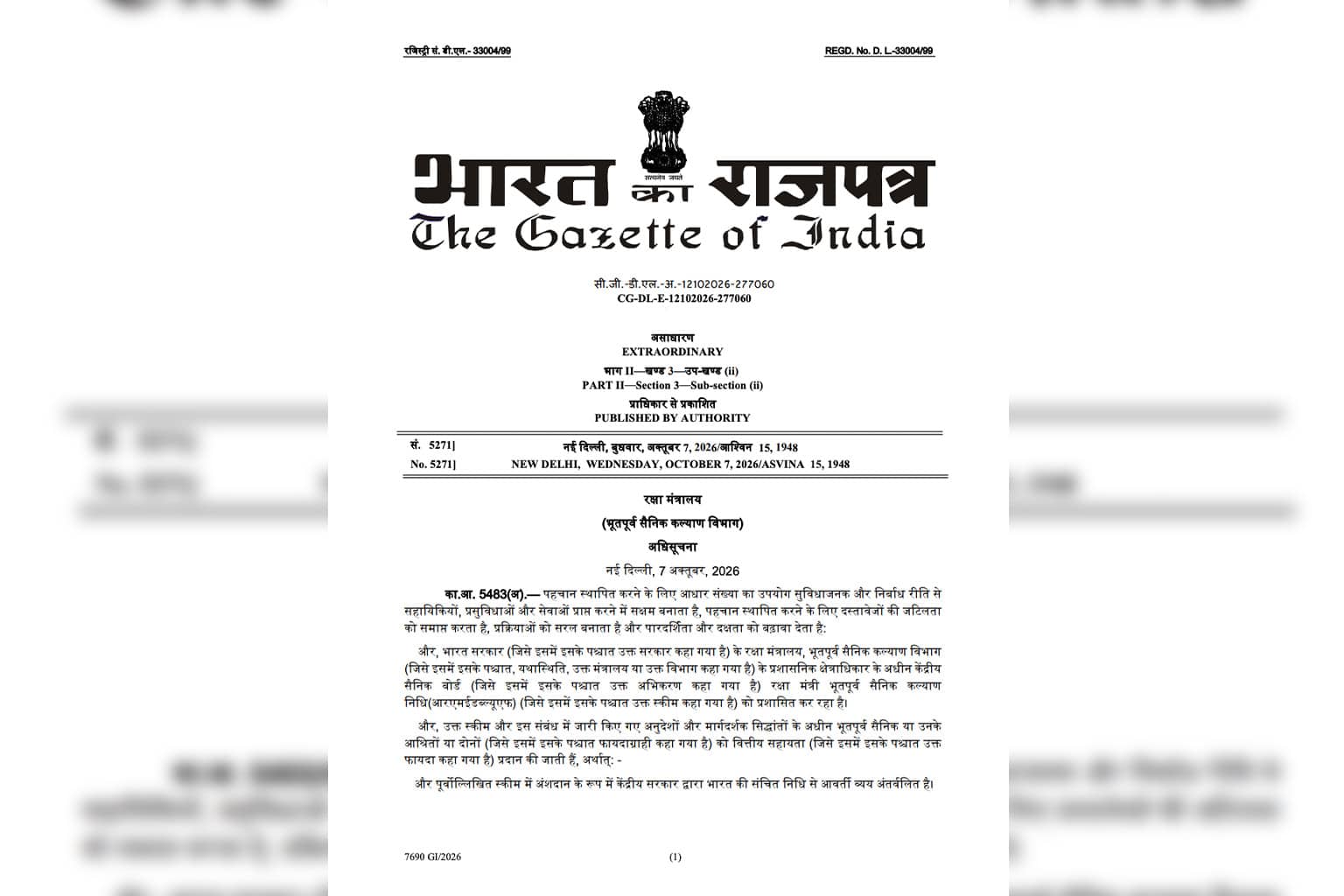
Click here to download
The Ministry of Defence has introduced a new Aadhaar-based identity verification requirement for beneficiaries of the Raksha Mantri Ex-Servicemen Welfare Fund (RMEWF). Under Notification S.O. 5483(E), ex-servicemen and their eligible dependents seeking financial assistance under RMEWF will now have to undergo Aadhaar authentication or furnish proof of possession of an Aadhaar number.
However, the notification contains an equally important protection: a genuine beneficiary should not automatically lose the welfare benefit merely because Aadhaar has not yet been issued or authentication fails. Separate alternative verification and exception-handling mechanisms have been prescribed.

The notification has been issued under Section 7 of the Aadhaar (Targeted Delivery of Financial and Other Subsidies, Benefits and Services) Act, 2016.
What exactly has changed for RMEWF beneficiaries?
RMEWF is administered by the Kendriya Sainik Board under the Department of Ex-Servicemen Welfare and provides financial assistance to ex-servicemen, their dependents or both.
The new order deals with identity verification for receiving these benefits.
A person seeking financial assistance under RMEWF will now be required to:
undergo Aadhaar authentication; or
furnish proof of possession of an Aadhaar number.
If Aadhaar has not yet been assigned, the beneficiary will be required to apply for Aadhaar enrolment.
This notification does not announce a new RMEWF grant, increase the amount of an existing grant or reduce an existing benefit. Its primary purpose is to introduce Aadhaar-based beneficiary identification.

No Aadhaar yet? Benefit is not automatically stopped
This is one of the most important parts of the notification.
If an eligible beneficiary has not yet received an Aadhaar number, he or she must first apply for Aadhaar enrolment. Until Aadhaar is assigned, identity can be established using the Aadhaar Enrolment ID (EID) along with one of the prescribed supporting documents.
For beneficiaries aged 18 years or above, the notification lists documents including:
Elector’s Photo Identity Card;
ration card;
prescribed caste or domicile certificate;
government/PSU medical or insurance identity card;
Indian passport;
recognised Class 10, 12 or equivalent certificate/marks statement;
government or PSU identity card issued to serving or retired public servants;
disability certificate or UDID card;
driving licence issued in India;
prescribed documents relating to legal guardianship; and
any other document subsequently specified by the Kendriya Sainik Board.
The EID remains important because the designated authority is required to check whether the Aadhaar enrolment request is valid and has not been rejected.
What if fingerprint or Aadhaar authentication fails?
An Aadhaar authentication failure does not automatically mean rejection of the RMEWF benefit.
The Gazette provides a step-by-step fallback mechanism.
If one biometric mode—such as fingerprint, iris or facial authentication—fails, another biometric mode or OTP-based authentication should be offered wherever feasible and admissible.
If biometric and OTP authentication are not possible, Aadhaar may be verified through approved offline mechanisms, including:
Aadhaar Secure QR Code, or
Aadhaar Paperless Offline e-KYC.
The genuineness of the Aadhaar information is to be established using UIDAI’s prescribed digital verification process.

Special safeguard for dependent children
The notification gives specific protection to children receiving benefits under RMEWF.
It states that the benefit shall not be denied to a child merely because Aadhaar authentication fails, proof of Aadhaar cannot be furnished, or Aadhaar has not yet been assigned after enrolment.
In such cases, identity and the child’s relationship with the parent or legal guardian can be established through the prescribed documents.
Records of benefits released through this exception mechanism must also be maintained and periodically reviewed and audited by the Kendriya Sainik Board.
For a child who has not yet been assigned Aadhaar, prescribed supporting documents include the Aadhaar enrolment acknowledgement/EID along with documents such as a birth certificate, Indian passport, recognised school certificates and prescribed documents establishing relationship with the parent or legal guardian.
What protection is available for adult ex-servicemen and dependents?
The order also specifically addresses beneficiaries aged 18 years or above.
The Kendriya Sainik Board has been directed to follow the exception-handling mechanism prescribed by the Direct Benefit Transfer Mission through Office Memorandum No. D-26011/04/2017-DBT dated 19 December 2017.
The stated purpose is to ensure that bona fide beneficiaries are not deprived of benefits due to Aadhaar-related difficulties.
This provision is significant for elderly veterans or other beneficiaries who may face biometric authentication difficulties.

Kendriya Sainik Board also has responsibilities under the order
The new rules do not place the entire responsibility on beneficiaries.
The notification directs the Kendriya Sainik Board, Department of Ex-Servicemen Welfare to facilitate Aadhaar enrolment or updating of Aadhaar details for beneficiaries who require it.
This may include coordination with Aadhaar registrars, arranging enrolment facilities at convenient locations or taking other appropriate steps under the applicable Aadhaar regulations.
The Ministry is also required to give adequate publicity so that beneficiaries are informed about the Aadhaar requirement.
Is Aadhaar now compulsory for RMEWF benefits?
For normal processing, Aadhaar-based identity verification has effectively become part of the RMEWF benefit-delivery system.
But describing the order simply as “No Aadhaar, No Benefit” would be incorrect.
The Gazette itself creates mechanisms for:
beneficiaries whose Aadhaar has not yet been issued;
biometric authentication failure;
OTP or biometric authentication difficulties;
dependent children without successful Aadhaar authentication; and
genuine adult beneficiaries facing Aadhaar-related problems.
Therefore, the correct interpretation is:
Aadhaar authentication or proof of Aadhaar is now required for RMEWF benefits, but the Government has also provided alternative verification and exception mechanisms so genuine beneficiaries are not automatically excluded.
Why is 12 October 2026 important?
Although Notification S.O. 5483(E) is dated 7 October 2026, paragraph 6 states that it will take effect from the date of its publication in the Official Gazette.
The notification was published in the Gazette on 12 October 2026 under Gazette ID CG-DL-E-12102026-277060.
Therefore, 12 October 2026 is the effective date of the notification.

What ex-servicemen and dependents should know?
Existing and prospective RMEWF beneficiaries should ensure that their Aadhaar details are correct and updated wherever possible.
If Aadhaar has not yet been issued, the beneficiary should complete Aadhaar enrolment and preserve the Enrolment ID acknowledgement along with the prescribed identity documents.
Beneficiaries should also remember that a biometric failure by itself should not be treated as the end of the claim process. The Gazette specifically provides alternative authentication and exception-handling mechanisms.
Most importantly, this order changes the verification process—not the basic entitlement automatically, and not the amount of RMEWF financial assistance.
Sources
Government of India — Ministry of Defence, Department of Ex-Servicemen Welfare
Notification S.O. 5483(E), dated 7 October 2026
Gazette ID: CG-DL-E-12102026-277060
Official Gazette PDF
Government of India — Official Gazette record
Published: 12 October 2026.



Leave a Reply