

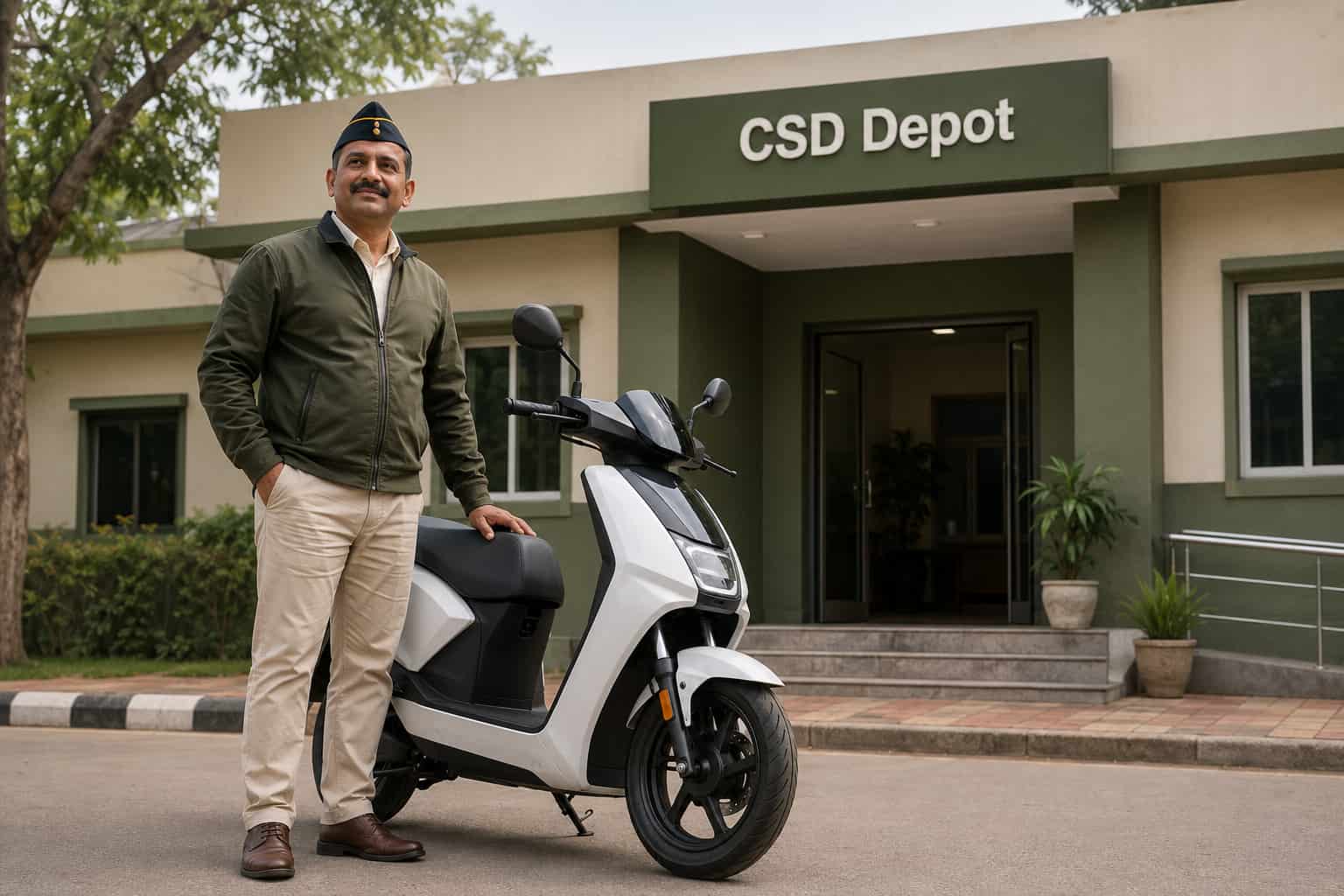
A possible new benefit for serving defence personnel, ex-servicemen and military families has attracted considerable attention: the extension of Central and State Government electric-vehicle subsidies to electric two-wheelers purchased through CSD.
The proposal was discussed during the 80th meeting of the Board of Control Canteen Services, held in Ranchi on 14 July 2026 under the chairmanship of Raksha Rajya Mantri Sanjay Seth.

However, beneficiaries must understand the present status correctly:
The subsidy proposal has been discussed, but no publicly available order has confirmed its implementation through CSD.
The official Ministry of Defence release identifies the extension of Central and State subsidies on electric two-wheelers purchased through CSD as a key agenda item. It does not announce a subsidy amount, implementation date, eligible scooter list or revised CSD purchasing procedure.
Therefore, reports claiming that “electric scooters have now become cheaper through CSD” would be premature.
What was discussed at the 80th BOCCS meeting?
The Board of Control Canteen Services meeting reviewed operational and administrative issues affecting the functioning of the Canteen Services Department.
The main agenda included:
- enhancement of budgetary support for CSD;
- modernisation of CSD depots;
- extension of Central and State Government subsidies to electric two-wheelers purchased through CSD;
- induction of products made by cooperative institutions;
- human-resource matters;
- availability of assistive devices for eligible persons with disabilities; and
- improved services for serving personnel, ex-servicemen and their dependants.
Senior representatives from the Ministry of Defence, the Armed Forces and CSD attended the meeting. The stated objective was to improve efficiency and strengthen services for the wider defence community.
Has the CSD electric scooter subsidy been approved?
The official release confirms that the proposal was placed before the meeting and discussed.
It does not use terms such as:
- approved;
- sanctioned;
- notified;
- launched;
- implemented; or
- made operational.
As of 15 July 2026, no publicly available CSD circular or Ministry of Defence implementation order has been located specifying how the subsidy would be provided to CSD beneficiaries.
The following details therefore remain unconfirmed:
| Question | Present position |
|---|---|
| Has a final subsidy been approved? | Not announced |
| What will be the subsidy amount? | Not announced |
| Which electric scooters will qualify? | No CSD-specific list issued |
| When will the benefit begin? | No date announced |
| Will every state provide the same benefit? | Not clarified |
| Will previous purchasers receive reimbursement? | Not announced |
| Has the AFD portal process changed? | No revised procedure located |
| Was the proposal discussed officially? | Yes |
The distinction between a policy discussion and an operational benefit is crucial. A proposal may require financial approval, coordination with Central and State authorities, software integration, dealer instructions and a formal CSD circular before it reaches beneficiaries.

What exactly is being proposed for CSD buyers?
The proposal is to explore whether subsidies already available under Central and State electric-vehicle policies can also be applied when an eligible beneficiary buys an electric two-wheeler through CSD.
This is relevant because a CSD purchase follows a separate administrative route.
A beneficiary normally selects a listed vehicle through the CSD AFD system, obtains documents from an authorised dealer, submits the demand to the concerned depot, completes verification and makes payment through the prescribed channel.
An EV incentive, on the other hand, may involve:
- confirmation that the vehicle model is eligible;
- verification of the buyer;
- vehicle registration;
- dealer participation;
- generation of an electronic voucher;
- and adjustment of the incentive on the invoice.
A formal procedure would therefore be needed to connect the EV-subsidy mechanism with the CSD AFD purchasing system.
How does PM E-DRIVE relate to this discussion?
The Central Government’s PM E-DRIVE portal states that registered electric two-wheelers have been covered under the extended scheme period until 31 July 2026. It also states that eligible privately or corporately owned registered electric two-wheelers can receive scheme benefits, provided that the vehicle and other conditions satisfy the applicable rules.
The scheme uses an Aadhaar-authenticated electronic voucher system for customers seeking the demand incentive.
However, these general PM E-DRIVE provisions do not by themselves prove that the incentive has been integrated with CSD purchases.
The BOCCS discussion appears to recognise this gap, but the official release does not explain whether:
- PM E-DRIVE will be the Central subsidy used;
- a separate Ministry of Defence mechanism will be created;
- State subsidies will be claimed by the dealer or beneficiary;
- the incentive will appear on the CSD price or dealer invoice;
- or the benefit will continue after the present PM E-DRIVE period.
Therefore, buyers should not add an assumed EV subsidy to their CSD savings while calculating the final price.
Will Central and State subsidies be the same throughout India?
Not necessarily.
State EV policies can differ in:
- subsidy amount;
- eligible vehicle category;
- registration fee;
- road-tax benefit;
- policy duration;
- maximum vehicle price;
- and availability of scheme funds.
CSD prices and tax concessions may also vary according to the state or price zone. The official CSD FAQ acknowledges that tax benefits are not uniform across all states.
A future implementation order would need to determine which state’s policy applies when:
- a beneficiary lives in one state;
- selects a CSD depot in another;
- buys from a dealer in another location; and
- registers the vehicle elsewhere.
Until these questions are resolved, a uniform nationwide CSD electric-scooter subsidy should not be promised.
How are two-wheelers currently purchased through the CSD AFD portal?
The official CSD purchasing procedure requires beneficiaries to follow a defined process.
The major steps are:
- Register or log in on the CSD AFD portal.
- Check whether the desired model and current monthly price are available.
- Obtain a dealer quotation based on the CSD price.
- Obtain a valid availability certificate from the dealer.
- Select the correct vehicle, price zone, dealer, depot and nominated URC.
- Upload the required documents and submit the demand.
- Wait for the concerned CSD depot to verify eligibility.
- Make payment only after receiving the portal notification.
- Download the purchase order, local supply order or authority letter after payment realisation.
- Complete the remaining formalities through the nominated URC and authorised dealer.
The official procedure advises buyers to verify the portal price against the dealer quotation and upload supporting documents such as PAN, payment proof, PPO or last-pay details and the availability certificate, where applicable.
Only models formally listed in the CSD system can be purchased through the AFD route. A model being available in the civilian market or approved under an EV scheme does not automatically make it available through CSD.

Can any electric scooter be purchased through CSD?
No.
Only models listed and available through the CSD AFD portal can be purchased under the CSD system. New models must complete the prescribed product evaluation and introduction process before becoming available.
For a buyer to eventually receive both CSD pricing and an EV subsidy, the electric two-wheeler may have to satisfy several conditions:
- the exact model and variant must be listed through CSD;
- it must qualify under the relevant Central or State EV policy;
- the authorised dealer must participate in both systems;
- the vehicle price must remain within any scheme ceiling;
- registration requirements must be met;
- and the eventual CSD subsidy procedure must be followed.
No official CSD-specific list combining all these conditions has been released.
What should serving personnel and veterans do before purchasing?
A beneficiary considering an electric scooter should first check the purchase on the basis of the current confirmed CSD price, without assuming an additional subsidy.
Before paying, the buyer should:
- confirm that the exact model and variant appear on the official AFD portal;
- check the price zone and current monthly price;
- obtain a written dealer quotation;
- obtain a valid availability certificate;
- ask the dealer whether any existing EV incentive is already included;
- obtain a clear invoice and price breakup;
- verify the applicable registration and insurance charges;
- and make payment only through the procedure communicated on the official portal.
The buyer should also ask the dealer to distinguish between:
- the civilian ex-showroom price;
- the CSD price;
- any manufacturer discount;
- an existing EV incentive;
- insurance;
- registration;
- accessories; and
- additional dealer charges.
This prevents a dealer discount from being incorrectly presented as a new government subsidy.
Should buyers postpone their purchase?
That depends on the urgency of the purchase.
A person who requires a vehicle immediately may evaluate the currently available CSD price and existing confirmed benefits.
A buyer who is purchasing mainly because of the expected additional subsidy should wait for:
- a Ministry of Defence or CSD circular;
- a revised AFD portal notice;
- an eligible-model list;
- a clear subsidy amount;
- and written dealer instructions.
The BOCCS discussion is a positive signal, but it does not guarantee that the benefit will be approved in its present form or introduced immediately.
Can previous buyers claim a refund?
No retrospective reimbursement has been announced.
The PIB release does not mention:
- refund to earlier buyers;
- adjustment against a previous invoice;
- subsidy reimbursement through a CSD depot;
- payment by a State Government;
- or credit against a future purchase.
A beneficiary who has already bought an electric scooter should not submit personal documents or pay a processing fee to anyone claiming that retrospective reimbursement has started.
CSD has also warned beneficiaries about unauthorised intermediaries and fake portals and advises users to deal only through official CSD channels.
What is happening with CSD depot modernisation?
Depot modernisation is further advanced than the electric-subsidy proposal.
During the Ranchi visit, the Raksha Rajya Mantri inspected CSD Depot Ramgarh, which is one of five pilot depots identified for modernisation.
The official release states that efforts are underway to transform the depot into a modern warehousing and logistics facility capable of meeting CSD’s growing operational requirements. The pilot is expected to guide the phased upgradation of other CSD depots across India.
The official announcement does not disclose:
- the names of the other four pilot depots;
- total project expenditure;
- completion deadline;
- technology or equipment being installed;
- vendor details;
- or the nationwide rollout schedule.
These details should not be added without a supporting government document.
How could depot modernisation help beneficiaries?
A more efficient depot network could potentially improve:
- movement of products;
- warehousing capacity;
- inventory management;
- replenishment of Unit Run Canteens;
- demand planning;
- supply-chain visibility;
- and overall service delivery.
These are expected operational benefits rather than outcomes already guaranteed by the official release.
For a veteran or serving family, the real success of modernisation will be measured through:
- better product availability;
- fewer avoidable delays;
- easier access;
- improved complaint resolution;
- and a more reliable purchasing experience.

What is happening with cooperative-sector products?
The review meeting also assessed the induction of products made by cooperative institutions.
The Government stated that products from organisations including:
- Tribal Cooperative Marketing Development Federation of India;
- Khadi and Village Industries Commission;
- National Agricultural Cooperative Marketing Federation of India;
- National Cooperative Organics Limited; and
- other cooperative bodies
are being added to the CSD product portfolio in phases.
This element is not merely at the discussion stage. According to the official release, phased induction is already underway.
The initiative is intended to provide greater market access to artisans, tribal communities, farmers and cooperative organisations while increasing the availability of indigenous products through the CSD network.
What was discussed for defence beneficiaries with disabilities?
The meeting also deliberated on making assistive devices available for eligible persons with disabilities among:
- serving defence personnel;
- ex-servicemen; and
- their dependants.
However, the official release does not provide:
- a list of devices;
- eligibility criteria;
- purchase limits;
- medical certification requirements;
- prices;
- or an implementation date.
This should therefore be described as a welfare proposal under consideration, not an active CSD entitlement.
What is officially confirmed and what remains pending?
Officially confirmed:
- The 80th BOCCS meeting was held in Ranchi on 14 July 2026.
- Extension of EV subsidies to CSD electric two-wheelers was discussed.
- Budgetary support and service improvements were reviewed.
- Ramgarh is one of five pilot depots selected for modernisation.
- Modernisation work at Ramgarh is underway.
- Cooperative-sector products are being inducted in phases.
- Availability of assistive devices was discussed.
Still pending or undisclosed:
- final EV-subsidy approval;
- subsidy amount;
- implementation date;
- eligible electric-scooter models;
- revised AFD purchase process;
- State-wise mechanism;
- retrospective benefit;
- names of the other four pilot depots;
- and detailed modernisation timelines.
Why is this development important for the defence community?
An electric two-wheeler can be useful for military families and veterans because it may offer:
- lower routine running costs;
- easier daily commuting;
- reduced dependence on petrol;
- quieter urban mobility;
- and simpler travel for short distances.
A properly implemented subsidy combined with CSD pricing could make selected electric scooters more affordable.
But the benefit will have practical value only after beneficiaries receive clear answers on:
- eligibility;
- vehicle models;
- subsidy amount;
- invoicing;
- registration;
- and the application process.
Until then, the development should be treated as a promising policy discussion rather than a confirmed financial benefit.
Final conclusion
The discussion at the 80th Board of Control Canteen Services meeting is a significant development for serving personnel, ex-servicemen and defence families.
For the first time in this review, the extension of Central and State EV subsidies to electric two-wheelers purchased through CSD has been formally included among the key agenda items.
However, the Government has not announced that the subsidy has begun.
As of 15 July 2026:
- no CSD-specific subsidy amount has been notified;
- no eligible electric-scooter list has been released under this proposal;
- no implementation date has been announced;
- no revised AFD purchasing procedure has been issued publicly;
- and no retrospective reimbursement has been confirmed.
Beneficiaries should continue using the existing CSD AFD procedure and calculate their purchase according to the benefits formally available on the date of transaction.
Meanwhile, CSD Depot Ramgarh is being modernised as one of five pilot depots, and products from cooperative organisations are being inducted into the CSD system in phases.
The direction of reform is positive.
But for the electric two-wheeler subsidy, the correct position remains:
Discussed officially, but not yet implemented for CSD buyers.
Frequently asked questions
Has the CSD electric scooter subsidy been approved?
No publicly available CSD or Ministry of Defence implementation order has confirmed that the subsidy has started. It was discussed at the 80th BOCCS meeting.
Have electric scooters become cheaper through CSD?
No new price reduction has been officially announced as a result of the BOCCS discussion.
Will Central and State EV subsidies both be available?
Both were mentioned in the meeting agenda, but the method of applying them through CSD has not been announced.
Can an ex-serviceman purchase an electric scooter through CSD?
An eligible beneficiary can purchase a two-wheeler model listed through the CSD AFD system, subject to the applicable entitlement and portal rules. The new subsidy proposal does not change those rules yet.
Can a previously purchased electric scooter receive reimbursement?
No retrospective reimbursement has been announced.
Should buyers follow a new purchase process?
No revised process has been issued publicly. Buyers should continue following the existing CSD AFD purchasing procedure.
Which depot is being modernised?
CSD Depot Ramgarh is one of five pilot depots. The official release does not identify the other four.
Are cooperative products already being added to CSD?
Yes. The Government says products from several cooperative institutions are being inducted into the CSD portfolio in phases.
Sources:-
1. Primary Ministry of Defence announcement
80th Board of Control Canteen Services meeting — PIB release dated 14 July 2026
https://www.pib.gov.in/PressReleasePage.aspx?PRID=2284568
2. Official CSD AFD vehicle-purchase procedure PDF
Revised procedure for purchasing four-wheelers, two-wheelers and white goods through CSD
https://afd.csdindia.gov.in/wp-content/uploads/media/2024/10/REVISED-PROCEDURE.pdf
3. Official CSD frequently asked questions
https://csdindia.gov.in/faq.html
4. PM E-DRIVE extension notification PDF
Ministry of Heavy Industries Gazette notification dated 27 March 2026
5. PM E-DRIVE operational guidelines PDF
6. Official PM E-DRIVE portal
https://pmedrive.heavyindustries.gov.in/
7. Official CSD AFD portal



Leave a Reply