

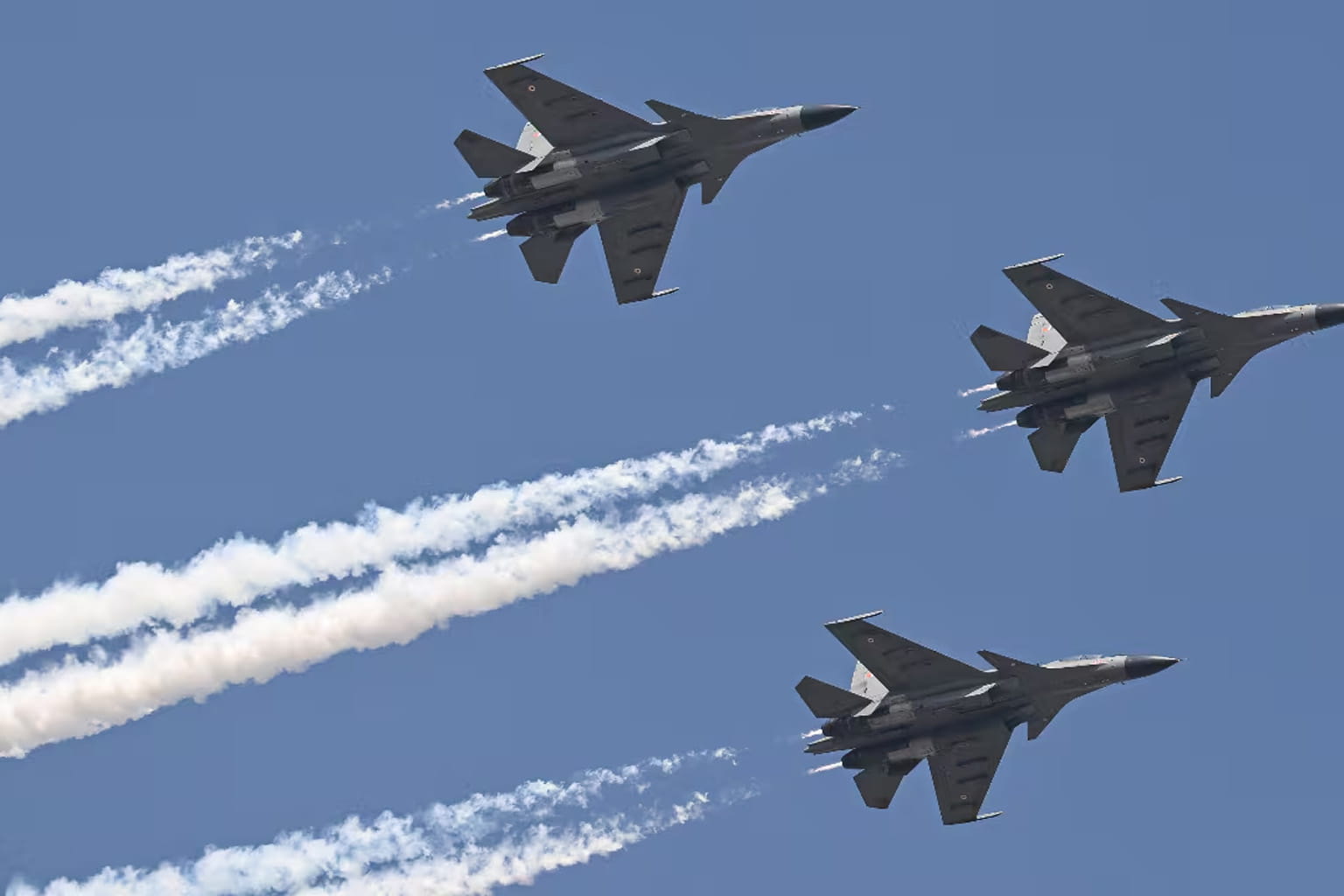
The Indian Air Force has received significant attention after being placed ahead of China in the WDMMA Global Air Powers Ranking 2026.
Some headlines describe the IAF as the world’s third-most powerful air force, while others report that India has secured the sixth position globally. At first glance, these claims appear contradictory.
They are not.
The official WDMMA table places the Indian Air Force sixth among 129 military aviation services. However, the list separately ranks the United States Navy, United States Army Aviation and United States Marine Corps Aviation. When these specialised branches are excluded and only conventional national air forces are compared, the IAF becomes third—behind the United States Air Force and the Russian Air Force.
Therefore, the most accurate conclusion is:
The Indian Air Force is sixth in WDMMA’s complete military aviation ranking and third in a derived comparison limited to conventional national air forces.
The word “derived” is important. WDMMA does not publish a separate official table titled “conventional air forces ranking.” The third-place position is reached by filtering out Army, Navy and Marine aviation branches from its complete list.

What is WDMMA, and how does its airpower ranking work?
WDMMA stands for the World Directory of Modern Military Aircraft.
Its 2026 database says it tracks:
- 103 countries;
- 129 military aviation services; and
- 48,082 aircraft.
The services assessed include Air Forces as well as Army, Navy and Marine aviation branches where applicable.
WDMMA does not rank a service only by counting how many aircraft it possesses. It uses a proprietary score known as the TruVal Rating, or TVR.
According to WDMMA, its formula considers factors such as:
- total fighting strength;
- fleet quality and composition;
- modernisation;
- logistical support;
- attack and defence capability;
- special-mission aircraft;
- bombers and close-air-support platforms;
- trainers;
- aircraft on order;
- domestic aerospace capacity;
- inventory balance; and
- operational experience.
The idea behind this method is reasonable: a large fighter fleet cannot operate effectively without transport aircraft, tankers, surveillance platforms, trainers, maintenance capacity, communications and logistics.
Airpower is not one aircraft. It is the entire system that allows aircraft to detect threats, launch missions, remain supplied and return to service.
Why is the Indian Air Force ranked ahead of China?
The comparison between India and China is one of the most discussed parts of the ranking.
| Indicator | Indian Air Force | Chinese Air Force |
|---|---|---|
| WDMMA rank | 6 | 7 |
| TruVal Rating | 69.4 | 63.8 |
| Aircraft assessed | 1,716 | 3,733 |
| Difference in aircraft | — | 2,017 more |
China has more than twice the aircraft inventory attributed to India by WDMMA. Despite this numerical advantage, the IAF receives a higher TruVal Rating.
This demonstrates the central principle of WDMMA’s methodology: aircraft quantity alone does not decide the score.
A larger inventory may contain:
- older aircraft;
- duplicated capabilities;
- uneven fleet composition;
- limited support assets; or
- platforms with different levels of operational value.
A smaller force may score better if the assessment gives greater value to fleet balance, logistics, training, special-mission capability, experience and future procurement.
However, the ranking does not prove that India is superior to China in every dimension of aerial warfare.
China continues to possess major advantages in numerical strength, military-industrial scale, aircraft production, unmanned systems and advanced fighter programmes. WDMMA’s result means only that its own formula gives the IAF a higher overall score.

Why has WDMMA placed the IAF ahead of China?
China is assessed as having a much larger aircraft inventory than India. WDMMA lists approximately 3,733 aircraft for the Chinese Air Force, compared with around 1,716 aircraft for the Indian Air Force.
Despite this numerical advantage, China receives a lower TruVal Rating.
| Indicator | Indian Air Force | Chinese Air Force |
|---|---|---|
| WDMMA rank | 6 | 7 |
| TruVal Rating | 69.4 | 63.8 |
| Aircraft assessed | 1,716 | 3,733 |
| Numerical advantage | — | 2,017 more aircraft |
The ranking demonstrates WDMMA’s central argument: airpower cannot be judged only by counting aircraft.
According to its methodology, the organisation also considers:
- fleet balance,
- combat capability,
- logistics,
- pilot and crew training,
- special-mission aircraft,
- transport support,
- modernisation,
- future procurement,
- domestic aerospace capacity,
- and operational experience.
A large inventory may contain older platforms, duplicated capabilities or an uneven force structure. A smaller but better-balanced fleet can receive a stronger score under such a system.
However, this does not prove that India is superior to China in every area of air warfare.
China continues to possess major advantages in aircraft quantity, industrial production, missile development, fifth-generation fighter programmes and unmanned systems.
The WDMMA result only shows that its proprietary model gives the IAF a stronger overall value score.

What does WDMMA count in the Indian Air Force fleet?
WDMMA’s public IAF inventory page lists 1,716 aircraft.
Its major category totals include:
| Category | WDMMA figure |
|---|---|
| Fighters | 542 |
| Helicopters | 498 |
| Transport aircraft | 282 |
| Trainers | 374 |
| Aerial tankers | 6 |
| Special-mission aircraft | 14 |
| Future procurement | 349 |
The database lists fighter aircraft such as the Su-30MKI, Jaguar, Mirage 2000, Tejas, Rafale and MiG variants. It also counts transport aircraft, helicopters, trainers, tankers and intelligence or airborne-surveillance platforms.
This helps explain why the ranking cannot be reduced to the number of frontline fighters.
A fighter force requires:
- pilot training;
- maintenance crews;
- tactical and strategic transport;
- aerial refuelling;
- airborne surveillance;
- electronic intelligence;
- weapons and spare parts;
- protected airfields; and
- an industrial support chain.
A country may own many combat aircraft but still face limitations if it cannot maintain high availability, supply distant bases or coordinate operations effectively.
What is the TruVal Rating?
The TruVal Rating is WDMMA’s proprietary score for comparing the fighting value of different air services.
The United States Air Force receives the highest TVR of 242.9, reflecting its combination of scale, industrial capacity, bombers, fighters, tankers, trainers, transport aircraft and special-mission fleets.
The IAF receives a TVR of 69.4, compared with China’s 63.8.
The score appears to reward services that possess a balanced structure rather than simply a high aircraft count.
However, an important limitation remains: WDMMA explains the broad factors used in its assessment but does not publish the precise mathematical weight assigned to each factor on its ranking page.
This means an independent analyst cannot fully reproduce the result.
For example, the public methodology does not clearly disclose:
- how much weight is assigned to combat aircraft;
- how operational experience is measured;
- how domestic production is scored;
- how future procurement is discounted;
- how aircraft age affects the score; or
- how readiness estimates influence the final TVR.
The ranking can therefore be useful for comparison, but it should not be treated like an independently audited military capability test.
Does WDMMA measure the entire military aviation strength of India?
No.
WDMMA separately ranks different aviation branches.
The 2026 table places:
- Indian Air Force at No. 6;
- Indian Naval Aviation at No. 27; and
- Indian Army Aviation at No. 36.
Therefore, the IAF’s sixth position is not a combined ranking of every aircraft operated by the Indian Armed Forces.
The same separation applies to other countries. Chinese Navy Aviation and Chinese Army Aviation are listed separately from the People’s Liberation Army Air Force.
This creates an important limitation when people use the table to compare “India versus China” at the national level.
The ranking compares individual services—not the complete military aviation strength of each country acting jointly.
Is WDMMA’s public IAF inventory fully updated?
The IAF inventory page raises a significant data-quality concern.
Although presented as part of the 2026 ranking, the page shows an update date of 12 October 2024. It also lists 40 MiG-21bis aircraft in the active inventory.
This conflicts with a later official development.
The Ministry of Defence confirmed that the MiG-21 completed its final operational sortie and was formally decommissioned from IAF operational service on 26 September 2025.
This means WDMMA’s public IAF fleet page still contains at least one major entry that was no longer current by the time the 2026 ranking attracted public attention.
It does not automatically invalidate the entire ranking, but it shows why readers should be cautious about treating every inventory figure as a real-time official count.
A ranking may carry the label “2026” while parts of its underlying public database reflect earlier information.
Does the ranking include military drones?
No.
WDMMA states that unmanned aerial vehicles are not currently tracked because public reporting differs significantly between countries and sources. It also states that its displayed readiness rates are based on a published USAF standard rather than confidential service-specific availability data.
Excluding drones is a major limitation in 2026 because unmanned systems now perform critical roles in:
- surveillance;
- reconnaissance;
- electronic warfare;
- targeting;
- precision strikes;
- logistics;
- loitering-munition attacks;
- communications relay; and
- battlefield-damage assessment.
This omission may particularly affect comparisons involving countries with rapidly expanding unmanned fleets.
A modern airpower ranking that excludes drones provides only a partial picture of military aviation capability.

Are WDMMA readiness figures official IAF data?
No.
The WDMMA inventory page displays hypothetical aircraft availability at different readiness levels, including 50%, 70%, 75% and 80%.
These should not be interpreted as confirmed Indian Air Force serviceability figures.
Actual military readiness data can involve sensitive information such as:
- aircraft undergoing maintenance;
- mission-capable rates;
- spare-engine availability;
- squadron-level deployment;
- weapons integration;
- pilot availability; and
- wartime surge capacity.
Public databases do not normally have complete access to this information.
Therefore, the WDMMA calculations should be understood as modelling scenarios, not official disclosures of how many IAF aircraft are operationally available on a particular day.
Does the ranking prove that the IAF would defeat China in an air war?
No ranking can reliably predict the outcome of a future conflict.
Real-world air operations depend on far more than fleet size and database scores.
Critical variables would include:
- geography and distance from airbases;
- runway and shelter availability;
- aircraft serviceability;
- pilot training and flying hours;
- missile inventories;
- electronic warfare;
- radar and satellite coverage;
- integrated air-defence systems;
- cyber capability;
- command-and-control networks;
- fuel and ammunition stocks;
- repair capacity;
- intelligence;
- weather; and
- coordination with land and naval forces.
A force may perform differently in defensive operations near its own bases than in offensive missions over extended distances.
WDMMA’s score is best understood as an independent structural comparison. It is not a war-game result, official intelligence assessment or guaranteed prediction of battlefield performance.
Where does the Pakistan Air Force stand?
WDMMA places the Pakistan Air Force at rank 18, with a TruVal Rating of 46.3 and an assessed fleet of 879 aircraft.
Under WDMMA’s methodology, the IAF is therefore ranked ahead of both:
- the Chinese Air Force; and
- the Pakistan Air Force.
This makes the Indian Air Force the highest-ranked conventional air force in South Asia under the WDMMA assessment.
However, this remains a private ranking based on publicly available information. It should not be converted into an official regional military verdict.
Why is sixth position still significant?
Some readers may feel that describing the IAF as sixth reduces the impact of the ranking.
It does not.
The complete table places the Indian Air Force ahead of several highly capable services, including:
- Chinese Air Force;
- Japanese Air Force;
- Israeli Air Force;
- French Air Force;
- Royal Air Force;
- South Korean Air Force; and
- Pakistan Air Force.
The five services placed above India include three separate American aviation branches and the Russian Air Force.
That makes the IAF’s sixth position a strong result within WDMMA’s framework.
The achievement becomes more credible when reported accurately rather than turned into an exaggerated “official world No. 3” declaration.
What capability areas must the Indian Air Force strengthen?
A favourable ranking should not distract from the requirements of real military preparedness.
India’s long-term airpower will depend on progress in areas such as:
- timely induction of fighter aircraft;
- faster production and delivery of Tejas variants;
- improvement in aircraft serviceability;
- additional airborne early-warning and control platforms;
- more aerial-refuelling aircraft;
- stronger electronic-warfare capability;
- long-range precision weapons;
- adequate stocks of missiles and spare parts;
- hardened and dispersed airbases;
- indigenous engine development;
- unmanned combat systems;
- secure battlefield networks; and
- closer integration with the Army and Navy.
WDMMA’s own IAF data shows relatively small numbers of aerial tankers and special-mission platforms compared with the total fleet. These force multipliers can be crucial because they extend range, improve situational awareness and help commanders coordinate complex operations.
The future of airpower will increasingly depend on the speed of the entire kill chain:
Detect the threat, share the information, make a decision and deliver an accurate response before the adversary can react.
The number of fighter aircraft remains important, but sensors, networks, electronic warfare, drones and weapons integration may become equally decisive.
Is the IAF world No. 3 headline misleading?
The answer depends on the wording.
Accurate with explanation:
The Indian Air Force becomes third when WDMMA’s table is filtered to compare conventional national air forces.
Most technically complete:
The IAF is sixth in WDMMA’s complete ranking of military aviation services and third in a derived comparison of conventional air forces.
Misleading:
The Indian Air Force has officially been declared the world’s third-most powerful air force.
The third version wrongly creates the impression that an official defence authority issued the result.
WDMMA itself notes that its material is based on publicly available information and that no endorsement by defence ministries or other organisations should be implied.
What is the final verdict on the IAF Global Airpower Ranking 2026?
The WDMMA Global Air Powers Ranking 2026 gives the Indian Air Force a strong independent assessment.
It places the IAF:
- sixth among 129 military aviation services;
- ahead of the Chinese Air Force;
- ahead of the Pakistan Air Force; and
- third when the table is filtered to compare conventional air forces only.
The result supports an important argument: military airpower cannot be judged by aircraft numbers alone.
Fleet balance, training, logistics, transport capability, aerial refuelling, special-mission aircraft, modernisation, domestic industry and operational experience all influence the effectiveness of an air force.
At the same time, the ranking has clear limitations:
- parts of the IAF database are outdated;
- the public page still lists retired MiG-21 aircraft;
- unmanned systems are excluded;
- readiness figures are modelled rather than official;
- the exact scoring weights are not published; and
- the ranking assesses services separately rather than total national aviation power.
The most accurate conclusion is therefore:
The Indian Air Force has been ranked sixth overall by WDMMA and ahead of China. Describing it as third is valid only when the comparison is narrowed to conventional national air forces and that method is clearly disclosed.
This is a significant result—but accuracy makes the achievement stronger, not weaker.
Frequently asked questions.
What is the Indian Air Force’s WDMMA rank in 2026?
WDMMA places the Indian Air Force sixth among 129 military aviation services.
Why is the IAF also being called the world’s third-most powerful air force?
The IAF becomes third when separate US Navy, US Army and US Marine aviation branches are removed and only conventional air forces are compared.
Is third position an official separate WDMMA ranking?
No. It is a derived comparison created by filtering the complete ranking.
Is the Indian Air Force ranked ahead of China?
Yes. WDMMA places the IAF sixth and the Chinese Air Force seventh.
Does China have more aircraft than India?
Yes. WDMMA attributes 3,733 aircraft to the Chinese Air Force and 1,716 to the IAF.
Why does India receive a higher score despite fewer aircraft?
WDMMA considers fleet balance, modernisation, logistics, training, special-mission capability, industrial capacity and operational experience rather than quantity alone.
Does WDMMA include drones?
No. WDMMA says unmanned aircraft are excluded because publicly available reporting is inconsistent.
Is WDMMA an official government organisation?
No. It is an independent military aviation database relying on publicly available information.
Can the ranking predict an India-China air conflict?
No. It cannot fully measure confidential readiness, missile stocks, intelligence, electronic warfare, geography or wartime mobilisation.
Sources.
- WDMMA Global Air Powers Ranking 2026.
- WDMMA Indian Air Force inventory page.
- WDMMA Chinese Air Force inventory and methodology notes.
- Ministry of Defence release on the final MiG-21 operational sortie and decommissioning.
- Indian Express report on the complete WDMMA ranking.
- Editorial reference supplied for review.

The IAF’s priority areas include:
- faster induction of new fighter aircraft,
- timely Tejas production and delivery,
- improved serviceability of existing platforms,
- additional airborne early-warning aircraft,
- more aerial-refuelling tankers,
- stronger electronic-warfare capability,
- modern long-range weapons,
- adequate stocks of missiles and spares,
- hardened and dispersed air bases,
- indigenous engine and aircraft development,
- and deeper integration with the Army and Navy.
Modern airpower increasingly depends on networks, sensors, space assets, drones, electronic warfare and precision weapons.
The number of fighters remains important, but the ability to detect, decide and strike faster may become even more decisive.
Why the IAF’s sixth overall position is still significant?
Calling the IAF sixth instead of third does not diminish the result.
WDMMA places India ahead of several technologically advanced air forces, including those of:
- China,
- Japan,
- Israel,
- France,
- the United Kingdom,
- South Korea,
- and Pakistan.
The IAF is also the highest-ranked service outside the United States and Russia within the top six.
This reflects the weight WDMMA gives to India’s combat fleet, operational experience, transport network, helicopter capability, training system and future procurement plans.
The result is therefore significant—but it should be celebrated with accuracy rather than exaggeration.
Final assessment
The WDMMA Global Air Powers Ranking 2026 presents a positive independent assessment of the Indian Air Force.
It places the IAF:
- sixth among all military aviation services,
- third among conventional national air forces,
- ahead of China’s People’s Liberation Army Air Force,
- and well ahead of the Pakistan Air Force.
The ranking reinforces an important principle: airpower is not determined by aircraft numbers alone.
Fleet balance, training, logistics, modernisation, surveillance, transport, industrial capability and operational experience all contribute to effective air combat power.
However, the ranking should not be interpreted as an official government declaration or a guaranteed measure of wartime superiority. Its underlying data may contain outdated entries, UAVs are excluded, readiness estimates are not official, and the complete TVR formula is not publicly available.
The most accurate conclusion is:
The Indian Air Force has received a strong independent rating from WDMMA and has been placed ahead of China. It is sixth in the complete military aviation ranking and third when conventional air forces are compared.
That is both a significant achievement and the correct way to report it.
Frequently asked questions
What is the Indian Air Force’s WDMMA rank in 2026?
The Indian Air Force is ranked sixth overall among all military aviation services assessed by WDMMA.
Why is the IAF being called the third-most powerful air force?
The IAF becomes third when separate US Navy, US Army and US Marine aviation branches are excluded and only conventional national air forces are compared.
Is the Indian Air Force ahead of China?
Yes. WDMMA places the IAF sixth and China’s Air Force seventh.
Does China have more aircraft than India?
According to WDMMA, China has a substantially larger assessed aircraft inventory than India.
Why does India receive a higher rating despite having fewer aircraft?
WDMMA considers fleet balance, logistics, training, modernisation, special-mission capability, domestic industry and operational experience—not only aircraft quantity.
Is WDMMA an official government organisation?
No. WDMMA is an independent military aviation database and analytical website.
Does the WDMMA ranking include drones?
No. WDMMA says UAVs are currently excluded due to inconsistencies in public reporting.
Can this ranking predict the outcome of an India-China air war?
No. A public ranking cannot fully measure serviceability, weapons, intelligence, geography, air-defence integration, cyber capability or wartime mobilisation.
Sources:-
WDMMA Global Air Powers Ranking 2026:
https://www.wdmma.org/ranking.php
WDMMA Indian Air Force inventory page:
https://www.wdmma.org/indian-air-force.php
WDMMA disclaimer and data limitations:
https://www.wdmma.org/disclaimer.php
Indian Express report on the complete ranking:
https://indianexpress.com/article/trending/top-10-listing/global-air-powers-ranking-2026-united-states-air-force-tops-list-indian-air-force-at-no-6-10775617/
The Week report on India-China comparison:
https://www.theweek.in/news/defence/2026/07/08/iaf-more-powerful-than-chinese-air-force-5-wdmma-air-powers-rankings-2026-findings.html
Times of India report on third-versus-sixth interpretation:
https://timesofindia.indiatimes.com/defence/news/iaf-ranks-3rd-in-global-airpower-outflanks-china-for-5th-time-since-2022-but-critical-gaps-still-remain/articleshow/132304986.cms



Leave a Reply