

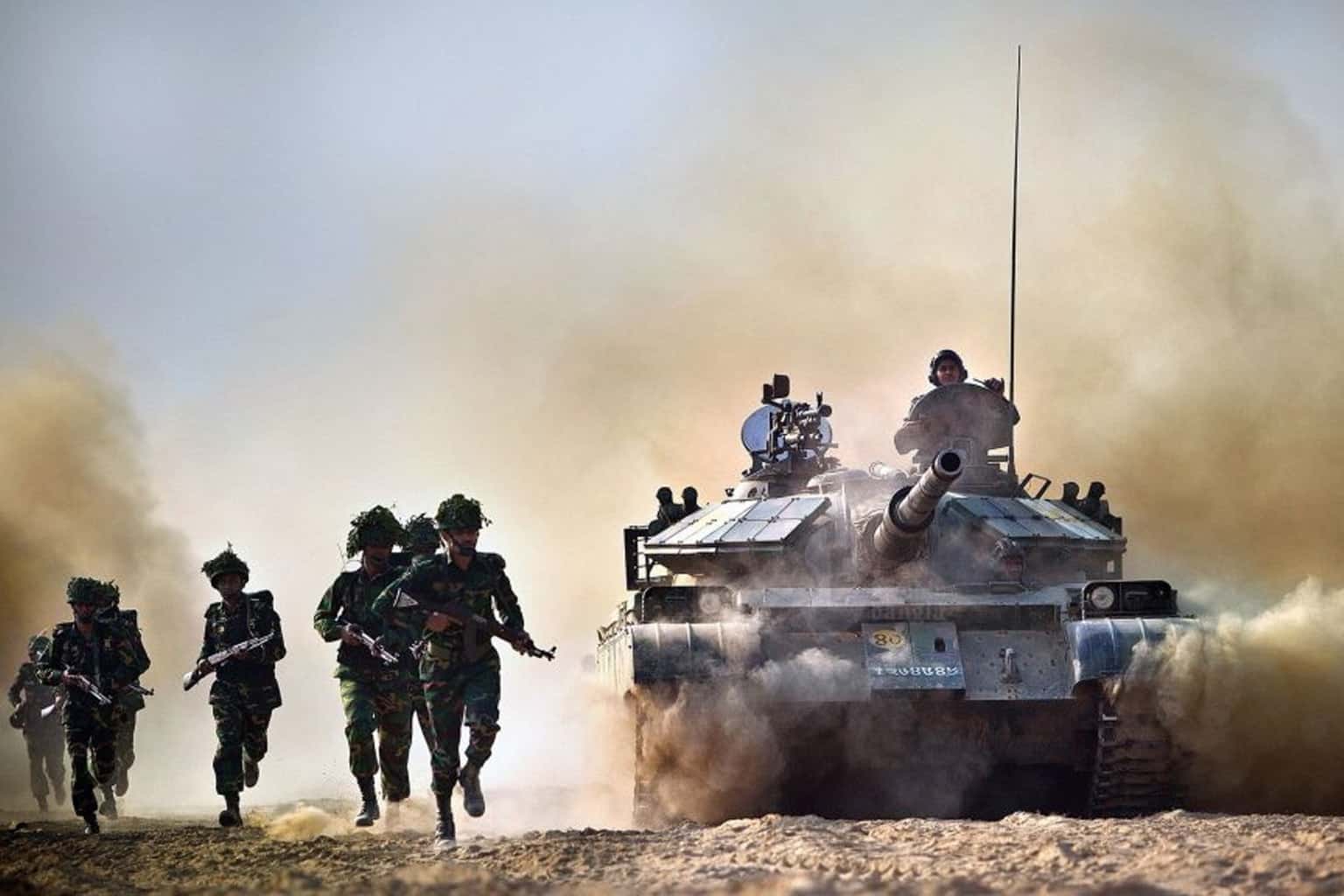
Future wars will not wait for slow mobilisation.
The side that can move faster, combine firepower quicker and respond with better coordination will hold a major advantage.
This is why the Indian Army’s reported move on Integrated Battle Groups, or IBGs, is important.

Media reports say the Army has moved ahead with new Integrated Battle Groups and a dedicated Fire Support Group as part of a major combat restructuring. The idea is to create faster, leaner and more self-contained formations that can respond quickly in difficult operational conditions.
This is not only a new formation name.
It is a change in how the Army may fight future wars.
What are Integrated Battle Groups?
An Integrated Battle Group is a self-contained combat formation designed to bring different arms together under one structure.
In simple words, an IBG is not just infantry.
It can include infantry, artillery, armoured elements, engineers, signals, logistics, maintenance support and medical support, depending on terrain and operational requirement.
The purpose is to reduce dependence on slow coordination between different formations.
A traditional large formation may take more time to bring all required elements together. An IBG is designed like a ready combat package, where essential fighting and support elements are already integrated.
This makes the formation faster, more flexible and better suited for quick response.
What is the fresh update?
Recent media reports say the Indian Army has created or moved ahead with Integrated Battle Groups and a dedicated Fire Support Group as part of a major military reform.
Some reports describe the latest move as five IBGs and one Fire Support Group. Earlier reporting by Indian Express had said the Army was set to create four IBGs and one Fire Support Group under the Panagarh-based XVII Mountain Strike Corps.
This difference should be handled carefully.
The professional and safe way to write it is:
Media reports indicate that the Indian Army has moved ahead with Integrated Battle Groups and a dedicated Fire Support Group, with detailed official structure awaited.
This avoids exaggeration and keeps the article accurate.
Why IBGs matter for the Indian Army?
The Indian Army is not only preparing for traditional war.
It is preparing for a battlefield where speed, drones, surveillance, precision weapons, electronic warfare, artillery, mobility and logistics must work together.
In such a battlefield, slow structures can become a weakness.
IBGs are meant to solve this problem.
They can help the Army respond faster, combine combat power more efficiently and reduce the time needed for large formations to mobilise.
For border areas, especially mountainous terrain, this can be very important.
A formation that can move quickly with its own firepower, engineers, communication and logistics support can create a sharper battlefield response.
Why this matters on the northern front?
Reports link the first IBG rollout with the XVII Mountain Strike Corps, which is oriented towards the northern border and mountain warfare requirements.
Mountain terrain creates special challenges.
Roads are limited.
Weather changes quickly.
Movement is slow.
Heavy formations take time to mobilise.
Logistics becomes difficult.
In such conditions, a lighter and integrated combat group can be useful because it is designed for quicker deployment and coordinated action.
This is why IBGs are being seen as important for future mountain warfare readiness.
How IBGs are different from traditional formations?
Traditional military formations are large and powerful, but they can take time to assemble all required elements for action.
An IBG is smaller than a corps or division, but more integrated than a normal single-arm formation.
That is the key difference.
It is designed to bring different combat and support arms together at the start itself.
So instead of waiting separately for infantry, artillery, engineers, logistics and medical support to come together, an IBG is built to operate as a combined package.
This can improve decision-making, movement and battlefield response.
What is the role of the Fire Support Group?
The dedicated Fire Support Group is being reported as an important part of this restructuring.
Its role is expected to concentrate firepower support for the IBGs.
In simple terms, the IBGs need quick and powerful fire support when they move or respond. A Fire Support Group can help by bringing artillery and related strike assets under a more focused structure.
This can help the Army deliver concentrated firepower instead of depending on scattered assets.
For future wars, this matters because speed alone is not enough.
Speed must be backed by firepower.
IBGs and future war response
Modern war is becoming faster and more transparent.
Drones can detect movement.
Satellites and sensors can track activity.
Precision weapons can strike quickly.
Electronic warfare can disrupt communication.
In such an environment, the Army cannot depend only on slow mobilisation and old command patterns.
It needs formations that can see, decide, move and strike faster.
IBGs fit into this requirement because they are designed around integration and speed.
The goal is not only to create smaller formations.
The goal is to create formations that can act faster with combined combat power.

Why this is a major Army transformation story?
The Indian Army has been moving through a larger transformation phase.
Recent discussions around Rudra Brigades, Bhairav Battalions, drone platoons, Divyastra batteries, Shaktibaan units and now IBGs show one larger trend:
The Army wants to become leaner, faster, technology-enabled and more integrated.
The Ministry of Defence’s official “Year of Reforms” background also points towards technologically advanced, combat-ready and multi-domain Armed Forces.
So IBGs should not be seen in isolation.
They are part of a wider effort to prepare the Army for future threats.
What does this mean for soldiers?
For soldiers, IBGs may mean more integrated training.
Infantry, artillery, engineers, signals, logistics and other elements may need to work together more closely.
This can improve coordination because soldiers will train and operate as part of a combined team rather than only as separate arms coming together later.
In future operations, a soldier may not fight only with his own unit’s capability.
He may fight inside a larger integrated system where firepower, drones, communication, engineers and logistics are linked more closely.
That is the direction in which modern armies are moving.
Why logistics will be critical?
A fast formation is useful only if it can be supported.
IBGs cannot succeed only with combat troops.
They need ammunition, fuel, medical support, repair teams, communication support, road access and supply chains.
This is especially important in mountain terrain.
A formation that moves fast but cannot be sustained will lose its advantage.
That is why logistics is not a background issue in IBGs.
It is one of the most important parts of the concept.
Why IBGs may improve decision-making?
In a large traditional structure, decisions may move through multiple layers.
IBGs are expected to reduce this delay by giving commanders a more integrated combat package.
When the commander has infantry, fire support, engineers, logistics and communication elements already connected, decisions can be faster.
This does not mean command becomes careless.
It means the formation is designed to reduce unnecessary waiting time.
In modern warfare, even a few hours can matter.
What should not be misunderstood?
This topic is strong, but it must be written carefully.
Do not claim that all details of IBG structure have been officially released unless a full official MoD or Army document confirms it.
Do not mention exact deployment locations beyond what credible reports have already stated.
Do not say IBGs guarantee victory.
Do not say large formations are no longer needed.
Do not say drones or IBGs will replace soldiers.
The better understanding is:
IBGs are a reported restructuring step meant to improve speed, integration, mobility and response. They may strengthen the Army’s ability to act faster in difficult terrain and future battlefield conditions.
Why this topic can interest the public?
For a normal reader, “Integrated Battle Group” may sound like a technical Army term.
But the meaning is simple.
The Army is trying to create combat groups that are faster and more complete.
Instead of waiting for different parts of the Army to come together after a situation develops, IBGs are designed to carry many essential parts together from the beginning.
That is why the topic matters.
It shows how the Army is preparing for wars where speed, coordination and readiness may decide the outcome.
What readers should remember?
Integrated Battle Groups are self-contained combat formations.
They are designed to bring infantry, firepower, engineers, logistics, communication and support elements together.
Media reports say the Indian Army has moved ahead with IBGs and a dedicated Fire Support Group.
The restructuring is linked with faster response and future-war readiness.
The XVII Mountain Strike Corps has been reported as a key formation connected with the first IBG rollout.
The official detailed structure should still be awaited before making final claims.
Final takeaway
The Indian Army’s Integrated Battle Groups show a clear direction: future warfare will demand faster, sharper and more integrated formations.
Large armies cannot depend only on size.
They need speed.
They need coordination.
They need firepower.
They need logistics.
They need formations that can respond before the enemy gets time to settle.
If the reports are accurate, the move towards IBGs and a Fire Support Group marks one of the important combat restructuring steps in recent years.
The real message is simple:
The Indian Army is preparing for a battlefield where the winner may not be the side that only has more troops.
It may be the side that can move faster, combine better and strike at the right time.
Sources:-
Economic Times — Indian Army creates five Integrated Battle Groups, one Fire Support Group
https://m.economictimes.com/news/defence/indian-army-creates-five-integrated-battle-groups-one-fire-support-group-in-major-military-reform/articleshow/132117309.cms
BharatShakti — Indian Army raises first Integrated Battle Groups in major combat restructuring
https://bharatshakti.in/indian-army-raises-first-integrated-battle-groups-in-major-combat-restructuring/
Indian Express — Army set to establish, operationalise first Integrated Battle Groups
https://indianexpress.com/article/india/army-set-to-establish-operationalise-first-integrated-battle-groups-next-month-10761985/
Times of India — How Integrated Battle Groups could change Indian Army’s future wars
https://timesofindia.indiatimes.com/defence/news/how-integrated-battle-groups-could-change-the-way-indian-army-fights-future-wars/articleshow/132113750.cms
PIB — Ministry of Defence declares 2025 as Year of Reforms
https://www.pib.gov.in/PressReleaseIframePage.aspx?PRID=2089184
PIB — Indian Army celebrates 78th Army Day at Jaipur
https://www.pib.gov.in/PressReleasePage.aspx?PRID=2214965



Leave a Reply