

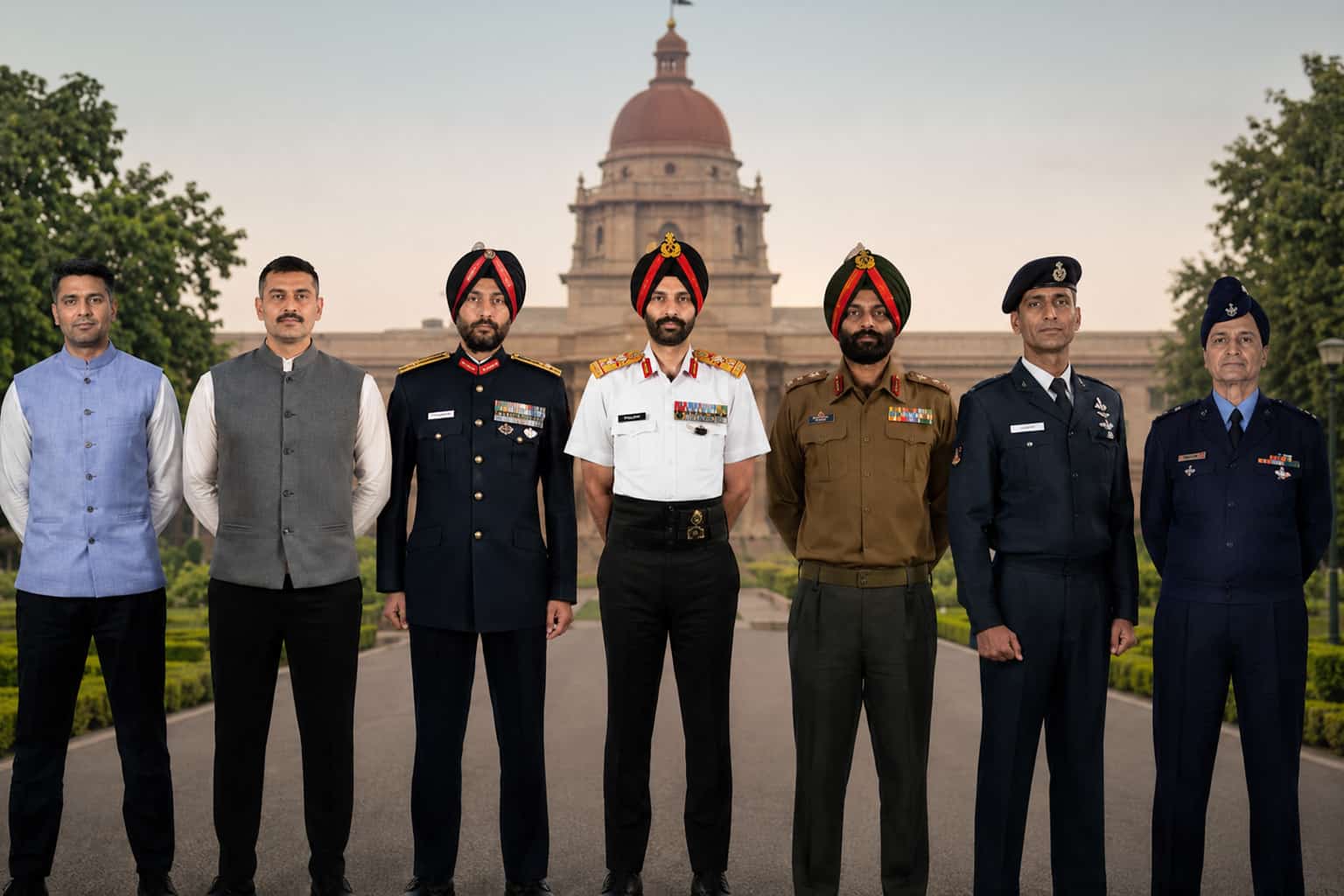
Army Uniforms 2026 brings major changes in Indian Army dress rules, including Bandi jackets, Battle Jacket winter dress, limited sword use, removal of colonial-era terms and stricter grooming and tattoo rules.

Army Uniforms 2026: Why this update is being discussed?
The Indian Army’s new dress rules under Army Uniforms 2026 have become a major topic of public discussion. The reason is simple: this is not only about what soldiers and officers wear. It is also about discipline, identity, tradition, professionalism and the gradual removal of colonial-era symbols from the Army’s public image.
According to multiple media reports citing the new Army Uniforms-2026 pamphlet/manual, the Indian Army has updated several dress and appearance rules. The reported changes include the introduction of the Bandi jacket as part of formal civil dress, a new winter working dress with a Battle Jacket, limited use of swords in ceremonial events, removal of archaic terms such as “Royal”, and stricter grooming and tattoo rules.
For the public, it may look like a uniform change. For the Army, it is a matter of standardisation, discipline and national identity.
Is this an official PDF-based update?
At the time of writing, a public official PDF of the complete Army Uniforms-2026 manual was not found on PIB or publicly accessible Indian Army pages.
This article is therefore based on credible media reports that cite the new Army Uniforms-2026 pamphlet. The details should be read as reported changes unless the full public official PDF becomes available.
This clarification is important because defence-related rules should always be reported carefully. Uniforms, ceremonial practices and grooming standards are matters of official regulation, not social media interpretation.
What is the main purpose of Army Uniforms 2026?
The main purpose appears to be threefold.
First, the Army wants to standardise dress and appearance norms across the force.
Second, it wants to modernise certain uniform practices so that they are more practical and contemporary.
Third, it wants to align military dress traditions with India’s own national identity by reducing residual colonial-era symbols and terminology.
This is why the story is not just about jackets or grooming. It is about how the Indian Army wants to present itself in a modern Indian context while retaining military discipline and regimental pride.
Bandi jacket: What is changing?
One of the most talked-about changes is the introduction of the Bandi jacket.
Reports say the Bandi jacket will be introduced as part of civil formal dress. It is described as a closed-neck coat to be worn over a full-sleeved shirt with matching formal trousers and closed footwear.
This is important because the Bandi jacket has an Indian formal identity. Its introduction gives the dress code a more indigenous appearance while still maintaining formality and discipline.
For many readers, this is the most visible part of the change. But the deeper point is that the Army is trying to combine dignity, Indian identity and formal military presentation.
Battle Jacket and winter working dress
Reports also mention a new winter working dress with a Battle Jacket.
The Battle Jacket is being discussed as part of a modern winter-dress system. Some reports say the older jersey-based winter working dress will be gradually replaced.
This is a practical change. Winter dress in the Army must balance smartness, comfort, climate, mobility and uniformity. A Battle Jacket-style system can create a sharper and more functional appearance during cold-weather duties.
However, readers should not misunderstand this as an overnight change for every person in every unit. Uniform transitions in the Armed Forces usually follow timelines, stock availability and official implementation instructions.

Use of swords has been limited
Another important change is linked with ceremonial sword use.
Reports say sword carriage has been narrowed. Reviewing Officers will no longer be required to carry swords during parades. Sword use will be limited to designated personnel and specific ceremonial roles.
This does not mean swords are completely banned from Army ceremonies. It means the rule has reportedly been refined to reduce unnecessary ceremonial carriage and align with modern practice.
This is an important distinction. Swords have historical and ceremonial value in military tradition. The reported change appears to be about rationalising their use, not removing military heritage entirely.
Colonial-era terms like “Royal” being dropped
One of the most symbolic parts of the update is the reported removal of archaic colonial-era terminology such as “Royal” from relevant dress references.
This fits into the wider post-colonial identity shift in Indian military culture. The Indian Army has inherited many traditions from the British Indian Army, but independent India has steadily adapted military symbols, terms and practices to reflect its own sovereign identity.
The removal of outdated colonial references should be understood in this context. The idea is not to erase military history, but to ensure that today’s Army reflects India’s national ethos.
What are the new grooming rules?
The Army has always maintained strict grooming and appearance standards. Reports on Army Uniforms 2026 suggest that grooming rules have been reinforced further.
The reported rules include restrictions on visible tattoos, body piercings, radical hairstyles, unauthorised beards, visible electronic gadgets, bracelets and cosmetic make-up while in uniform.
The focus is on uniformity and discipline. The Army is a structured organisation where personal appearance is not treated as an individual fashion statement. It is connected with military bearing, identity and professionalism.
Tattoo policy: What should readers understand?
Tattoo rules are among the most searched topics in Army-related content because many defence aspirants worry about whether tattoos can affect selection or service.
Reports say the Army Uniforms 2026 manual reinforces restrictions on tattoos and body piercings. The basic logic is that tattoos visible in uniform or tattoos that violate service norms can create issues.
Readers should understand that tattoo-related rules can be technical and may depend on placement, type, visibility and official policy. Aspirants should not rely on reels or short videos for tattoo guidance. They should check official recruitment instructions, service rules and the latest notifications before making any assumption.
For serving personnel, the standard message is simple: appearance in uniform must remain disciplined, clean and professional.
Why does the Army care so much about appearance?
Many civilians ask why the Army has strict rules about dress, moustaches, hair, tattoos, accessories and cosmetics.
The answer lies in military discipline.
A uniform creates equality. It reduces personal display and strengthens group identity. It tells the public that the person is not acting as an individual, but as a representative of the Indian Army.
When every soldier follows the same appearance standards, it creates unity, seriousness and order. In a military organisation, even small details matter because they reflect discipline.
Is this only about fashion?
No. This is not a fashion update.
Army uniforms are connected with command, respect, discipline, morale, regimental tradition and national identity. A change in dress rules sends a message about how the Army sees itself and how it wants to be seen by the nation.
The Bandi jacket reflects Indian formal identity.
The Battle Jacket reflects modern utility.
The limited sword rule reflects practical ceremonial reform.
The removal of colonial terms reflects national self-confidence.
The grooming rules reflect discipline and uniformity.
Together, these changes show a wider shift in the Army’s visual and ceremonial culture.
What does this mean for serving personnel?
For serving personnel, the new rules mean closer attention to dress, grooming and ceremonial instructions.
Every unit and formation will likely follow implementation instructions through the official chain of command. Personnel should wait for proper unit-level directions rather than depend on social media summaries.
The practical message is clear: uniforms must be worn correctly, appearance standards must be followed, and ceremonial dress must match the updated rules.
What does this mean for defence aspirants?
For defence aspirants, Army Uniforms 2026 gives an important lesson.
Joining the Army is not only about clearing a written exam, SSB, medical test or physical standard. It is also about accepting a disciplined way of life.
The Army regulates appearance because the uniform carries responsibility. A person who wants to wear the uniform must be ready to follow grooming, dress and conduct rules.
Aspirants should especially take note of tattoo and grooming-related guidance. Before getting any tattoo or body piercing, they should check official recruitment rules carefully.
Why is the Bandi jacket attracting public attention?
The Bandi jacket is attracting attention because it is visibly Indian and formal at the same time.
For decades, formal military dress in India carried several colonial influences. The introduction of an Indian-style formal garment is being seen as a symbolic step.
It also connects with the larger theme of Indianisation in military traditions. The Indian Army is modernising its visual identity while maintaining the seriousness of military dress.
This balance is important. The Army cannot become casual in appearance, but it can still evolve with time.
Why removing colonial symbols matters?
Uniforms are powerful symbols. They tell a story about authority, identity and history.
India’s Armed Forces have a proud legacy that includes pre-independence regimental traditions as well as post-independence wars, operations, peacekeeping missions and national service. The challenge is to preserve valuable traditions while removing unnecessary colonial baggage.
Dropping outdated terminology and reforming ceremonial practices is part of that journey.
It shows that India’s Army is confident enough to respect history without being tied to colonial symbolism.
What should not be misunderstood?
There are a few points that readers should not misunderstand.
First, this does not mean the entire Army uniform system has changed overnight.
Second, swords have not been completely removed from all ceremonies. Reports suggest their use has been limited and rationalised.
Third, the Bandi jacket is not a casual fashion item. It is part of a formal dress update.
Fourth, grooming rules are not new in spirit. The Army has always maintained strict appearance standards. The 2026 update appears to clarify and reinforce them.
Fifth, until the full public official PDF is available, readers should treat detailed points as media-reported details citing the Army Uniforms-2026 pamphlet.
Why this topic matters for the public?
This topic matters for the public because the Army uniform is one of the most respected symbols in India.
People see the uniform in parades, ceremonies, public events, recruitment rallies, cantonments, Republic Day, funerals, gallantry ceremonies and national moments of pride.
When the Army changes its dress rules, it naturally creates curiosity.
But the public should understand that uniforms are not only about looks. They are about discipline, standardisation and identity.
Why this topic matters for Sainik Welfare News readers?
Sainik Welfare News readers include serving personnel, veterans, defence families and aspirants. For them, this update is important because it touches the daily culture of Army life.
Veterans may compare the new rules with older traditions. Serving personnel may look for practical implementation. Aspirants may want to understand grooming and tattoo implications. Families may want to understand why appearance rules are so strict.
This makes Army Uniforms 2026 a strong public-interest defence story.
Final takeaway
Army Uniforms 2026 is more than a change in dress rules.
It reflects a wider movement towards standardisation, modernisation and Indian identity within the Army’s dress and ceremonial culture.
The reported introduction of the Bandi jacket, Battle Jacket, limited sword use, removal of colonial-era terminology and stricter grooming rules shows that the Army is refining both appearance and symbolism.
For soldiers, the message is discipline.
For aspirants, the message is preparation.
For the public, the message is that the uniform remains a symbol of national pride, but its form can evolve with time.
A uniform is not just cloth. In the Army, it is duty, dignity and discipline stitched together.
Sources:-
NDTV / ANI — Indian Army’s new uniform code, Bandi jacket and removal of colonial-era customs
https://www.ndtv.com/india-news/indian-armys-new-uniform-code-british-era-customs-banned-no-use-of-royal-11635466
Times of India — Army brings in Bandis, Battle Jackets, limited sword use and drops archaic terminology
https://timesofindia.indiatimes.com/defence/to-remove-residual-colonial-dress-customs-army-brings-in-bandis-battle-jackets-use-of-swords-limited-archaic-terminology-like-royal-dropped/articleshow/131730941.cms
India Today — Indian Army unveils new dress code and phases out colonial-era traditions
https://www.indiatoday.in/india/story/indian-army-dress-code-2026-bandi-jacket-colonial-practices-grooming-rules-2926599-2026-06-15
Economic Times — Army Uniforms 2026 manual and new dress rules
https://m.economictimes.com/news/defence/indian-army-uniforms-2026-manual-from-new-winter-dress-to-bandi-jackets-tatto-rules-all-about-armys-new-dress-rules/articleshow/131716098.cms



Leave a Reply