

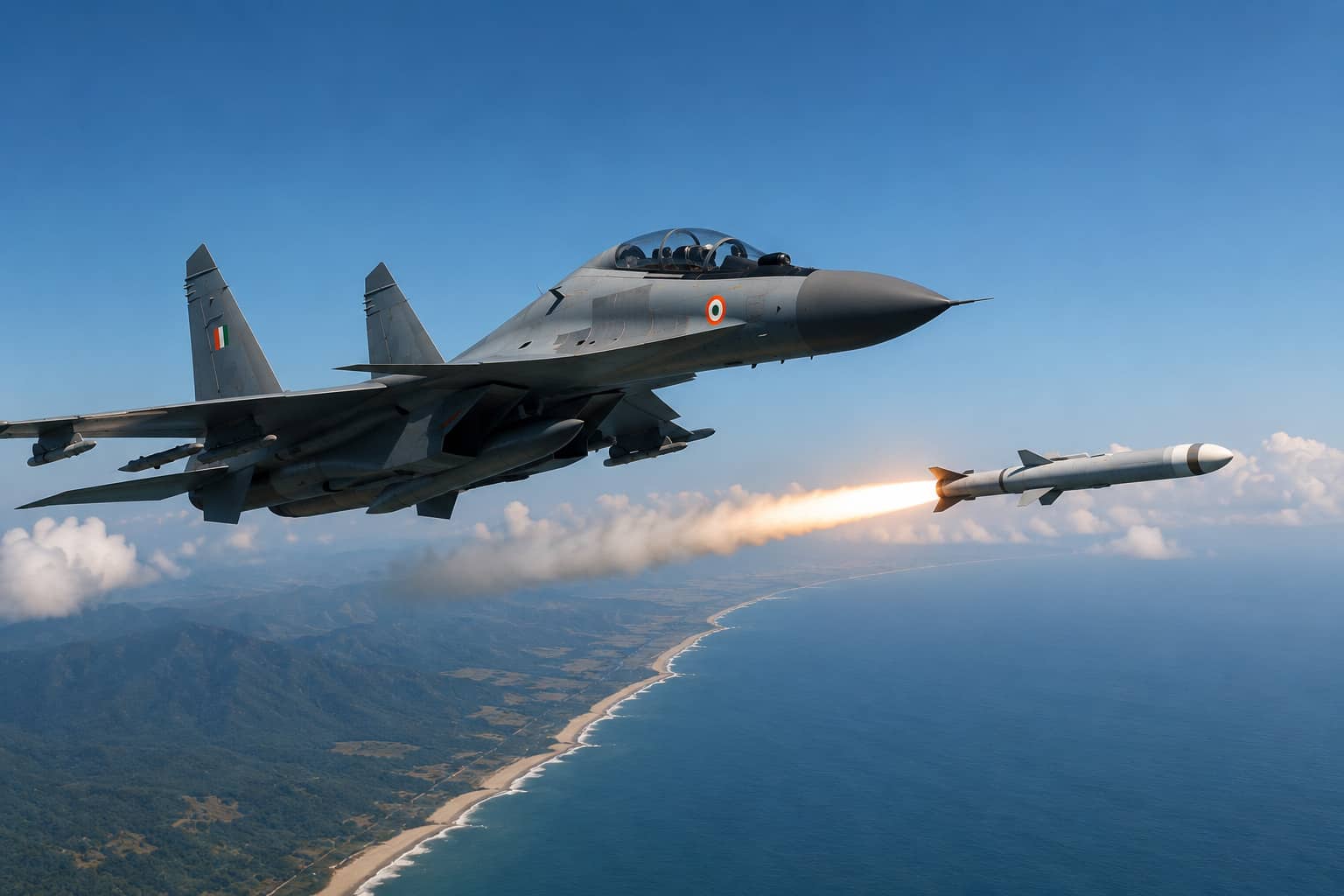
India’s successful RudraM-II missile test is not just another defence update. It is a clear signal that India is moving deeper into the age of indigenous precision warfare, where air power is not only about fighter aircraft, but also about the weapons they carry, the accuracy they deliver and the confidence they create for the forces.

According to the official Ministry of Defence update, DRDO and the Indian Air Force conducted successful flight-tests of the RudraM-II Air-to-Surface Missile from an airborne platform. The tests were conducted under extreme release conditions, and the missile was guided to a predefined target with pinpoint accuracy. The official statement also confirmed that all test objectives were fully met.
That one line, “all test objectives were fully met,” is important. In missile development, success is not only about launch. It is about guidance, trajectory, control, stability, accuracy, data capture and system performance under real test conditions. RudraM-II passing these objectives shows that India’s indigenous missile ecosystem is steadily maturing.
What is RudraM-II and why does it matter?
RudraM-II is an indigenous air-to-surface missile. In simple words, it is a missile that can be launched from an aircraft to hit a target on the ground or surface. For a modern air force, such weapons are extremely important because they allow fighter aircraft to strike with greater accuracy and from a safer distance.
This matters for the Indian Air Force because modern warfare is no longer fought only by aircraft entering deep into dangerous zones. The stronger capability is to identify, lock and destroy critical targets with precision. A missile like RudraM-II adds to that kind of strike power.
For India, the bigger point is self-reliance. When such systems are developed by DRDO with the support of the Indian Air Force and industry partners, it reduces dependence on foreign suppliers and strengthens India’s long-term defence preparedness.
Why this test is bigger than one missile launch?
Many people read a missile-test headline and move on. But every successful test has a deeper message.
First, it tells the armed forces that an indigenous system is moving forward in reliability.
Second, it gives scientists and engineers real flight data to improve the weapon further.
Third, it shows that India is working seriously on air-launched precision strike capability, which is a key requirement in modern conflict.
Fourth, it supports the larger Atmanirbhar Bharat vision in defence technology.
The RudraM-II test also fits into a wider pattern. India has been pushing for stronger indigenous capability in missiles, guided weapons, electronic warfare, aircraft systems and defence production. Each successful test adds one more layer to that national capability.

What it means for India’s air power?
Air power is not only about having powerful fighter jets. It is also about the weapons those jets can carry. A fighter aircraft becomes more effective when it is equipped with accurate, reliable and mission-ready weapons.
This is where RudraM-II becomes important. An indigenous air-to-surface missile gives the Indian Air Force more options in future operations. It can support precision targeting, improve strike flexibility and strengthen the country’s ability to respond to threats with confidence.
For defence watchers, this test should be seen as a capability signal. It shows that India is not only buying platforms, but also building the weapons and systems that make those platforms more powerful.
Why defence families and veterans should follow such updates?
For veterans, serving personnel and defence families, such updates are not just technical news. They reflect the strength of the system behind the soldier, air warrior and commander.
When Indian scientists, test ranges, armed forces and industry partners work together to create indigenous capability, it improves national security in the long run. It also gives confidence that future generations of Indian forces will have more home-grown systems to depend on.
This is why sainikwelfare.in treats such updates as more than a weapons story. It is a story of preparedness, self-reliance and institutional effort.
The important caution
A successful test does not automatically mean immediate mass induction or operational deployment. Missile systems go through multiple stages of testing, validation, integration and user evaluation before they become fully operational in large numbers.
So the right way to understand this update is simple: RudraM-II has achieved an important successful flight-test milestone, and that is a positive step for India’s indigenous defence capability. But further official updates will decide the exact path of induction and operational use.
Final takeaway
The RudraM-II missile test is important because it shows India’s growing confidence in indigenous air-launched precision weapons. For the Indian Air Force, it adds to the future direction of stronger strike capability. For DRDO, it reflects progress in advanced missile technology. For the country, it is another reminder that real defence strength is built step by step, test by test and system by system.
This is why RudraM-II is not just a missile name in the news. It is a signal that India’s air power is becoming more indigenous, more precise and more future-ready.
Sources:-
DRDO & IAF conduct successful flight-tests of RudraM-II Air-to-Surface Missile
https://www.pib.gov.in/PressReleasePage.aspx?PRID=2268099
Alternative PIB detail page:
https://www.pib.gov.in/PressReleaseDetail.aspx?PRID=2268099&lang=1®=1
PIB Year End Review 2024, mentions earlier RudraM-II flight-test on 29 May 2024
https://www.pib.gov.in/PressReleasePage.aspx?PRID=2088180&lang=2®=3
Economic Times, RudraM-II test from Su-30MKI
https://m.economictimes.com/news/defence/drdo-iaf-successfully-test-rudram-ii-air-to-surface-missile-from-su-30mki-fighter-hits-target-with-pin-point-accuracy/articleshow/131465756.cms
Times of India, RudraM-II successful flight-tests
https://timesofindia.indiatimes.com/defence/news/india-successfully-test-fires-rudram-2-all-about-the-anti-radiation-missile/articleshow/131465653.cms



Leave a Reply