

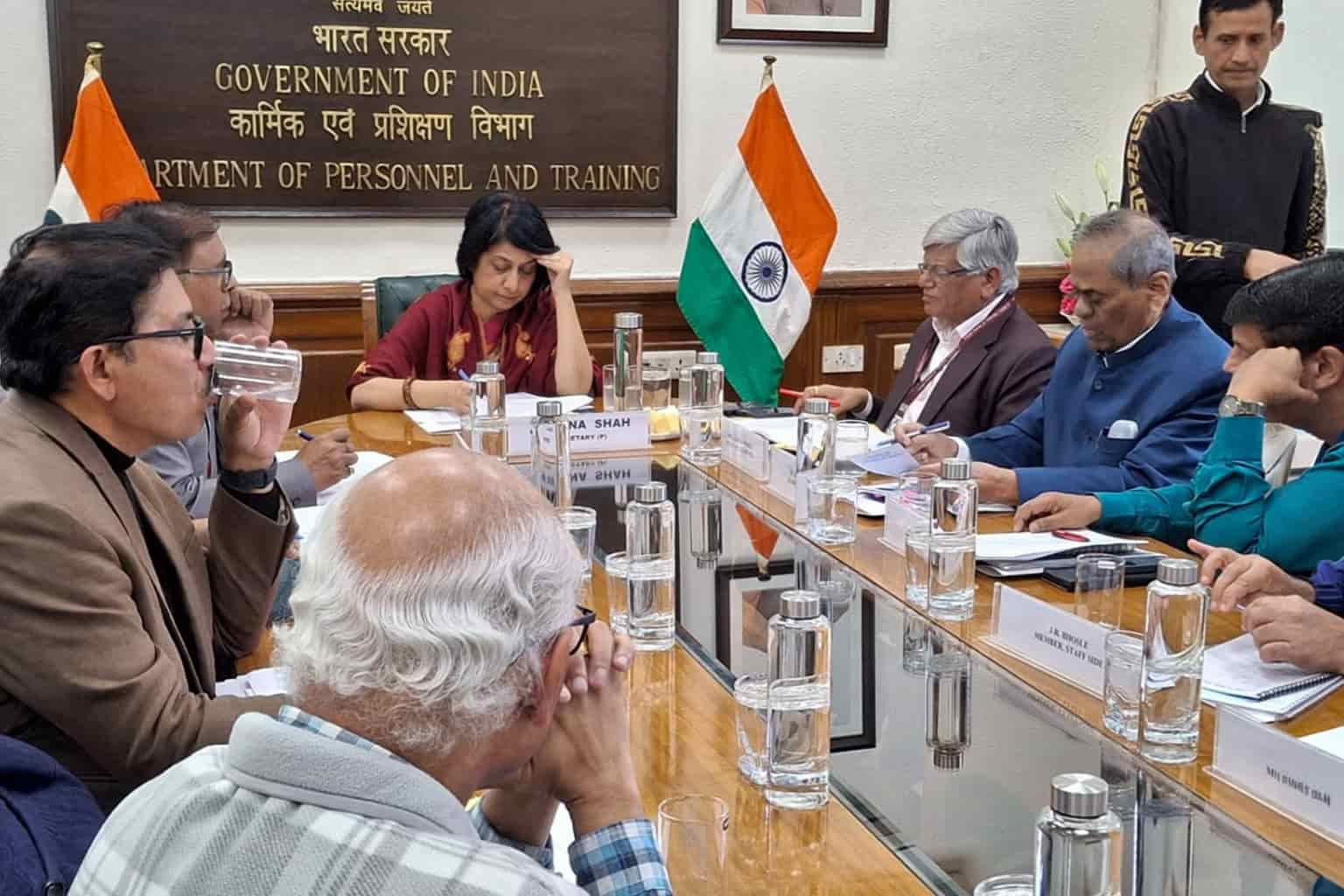
The 8th Central Pay Commission’s Lucknow visit has become an important development for serving defence personnel, ex-servicemen, pensioners and family pensioners.
According to the update shared by veterans’ representatives, a detailed interaction took place with the Pay Commission panel during the Lucknow visit on 22 and 23 June 2026. The discussion reportedly lasted around 45 to 50 minutes and covered several long-pending defence pay, pension and welfare issues.
This meeting is important because the 8th CPC is still in its consultation and data-gathering phase. This is the stage where representations, memoranda and field-level concerns matter the most.
Why the Lucknow meeting matters?
Pay Commissions do not work only through files. They also depend on the voices of employees, pensioners, associations and affected groups.
The Lucknow visit gave stakeholders from Uttar Pradesh an opportunity to interact with the Commission. The official 8th CPC notice had earlier invited Central Government organisations, institutions, unions and associations to seek appointments for the Lucknow interaction by submitting their Memo ID.
For the defence community, this visit was more than a formal meeting. It was a chance to place military-specific issues directly before the panel.
Defence service has its own hardship, command structure, early retirement pattern, field conditions, counter-insurgency duties, family separation and pension concerns. That is why veterans’ organisations believe that military pay and pension issues cannot be viewed exactly like civilian service issues.
Who represented the veterans’ side?
As per the update, the Federation of Veterans Associations side was represented by Naval veteran Ashok Kumar Rastogi, Army veteran Raghavendra Singh and other members associated with the veterans’ team.
The appointment was reportedly taken through an affiliated ex-servicemen welfare association from the Baghpat region. The representatives stated that they received sufficient time and were able to discuss the memorandum point by point in a positive environment.
This is a significant detail because many defence personnel and pensioners often feel that their issues are heard only after decisions are already shaped. In this case, the message from the representatives is that the panel listened to the points patiently during the consultation stage.
Key demand: Fitment factor of 3
One of the major points reportedly placed before the Commission was the demand for a fitment factor of 3.
The fitment factor is one of the most watched terms in every Pay Commission. It directly affects the conversion of existing basic pay and pension into the new structure.
For serving personnel, it influences revised salary. For pensioners, it can influence revised pension calculations. For family pensioners, it becomes even more important because their monthly income depends on pension revision rules.
The veterans’ demand for a fitment factor of 3 should be understood as a proposal, not a confirmed decision. The 8th CPC has not yet announced any final fitment factor.
Demand to start military pay levels from Pay Level 5
Another important issue reportedly raised was that military personnel should not begin from Pay Level 3 and that the starting level should be raised to Pay Level 5.
This demand is linked to dignity of entry-level military service and the nature of duties performed by soldiers.
The argument from the defence side is simple: a soldier’s service conditions are not limited to routine office work. From the beginning of service, he is trained for field duties, weapon handling, operational readiness, discipline under command and possible deployment in difficult areas.
That is why veterans’ groups are asking the Commission to relook at the starting placement of military personnel in the pay matrix.
Military Service Pay and parity concerns
The issue of Military Service Pay was also reportedly discussed.
Military Service Pay has always been an emotional and technical subject for the armed forces community. It is not just an allowance. It is seen as recognition of the unique conditions of military life — risk, mobility, restrictions, field hardship and the obligation to serve wherever ordered.
The demand placed before the panel reportedly focused on a more balanced and fair approach to MSP so that defence personnel do not feel divided by avoidable pay differences.
A professional Pay Commission review must examine whether the present MSP structure reflects the true nature of military service across ranks.
Bonus issue: Beyond the ₹7,000 ceiling
The representatives also reportedly raised the issue of bonus.
The concern is that defence personnel receive a non-productivity linked bonus calculated with a ceiling that many consider outdated and inadequate. The demand reportedly placed was that the bonus system for soldiers should be brought closer to a fairer and more meaningful framework.
This issue may appear small compared to fitment factor or pension, but for soldiers and lower ranks, even such benefits carry practical value.
A Pay Commission is expected to examine not only big salary numbers, but also smaller service benefits that affect morale and household planning.
Leave encashment and service-life balance
Leave encashment was another point reportedly discussed, with a demand to enhance the existing limit from 300 days to 450 days.
This demand has a strong military logic behind it.
Many defence personnel are unable to use leave freely due to field postings, operational requirements, training commitments, movement restrictions and unit-level responsibilities. In difficult stations, the soldier may earn leave on paper but may not always be able to use it in real life.
A higher leave encashment ceiling would recognise this reality.
It would also send a message that when the system prevents a soldier from taking leave due to duty requirements, the unused leave should not lose value.
LTC and additional leave for counter-insurgency duties
The update also mentions demands related to LTC and leave benefits, including enhanced entitlement and one month of extra annual leave for personnel posted in counter-insurgency areas.
This is a very important welfare issue.
Counter-insurgency deployment is physically and mentally demanding. It involves uncertain movement, heightened alertness, separation from family and long periods of pressure. For officers, JCOs and jawans posted in such areas, additional leave support can help reduce stress and improve family stability.
The demand should be seen as a welfare measure, not merely as a service concession.

X Group Pay and honorary rank benefits
The representatives also reportedly raised the issue of X Group Pay and honorary rank benefits.
The concern around X Group Pay is that technical qualification and specialised duties should be recognised fairly. The demand was that X Group Pay should be applied in a more equal and rational manner.
Another issue was connected with honorary ranks. The representatives reportedly argued that when personnel receive honorary rank recognition, they should also receive appropriate monetary benefit.
They also pointed to the example of honorary Naib Subedar benefit and asked that similar financial recognition should be considered across other honorary rank cases.
This issue matters because honorary rank is not just a title. For many soldiers, it represents decades of discipline, service record and institutional recognition.
Agniveer welfare: Disabled and deceased Agniveers
One of the most sensitive points reportedly raised was about Agniveers who become disabled or lose their lives during service.
The demand was that deceased and disabled Agniveers should receive facilities in line with the dignity given to regular soldiers.
This issue needs careful and humane treatment.
Whatever the policy debate around Agnipath may be, a young person serving in uniform carries real risk and responsibility. If an Agniveer loses life or suffers disability during service, the family’s pain is not temporary. Therefore, welfare treatment must be seen from the perspective of national obligation, not only contractual structure.
ECHS contribution and medical entitlement
ECHS-related concerns were also reportedly discussed.
The representatives argued that ECHS contribution should be made more flexible or optional according to the ward/category chosen by the individual. Their logic was linked to the fact that fixed medical allowance is received uniformly, while ECHS contribution and entitlement structure may not feel equally balanced to all categories.
Medical care remains one of the biggest concerns for retired defence personnel and their families. For many pensioners, ECHS is not an extra facility; it is a lifeline.
That is why any demand relating to ECHS must be examined with sensitivity, especially for older veterans, widows and dependents.
Disability pension and non-discrimination
Disability pension was another major welfare point.
Veterans’ representatives reportedly argued that there should be no discrimination in disability pension matters.
This issue has remained sensitive for the defence community because disability during service can affect a person’s earning capacity, family stability and quality of life for decades. A fair disability pension system is not charity. It is compensation for service-related loss and hardship.
The 8th CPC should examine this area with a soldier-first approach.
Family pension: Demand to increase from 30% to 60%
Family pension was one of the most important issues reportedly raised before the panel.
The representatives proposed that ordinary family pension, currently linked to 30% of last pay in many cases, should be increased to 60%.
This demand will resonate deeply with widows and dependent families.
When a pensioner passes away, the family’s expenses do not become half overnight. House rent, medical bills, dependent care, food, utilities and social responsibilities continue. In many defence families, the spouse may be elderly and financially dependent.
A higher family pension would directly strengthen the dignity and security of surviving spouses.
Jawan pension demand: 67% of last emoluments
Another significant proposal reportedly placed before the Commission was that jawans should receive pension at 67% of last emoluments.
The argument behind this demand is linked to the early retirement pattern of soldiers.
Many jawans retire much earlier than civilian employees. Their second-career opportunities are uncertain, and by the time they return to civilian life, they often carry family responsibilities, children’s education expenses and health concerns.
A fair pension formula for jawans must recognise this shorter service span and early retirement reality.
Why timing is important?
The strongest message from the representatives was that beneficiaries should not wait silently.
The Pay Commission is currently hearing stakeholders, visiting states and collecting inputs. This is the right time for associations, unions and pensioner bodies to place their demands through proper appointment and memorandum channels.
Once the consultation window closes and recommendations begin taking shape, complaints made later may not carry the same weight.
For defence personnel, pensioners, family pensioners and government employees, participation at this stage is essential.
What is confirmed and what is not confirmed?
This article must be understood carefully.
Confirmed officially: the 8th CPC issued a notice for its Lucknow visit on 22 and 23 June 2026 and invited stakeholders to seek appointments with Memo ID.
Reported by representatives: veterans’ groups discussed multiple defence pay, pension and welfare demands with the panel for around 45 to 50 minutes in a positive environment.
Not confirmed: no fitment factor, pay matrix, pension formula, MSP revision, ECHS change or family pension increase has been officially approved yet.
The meeting is important because the issues have been placed before the panel. But placement of demand is not the same as acceptance of demand.
Final view
The Lucknow interaction should be seen as a serious consultation moment for the defence community.
Veterans’ representatives used the opportunity to place issues that affect serving personnel, ex-servicemen, pensioners, family pensioners, disabled soldiers, Agniveers and widows.
The most important message is this: the 8th CPC process is active, and the defence community is trying to ensure that military-specific realities are not lost in general pay revision discussions.
Whether all demands are accepted or not will be known only when the Commission submits its recommendations and the Government takes a final decision.
But one thing is clear — if the voice of soldiers and veterans has to be heard, it must be placed on record now.
The Lucknow meeting shows that veterans are not waiting for the final report silently. They are participating, documenting and reminding the system that military service deserves a separate, fair and deeply informed review.
Sources:-
Official 8th CPC Lucknow visit notice:
https://8cpc.gov.in/document/notice-regarding-8cpc-visit-to-lucknow-uttar-pradesh-22-23-june-2026/
Official PDF of Lucknow visit notice:
https://cdnbbsr.s3waas.gov.in/s354b2b21af94108d83c2a909d5b0a6a50/uploads/2026/05/20260521886747762.pdf
8CPC Memorandum Submission page:
https://8cpc.gov.in/8cpc-memorandum-submission/
8CPC Online Data Portal:
https://8cpc.gov.in/8cpc-online-data-portal/


Leave a Reply