

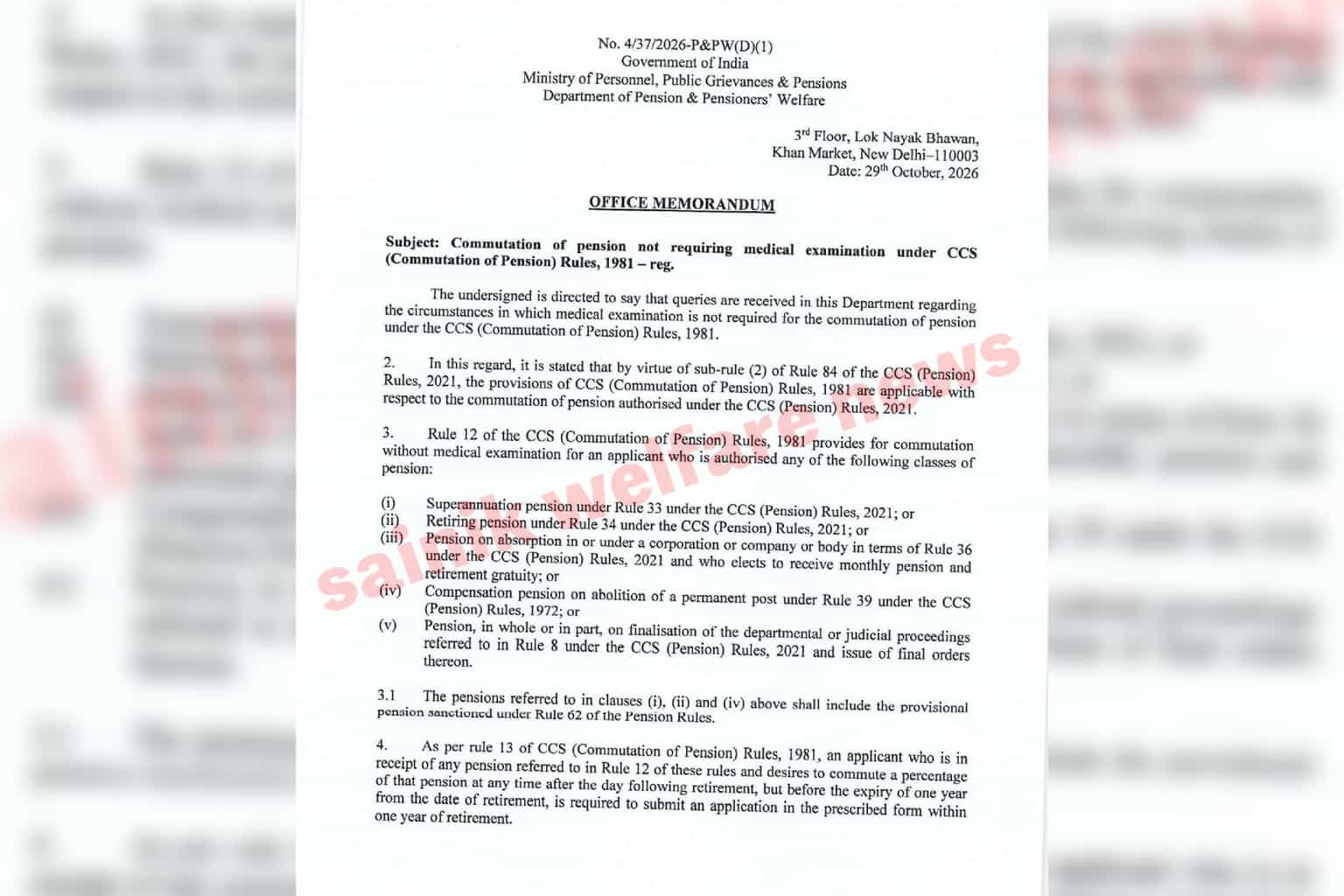
Download the official document
The Department of Pension & Pensioners’ Welfare (DoPPW) has issued an important clarification regarding pension commutation for retired Central Government employees facing departmental or judicial proceedings.
Through Office Memorandum No. 4/37/2026-P&PW(D)(4), dated 29 October 2026, the Government has clarified when pension commutation is prohibited, when pensioners can apply after proceedings conclude, and when a medical examination becomes compulsory.
The clarification is particularly relevant to retired employees receiving provisional pension because departmental or judicial proceedings remain pending.
What has the Govt clarified about pension commutation?
The Office Memorandum addresses pension commutation in cases covered under Rule 8 of the Central Civil Services (Pension) Rules, 2021.
According to Rule 84(2) of the CCS (Pension) Rules, 2021, the provisions of the CCS (Commutation of Pension) Rules, 1981 apply to commutation authorised under the 2021 rules.
Rule 4 of the 1981 rules prohibits the commutation of provisional pension during departmental or judicial proceedings covered under Rule 8.
However, once these proceedings are finalised and the competent authority issues an order authorising pension, wholly or partly, an eligible pensioner may apply for commutation under Rule 13.

This distinction is important for government employees who retired while disciplinary or judicial proceedings were continuing.
When can pensioners get commutation without medical examination?
The Government has clarified that the medical examination requirement depends on when the commutation application is received by the Head of Office.
An eligible pensioner applying within one year of the issue of the pension-authorising order does not require a medical examination.
If the application is received after this period, a medical examination becomes mandatory under Rule 18 of the CCS (Commutation of Pension) Rules, 1981.

Important: The one-year period begins from the date of issue of the pension-authorising order, not automatically from the employee’s original retirement date.
Pension Commutation Example: How does the one-year rule work?
Consider a Central Government employee who retired in March 2024 while departmental proceedings were pending.
During the proceedings, the employee continued receiving provisional pension but could not commute it.
Suppose the proceedings concluded and the competent authority issued an order authorising pension on 15 December 2026.
In this situation, an eligible application received by the Head of Office within one year of that order would not require a medical examination.
However, if the application is received after the prescribed one-year period, the pensioner would have to undergo a medical examination under Rule 18.
This example illustrates the application deadline. Actual commutation entitlement remains subject to the applicable pension rules.
What should affected pensioners do?
Pensioners whose departmental or judicial proceedings have concluded should carefully examine their pension-authorising order before applying for commutation.
They should verify that the proceedings have been formally finalised, an order authorising pension has been issued, and their application is submitted according to the prescribed procedure.

Pensioners should also retain copies of the pension-authorising order, the commutation application and proof of its receipt by the appropriate office.
These records can help establish whether the application was received within the prescribed deadline.
Does this pension commutation clarification apply to defence pensioners?
The memorandum specifically refers to the CCS (Pension) Rules, 2021 and the CCS (Commutation of Pension) Rules, 1981.
These provisions govern the relevant categories of Central Government civilian pensioners.
The document does not expressly extend the same clarification to Armed Forces service pensioners, who are governed by separate defence pension regulations.

Therefore, defence pensioners should examine their commutation entitlement under the applicable military pension rules rather than assume that the civilian CCS provisions automatically apply.
Has the Govt changed the 15-year pension commutation restoration period?
No. The DoPPW Office Memorandum dated 29 October 2026 does not announce any change to the existing commuted-pension restoration period.
It also does not increase the maximum permissible commutation percentage or introduce a new general commutation benefit.
The memorandum is limited to clarifying the admissibility of pension commutation after departmental or judicial proceedings and the related medical examination requirements.
Sources
1. Department of Pension & Pensioners’ Welfare — Office Memorandum
OM Number: 4/37/2026-P&PW(D)(4)
Date: 29 October 2026
Subject: Admissibility of commutation of pension in the cases covered under Rule 8 of the CCS (Pension) Rules, 2021.
Department of Pension & Pensioners’ Welfare — Official Website
2. CCS (Commutation of Pension) Rules, 1981
Government of India — Pensioners’ Portal
3. CCS (Pension) Rules, 2021



Leave a Reply