

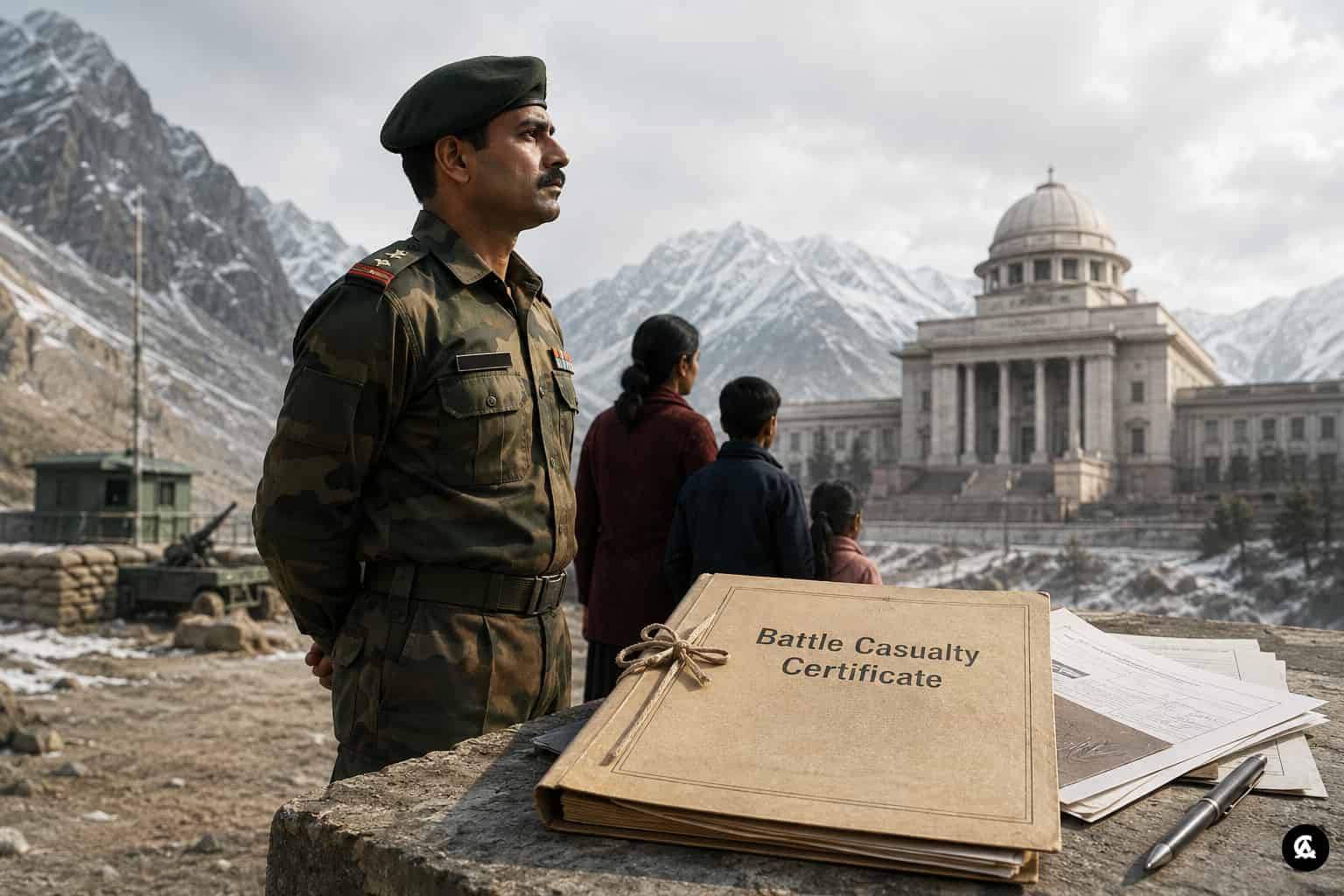
For Saksham Rathore, the most important document in his application was not a university degree or an employment certificate.
It was the Battle Casualty Certificate issued after the death of his father, Brigadier Abhimanyu Singh Rathore.

The Indian Army had officially classified the officer’s death as a battle casualty. Haryana authorities, however, repeatedly refused to give Saksham compassionate appointment, arguing that his father had died because of a medical condition rather than direct enemy action.
The disagreement eventually reached the Punjab and Haryana High Court.
On 17 July 2026, the court quashed three rejection orders and directed Haryana to treat Saksham as eligible under the state’s policies for dependants of battle casualties. The appointment process was ordered to be completed within four months of receiving the certified judgment.
The decision is important not merely because one applicant secured relief.
It raises a much larger question for military families:
Can a state government disregard the Army’s official battle-casualty classification by using a narrower interpretation of words such as “martyr” and “killed in action”?
In this case, the High Court’s answer was clear.
Who was Brigadier Abhimanyu Singh Rathore?
Brigadier Abhimanyu Singh Rathore was a serving Indian Army officer deployed during Operation Snow Leopard, the military operation associated with the India-China border confrontation.
Court reports state that the medical condition leading to his death developed while he was serving in the high-altitude operational environment of Leh, Ladakh. He later underwent treatment at Command Hospital, Chandigarh, and died on 30 July 2023.
His condition was identified in the court record as Cerebral Venous Thrombosis, or CVT—a clot in the veins that drain blood from the brain.
The High Court linked the circumstances of the illness to the risks of high-altitude operational service. It rejected the idea that the death could simply be separated from the officer’s deployment and treated like an ordinary illness unrelated to military duty.
Military authorities subsequently issued a Battle Casualty Certificate dated 10 January 2024 under the applicable Army policy.
That official classification became the foundation of his son’s claim.
Why did his son apply for compassionate appointment?
Saksham Rathore is reported to be a B.Com graduate and MBA degree holder.
After the Army classified his father’s death as a battle casualty, his application for compassionate appointment was forwarded to the Haryana authorities in January 2024. He sought employment under the state’s welfare policies covering dependants of Armed Forces personnel who become battle casualties.
Compassionate appointment is not an automatic inheritance of a government job.
It is a welfare measure governed by the wording, eligibility conditions and procedures of the applicable policy. In Saksham’s case, the dispute centred on whether the state’s policies covered the dependant of an officer whose death had been officially classified as a battle casualty but had resulted from a medical condition developed during operational deployment.

Why did Haryana reject the application?
The application was rejected through orders dated:
- 16 February 2024
- 24 May 2024
- 4 December 2025
The state’s principal position was that its policy applied to dependants of “martyrs,” while Brigadier Rathore had died due to a medical condition and had not been killed directly in hostile action.
It also argued that the later 2023 policy could not be applied retrospectively. Saksham’s case was that the earlier 2018 policy already covered dependants of battle casualties.
This transformed the dispute into a question of terminology.
The Army had used the official classification Battle Casualty.
The state focused on whether he could be described as a martyr.
The court found that this distinction was inconsistent with the policy framework and the military classification already issued by the competent authority.
“Martyr” and “battle casualty” are not interchangeable administrative terms
In public conversation, the word “martyr” is frequently used to honour personnel who die in service to the nation.
However, official welfare decisions depend on recognised classifications and policy language rather than emotional or ceremonial terminology.
The High Court observed that the Armed Forces use Battle Casualty as the relevant official expression. It also noted that Haryana’s 2018 policy had expressly widened eligibility to include dependants of battle casualties, while the 2023 framework further addressed such cases.
This was crucial.
Once the competent military authority had declared the death a battle casualty, the state could not deny the related welfare benefit by substituting its own narrower description of the death.

What did the High Court decide?
Justice Nidhi Gupta criticised Haryana’s approach as excessively technical and unsympathetic.
The court held that the state could not create an artificial distinction between “martyr” and “battle casualty” when its own policy included the latter category.
It also rejected the argument that the Brigadier’s death was merely the result of an ordinary disease. The judgment treated the high-altitude operational circumstances and the resulting medical condition as inseparable from his military service.
The court therefore:
- Quashed all three rejection orders
- Directed Haryana to recognise Saksham as eligible
- Ordered the state to grant compassionate appointment
- Set a four-month time limit from receipt of the certified order
Why the Battle Casualty Certificate became decisive?
A battle-casualty certificate is not merely a condolence document.
It records an official service classification made by the competent defence authority under the applicable military rules.
That classification can become important in claims involving:
- Ex-gratia assistance
- State welfare schemes
- Compassionate appointment
- Education benefits
- Housing or rehabilitation support
- Other policy-linked entitlements
The exact benefit still depends on the relevant central or state policy. A battle-casualty certificate does not automatically create every possible entitlement.
But in this case, it prevented Haryana from treating the death as an ordinary medical event after the Army had officially classified it otherwise.

Does a battle casualty always mean death from enemy fire?
No.
The term can be wider than the popular understanding of a soldier being killed directly by enemy fire.
Military classification depends on the circumstances recognised under the applicable rules. Operational accidents, environmental conditions and certain deaths occurring in operational areas may be dealt with differently from ordinary physical casualties.
However, every case must be assessed on its own official record.
Families should not assume that every death or illness occurring during service will automatically be classified as a battle casualty. That decision rests with the competent military authority under the relevant policy.
In Brigadier Rathore’s case, the Army had already completed that assessment and issued the certificate.
Why this judgment matters for defence families?
The ruling carries four practical lessons.
1. Operational conditions can have medical consequences
Military danger is not limited to bullets, explosions or direct contact with an adversary.
Personnel deployed at extreme altitude may face oxygen deficiency, severe cold, dehydration and other physiological risks. The judgment recognised that a service-related medical condition arising in an operational environment cannot always be treated like an unrelated civilian illness.
2. Official classifications matter more than informal terminology
Government departments must examine the certificate and applicable policy rather than relying only on popular expressions such as “martyr.”
3. Rejection orders must follow the policy
A welfare application cannot be denied merely by repeating a conclusion. Authorities must consider the documents, policy provisions and the applicant’s actual eligibility.
4. Families may need to challenge an incorrect interpretation
Saksham’s application was rejected three times before the court intervened.
The case shows why families should preserve every application, forwarding letter, certificate and rejection order.

Does this judgment give automatic jobs to all battle-casualty families?
No.
This is an important limitation.
The judgment arose from:
- A particular family’s facts
- An official Army battle-casualty certificate
- Haryana’s 2018 and 2023 policies
- Three specific rejection orders
- The petitioner’s eligibility claim under those policies
It does not establish that every dependant of every battle casualty anywhere in India automatically receives a government job.
Other cases may involve different:
- State policies
- Eligibility limits
- Educational qualifications
- Application deadlines
- Family circumstances
- Categories of employment
- Military classifications
The ruling is highly relevant as a legal precedent, particularly where a state attempts to disregard an official military classification. But each claimant must still establish eligibility under the policy that applies to them.
Can Haryana appeal the decision?
A High Court judgment can potentially be challenged before a higher judicial forum.
As of the reports reviewed, no confirmed appeal or stay order had been publicly reported.
Until such an order emerges, the High Court’s direction requires the state to complete the appointment exercise within the period specified by the court.
What should a defence family do after receiving a rejection?
A rejection does not necessarily mean the claim is legally invalid.
Families may consider the following steps:
- Obtain the complete written rejection order.
- Compare the stated reason with the applicable policy.
- Confirm that the correct casualty classification is recorded.
- Obtain copies of all forwarding letters from military authorities.
- Submit a representation seeking a reasoned review.
- Preserve proof of submission and receipt.
- Seek qualified legal advice where the policy appears to have been incorrectly interpreted.
This is general information, not individual legal advice. Deadlines and remedies can vary from case to case.

Frequently asked questions
Who is Saksham Rathore?
Saksham Rathore is the son of late Brigadier Abhimanyu Singh Rathore. He approached the Punjab and Haryana High Court after Haryana repeatedly rejected his application for compassionate appointment.
When did Brigadier Abhimanyu Singh Rathore die?
He died on 30 July 2023 after treatment for a medical condition whose onset was linked in the court proceedings to his high-altitude operational deployment.
When was the death declared a battle casualty?
Military authorities issued the Battle Casualty Certificate on 10 January 2024.
Why was compassionate appointment denied?
Haryana argued that the policy applied to dependants of “martyrs” and that the officer had died from a medical condition rather than direct hostile action.
What did the High Court order?
The court quashed the three rejection orders and directed Haryana to treat Saksham as eligible and grant compassionate appointment within four months of receiving the certified order.
Does the ruling apply automatically across India?
No. It interprets a specific case under Haryana’s policies. Other claims must be assessed under the rules applicable to the claimant.
Is a battle casualty limited to death from enemy firing?
Not necessarily. The competent military authority determines the classification under the relevant rules and circumstances.
Conclusion
Brigadier Abhimanyu Singh Rathore’s family possessed what should have been the clearest document in the case: an official Battle Casualty Certificate issued by the Army.
Yet the compassionate-appointment claim was rejected three times because the state adopted a narrower understanding of how an operational death should be described.
The Punjab and Haryana High Court brought the case back to its essential point.
The officer’s medical condition arose during high-altitude operational service. The competent military authority classified his death as a battle casualty. Haryana’s own welfare policies recognised battle-casualty dependants.
The state therefore could not use semantics to erase the significance of that classification.
The judgment’s strongest message is not that every military family is automatically entitled to employment.
It is this:
A welfare policy meant for service families must be interpreted through its purpose, its actual wording and the official military record—not through an artificial distinction that defeats the benefit itself.
For defence families, the case also delivers a practical lesson: preserve every service certificate, policy letter, forwarding document and rejection order.
Sometimes one official classification can determine the entire course of a welfare claim.
Sources:-
- Punjab and Haryana High Court judgment — direct PDF
Saksham Rathore v. State of Haryana and Others, CWP-5345-2026, decided 17 July 2026 - CourtBook — case summary and order details
Punjab and Haryana HC grants compassionate appointment to son of Battle Casualty Army officer - The Indian Express
‘Battle casualty’: Punjab and Haryana High Court orders job for late Army man’s son - The Tribune
HC raps Haryana for denying job to battle-casualty officer’s son - LiveLaw
High Court slams Haryana for denying compassionate appointment to officer’s son - LiveLaw-hosted judgment PDF — alternate direct copy
Download the 15-page High Court order _



Leave a Reply