

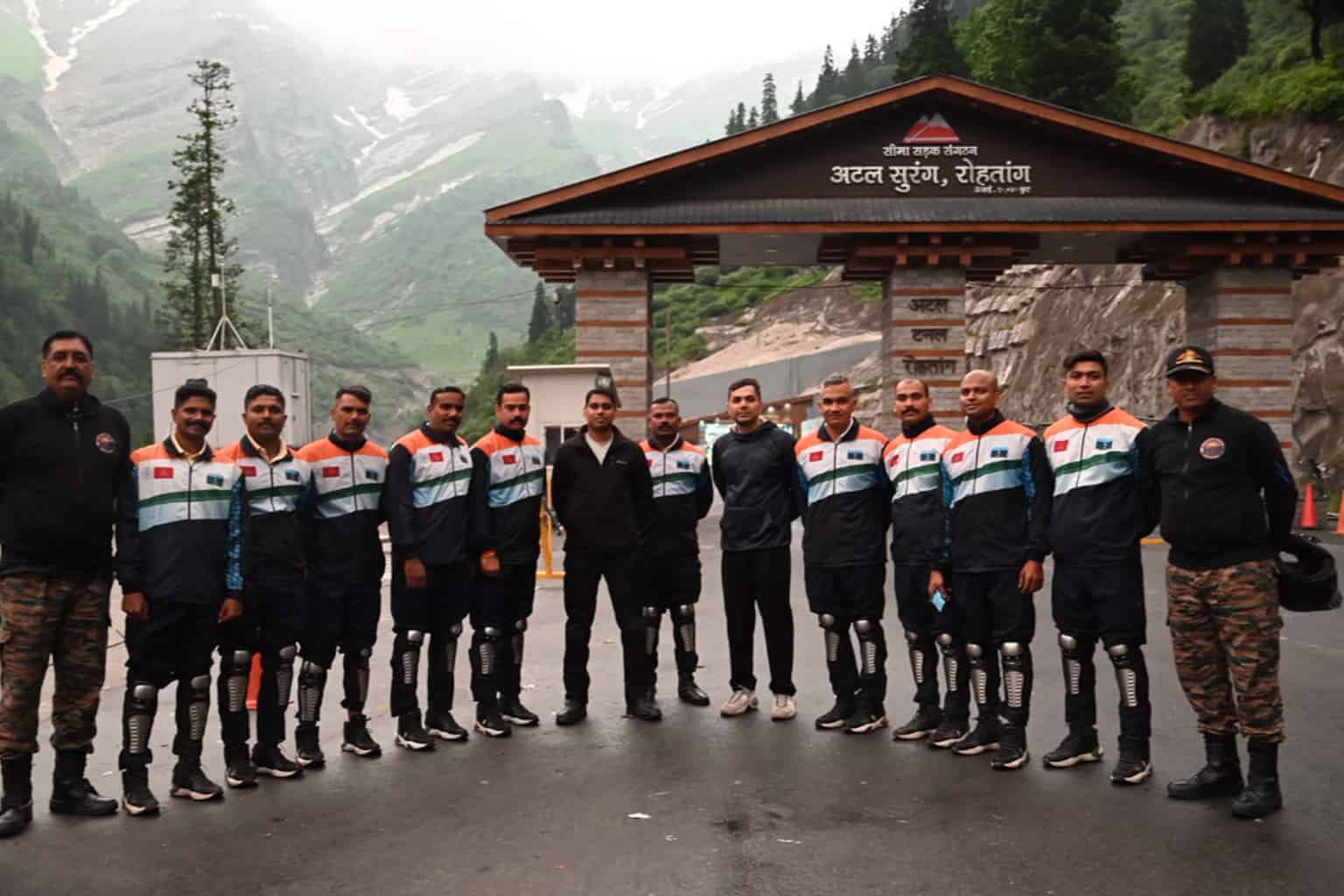
Ten Indian Army riders, two motorcycles, a 9.8-kilometre high-altitude tunnel and less than ten minutes to complete an extraordinary display of balance and teamwork.
On 1 July 2026, the Indian Army’s Corps of Signals Dare Devils team travelled through the Atal Tunnel near Rohtang with five riders balanced on each motorcycle. The Ministry of Defence stated that the team completed the entire tunnel in 9 minutes and 47.97 seconds at an altitude of approximately 10,075 feet.

The feat formed part of the nationwide “Wheels of Valour: Sanchar Shakti” motorcycle expedition, organised as a tribute to the courage and sacrifice associated with Kargil Vijay Diwas.
Although the operation has gained attention because of its visual impact, it should not be treated merely as a motorcycle stunt. It required months of training, technical preparation, coordination, physical endurance and exceptional trust between the riders.

Atal Tunnel record at a glance
| Detail | Official information |
|---|---|
| Date of performance | 1 July 2026 |
| Team | Corps of Signals Dare Devils |
| Number of riders | 10 |
| Number of motorcycles | 2 |
| Riders per motorcycle | 5 |
| Distance covered | 9.8 kilometres |
| Time taken | 9 minutes 47.97 seconds |
| Altitude | Around 10,075 feet |
| Location | Atal Tunnel, Rohtang |
| Expedition | Wheels of Valour: Sanchar Shakti |
| Purpose | Tribute linked to Kargil Vijay Diwas |
The figures were first released by the Ministry of Defence through PIB on 2 July 2026 and were later included in the Government’s official Kargil Vijay Diwas 2026 backgrounder.
What exactly did the Army riders accomplish?
The performance involved ten trained riders travelling through the complete Atal Tunnel on only two motorcycles.
This means that five riders had to remain positioned on each moving motorcycle while the machines covered 9.8 kilometres.
Unlike a brief balancing display performed inside an enclosed stadium, this formation had to remain stable during a continuous high-altitude tunnel crossing.
The riders had to coordinate:
- Body position
- Weight distribution
- Speed
- Balance
- Formation stability
- Communication
- Entry and exit timing
- Response to any unexpected movement
According to the Ministry of Defence, the attempt demonstrated military precision, endurance, teamwork and specialised riding skills.
How fast did the motorcycles travel?
Based on the officially stated distance and time, the motorcycles maintained an average speed of approximately 60 kilometres per hour.
The calculation is:
- Distance: 9.8 kilometres
- Time: 9 minutes 47.97 seconds
- Equivalent time: approximately 0.1633 hours
- Average speed: approximately 60 km/h
This is an average calculated from the official figures. It does not reveal the motorcycles’ maximum speed or the exact speed maintained during individual sections of the tunnel.
The significance lies in maintaining a multi-rider formation over the full distance, rather than simply completing the route quickly.

Why was the performance particularly demanding?
Motorcycle display riding becomes more difficult when several people share one moving machine.
Each rider changes the motorcycle’s:
- Centre of gravity
- Total load
- Aerodynamic behaviour
- Acceleration response
- Braking requirement
- Steering sensitivity
Even a small movement by one rider can affect the balance of the entire formation.
Inside a long tunnel, the team also has to operate in an enclosed environment with artificial lighting, limited lateral space and a continuous road surface that leaves little room for formation correction.
The Ministry of Defence said the achievement followed months of intensive training, rehearsal and technical preparation.
Why did the riders choose Atal Tunnel?
Atal Tunnel is located beneath the Rohtang Pass and provides strategic all-weather connectivity in Himachal Pradesh.
The Ministry of Defence describes it as the world’s longest highway tunnel situated above 10,000 feet. The record attempt took place at an altitude of approximately 10,075 feet.
The location added several layers of meaning:
- It represented modern infrastructure in a strategically important Himalayan region.
- The high-altitude setting tested endurance and preparation.
- The enclosed tunnel created a distinct technical environment.
- The route matched the expedition’s wider journey towards Ladakh and the Kargil War Memorial.
The team reached Palchan on 30 June before undertaking the tunnel performance on 1 July.
Who are the Corps of Signals Dare Devils?
The Dare Devils are the motorcycle display team associated with the Indian Army’s Corps of Signals.
Their displays are designed around precision riding, balance, formation control and teamwork. The Atal Tunnel performance reflected the qualities normally associated with military training: repeated practice, discipline and confidence in every member of the team.
The broader expedition also highlighted the role of the Corps of Signals in supporting military communication and information connectivity during peace and operations.
The riders were not merely representing an adventure team. They were carrying the identity and traditions of an Army arm responsible for keeping military formations connected.

Why was it dedicated to Kargil Vijay Diwas?
The performance was conducted as part of activities honouring the courage, sacrifice and determination demonstrated during the 1999 Kargil War.
Kargil Vijay Diwas is observed on 26 July each year to commemorate India’s victory in Operation Vijay and remember the personnel who made the supreme sacrifice.
The motorcycle expedition connected remembrance with youth outreach, adventure and military professionalism.
The Government’s Kargil Vijay Diwas 2026 backgrounder later highlighted the Atal Tunnel performance as one of the commemorative initiatives associated with the occasion. It stated that the Dare Devils created a new world record on 1 July 2026.
This association gives the performance greater depth.
The riders were not attempting a record solely for spectacle. The expedition carried a message about courage, discipline, national service and remembrance.
What was the Wheels of Valour: Sanchar Shakti expedition?
“Wheels of Valour: Sanchar Shakti” was a nationwide motorcycle expedition led by the Corps of Signals.
The journey included visits to:
- War memorials
- Military establishments
- Communication centres
- Educational institutions
- Veterans’ locations
- NCC cadet gatherings
- Youth-interaction programmes
The purpose was to honour military heritage while encouraging young citizens to value discipline, service and nation-building.
Supporting reports state that a 20-member expedition team included officers, Junior Commissioned Officers, Other Ranks and women associated with the Corps of Signals. The expedition eventually reached the Kargil War Memorial at Dras after an 11-day journey through difficult terrain.
The journey continued beyond the Atal Tunnel
The record attempt was one milestone within a wider expedition.
After completing the tunnel feat, the team continued towards the Kargil region. Its activities were designed to connect military history with the present generation.
At the Kargil War Memorial, the expedition paid tribute to those who fought and died during the conflict.
This progression created a clear narrative:
Adventure → endurance → remembrance → youth inspiration
The motorcycles attracted public attention, but the final destination reinforced the purpose behind the journey.

Which organisations supported the record attempt?
A performance involving several riders inside a strategic high-altitude tunnel required cooperation beyond the motorcycle team.
The official release acknowledged support from:
- District Administration, Manali
- Himachal Pradesh Police
- Border Roads Organisation
- Director General Border Roads
- Project Yojak
- Project Deepak
- 38 Border Roads Task Force
Lieutenant General Vivek Dogra, Signal Officer-in-Chief and Colonel Commandant of the Corps of Signals, thanked the participating authorities for their planning, cooperation and support.
Their role would have been important for safe coordination, route management and the controlled conduct of the attempt.
Was it a successful world record or only an attempt?
This requires careful wording.
The Ministry of Defence’s original 2 July release described the performance as a successfully completed “new World Record attempt.”
The official Kargil Vijay Diwas backgrounder issued on 24 July went further and stated that the Corps of Signals Dare Devils “created a new world record” on 1 July.
However, no separate publicly available certificate from Guinness World Records or another independent record-certifying organisation was located among the reviewed sources.
Therefore, the most accurate wording for publication is:
According to the Ministry of Defence, the Corps of Signals Dare Devils created a new world record inside the Atal Tunnel.
The article should not call it a “Guinness World Record” unless an official Guinness certificate or listing is produced.
What should not be claimed?
Avoid publishing unsupported statements such as:
- It has been certified by Guinness World Records.
- It was the fastest motorcycle crossing ever recorded inside any tunnel.
- The riders faced combat conditions.
- The tunnel was opened specially without any safety arrangements.
- The motorcycles crossed at a fixed maximum speed.
- No other team has attempted a similar formation anywhere in the world.
The verified facts are already powerful enough. Exaggeration would reduce the article’s credibility.

Why did the performance become social-media friendly?
The story contains several elements that naturally attract online attention:
- An instantly understandable number: ten riders
- Only two motorcycles
- A famous landmark
- A complete tunnel crossing
- A time below ten minutes
- Indian Army participation
- High-altitude conditions
- Kargil Vijay Diwas connection
The visual itself communicates the difficulty even before a viewer reads the details.
However, the most useful content should go beyond amazement.
A strong article should explain that the performance depended on collective discipline. Five riders on one motorcycle cannot succeed through individual bravery alone. Every person must understand the movements and limitations of the other four.
That is why the record serves as a practical symbol of teamwork.
What can young people learn from the Dare Devils?
The performance offers four positive lessons.
Preparation comes before performance:
The few minutes seen by the public were backed by months of training.
Trust must be earned:
Every rider depended on the discipline of the others.
Individual skill must support the team:
A talented rider acting independently could destabilise the entire formation.
Courage requires control:
Military adventure is not careless risk-taking. It combines confidence with planning and safety.
These lessons explain why the expedition was used to inspire NCC cadets and young citizens.
Frequently asked questions
When was the Atal Tunnel performance conducted?
It took place on 1 July 2026. The Ministry of Defence issued its initial release on 2 July.
How many riders participated?
Ten riders participated on two motorcycles—five riders on each motorcycle.
How long is Atal Tunnel?
The distance covered during the performance was 9.8 kilometres.
How much time did the riders take?
They completed the route in 9 minutes and 47.97 seconds.
What was their approximate average speed?
The official distance and time produce a calculated average of approximately 60 km/h.
Was the feat connected with Kargil Vijay Diwas?
Yes. The expedition and world-record initiative were dedicated to honouring the courage and sacrifice associated with Kargil Vijay Diwas.
Was it a Guinness World Record?
The Ministry of Defence later described it as a new world record. No separate publicly available Guinness certification was found in the reviewed sources.
What does Sanchar Shakti mean in this context?
It was the title used for the Corps of Signals’ Wheels of Valour expedition, reflecting communication capability, military heritage and national outreach.
Did the expedition end at Atal Tunnel?
No. The team continued its journey and reached the Kargil War Memorial at Dras, where it paid tribute to the personnel who sacrificed their lives during the Kargil War.
Conclusion
The Atal Tunnel achievement lasted less than ten minutes, but it represented months of preparation.
Ten Corps of Signals Dare Devils rode through a 9.8-kilometre high-altitude tunnel on only two motorcycles. The riders maintained a complex formation while travelling at an average speed of approximately 60 km/h.
According to the Ministry of Defence, the performance created a new world record.
Its larger meaning came from the journey surrounding it.
The Wheels of Valour: Sanchar Shakti expedition connected military adventure with remembrance. It honoured Kargil heroes, visited war memorials, interacted with veterans and encouraged young citizens to value discipline and national service.
The visual may look like a spectacular motorcycle stunt, but the principle behind it was deeply professional:
Ten individuals succeeded because they moved as one team.
That combination of skill, trust, preparation and purpose is what made the Atal Tunnel performance significant.
Official and supporting sources
- Ministry of Defence/PIB release dated 2 July 2026.
- PIB Kargil Vijay Diwas 2026 official backgrounder dated 24 July 2026.
- The Tribune’s report on the Atal Tunnel attempt and supporting agencies.
- Report on the expedition reaching the Kargil War Memorial.
Editorial note
This article uses the term “world record” with attribution to the Ministry of Defence. It does not claim independent Guinness World Records certification because no separate public certificate was found among the reviewed sources.
Sources:-
1. Primary official source — Ministry of Defence/PIB
Corps of Signals Dare Devils Attempt New World Record at Atal Tunnel
Issued on 2 July 2026, this is the main official source. It confirms:
- Performance held on 1 July 2026
- Corps of Signals Dare Devils
- 10 riders on two motorcycles
- 9.8-km Atal Tunnel crossing
- Time: 9 minutes 47.97 seconds
- Altitude: 10,075 feet
- Connection with Kargil Vijay Diwas
- Cooperation from Manali administration, Himachal Police, BRO projects and 38 BRTF
2. PIB Kargil Vijay Diwas 2026 backgrounder
Kargil Vijay Diwas 2026: A Tribute to Valour, Sacrifice and the Spirit of India
Published on 24 July 2026, this later official document states that the Dare Devils “created a new world record” on 1 July. It repeats the 10 riders, two motorcycles, 9.8 km and 9:47.97 figures.
Official PDF version of the PIB backgrounder
3. Ministry of Defence — official Facebook post
Ministry of Defence Facebook post on Wheels of Valour: Sanchar Shakti
The official Ministry account highlights the Atal Tunnel feat and the expedition’s onward journey to the Kargil War Memorial.
4. Ministry of Defence — official Instagram coverage
Open the official Instagram post
The post covers the world-record feat, difficult terrain, courage, endurance and military precision during the expedition.
Ministry of Defence official Instagram account
5. Fire and Fury Corps — official expedition update
Official Fire and Fury Corps X post
This supports the broader expedition timeline and confirms that the Wheels of Valour–Sanchar Shakti team reached the Kargil War Memorial on 4 July 2026.
6. The Tribune
10 riders, 2 motorcycles, 1 record bid inside Atal Tunnel
This report cites a defence spokesperson and adds details about training, high-altitude conditions, safety protocols and support from local authorities and the Border Roads Organisation.
7. United News of India
Corps of Signals Dare Devils create world record at Atal Tunnel
UNI describes it as the defining achievement of the national expedition and confirms all the major figures.
8. Defence and regional supporting report
Army’s Corps of Signals Dare Devils attempt new world record inside Atal Tunnel
This report is based on the Defence Wing/PIB release and includes the high-altitude, training and safety aspects.
9. Expedition reaching Kargil War Memorial
Wheels of Valour: Sanchar Shakti reaches Kargil War Memorial
This report explains the wider 11-day journey, the 20-member expedition team, war-memorial visits, youth interaction and the Atal Tunnel feat as a key milestone.
10. DD India — Kargil Vijay Diwas context
Kargil Vijay Diwas: A legacy of courage that continues to shape India’s defence journey
This government broadcaster’s report places the expedition among the official 2026 Kargil Vijay Diwas commemorative activities.



Leave a Reply