

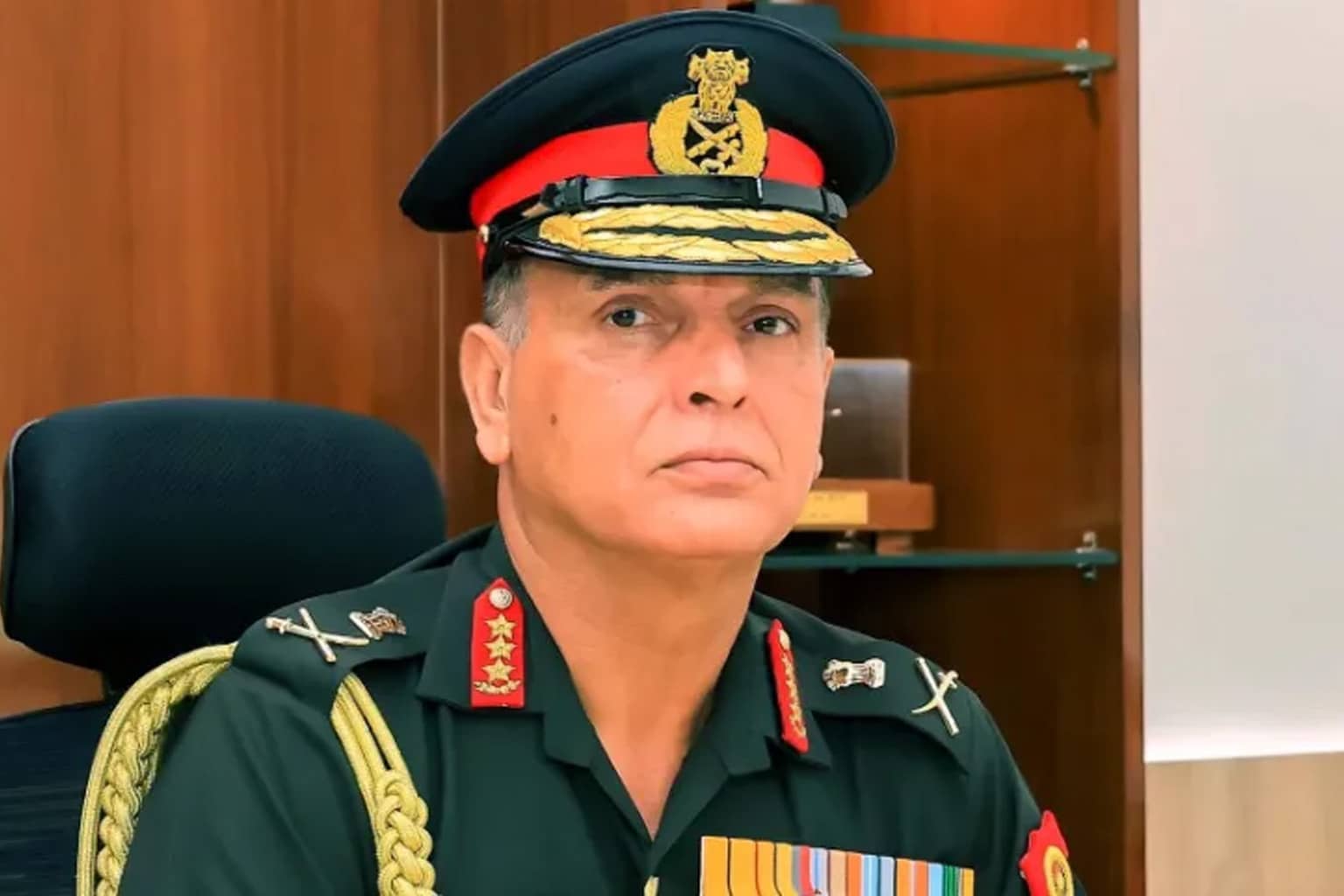
Every Army Chief receives the baton in silence before the country begins to understand what that moment really means.
On paper, it is a change of appointment. One name replaces another. One photograph appears where another stood before. But inside the Indian Army, the change of Chief is never just a ceremonial line. It is a shift in responsibility, direction and expectation.

General Dhiraj Seth, PVSM, UYSM, AVSM, has taken over as the 31st Chief of the Army Staff, succeeding General Upendra Dwivedi, who completed more than four decades of service and relinquished the appointment of COAS on 30 June 2026.
The appointment was announced earlier. Now the command has formally moved.
And that is why this story deserves to be written again — not as a repeat, but as the beginning of a new Army chapter.
From announcement to command
On 13 June 2026, the Government appointed Lt Gen Dhiraj Seth as the next Chief of the Army Staff with effect from the afternoon of 30 June 2026. At that time, he was serving as Vice Chief of the Army Staff. The same release said General Upendra Dwivedi would retire from service on the same day.
That was the first story: who is Lt Gen Dhiraj Seth and why was he appointed?
The new story is different.
General Dhiraj Seth is no longer the officer-designate. He is now the serving Chief of the Indian Army. Current reports confirm that he has taken over as the 31st COAS as General Upendra Dwivedi concludes his tenure.
For readers, this distinction matters. Appointment is a government decision. Assumption of charge is the moment responsibility becomes real.
Why this transition matters?
The Indian Army is not entering a quiet period. It is already moving through a major transformation cycle. The outgoing Chief’s official farewell note says Gen Upendra Dwivedi’s tenure focused on operational preparedness, jointness among the Services, transformation, technology absorption, force restructuring and soldier-centric initiatives.
That means General Dhiraj Seth is not taking charge of an Army standing still.
He is taking charge of an Army already preparing for a battlefield shaped by drones, surveillance, electronic warfare, precision weapons, integrated formations, faster decision-making and joint operations with the Navy and Air Force.
This is why the new Chief’s background becomes important.
An Armoured Corps officer at the top
General Dhiraj Seth was commissioned into the Armoured Corps in December 1986. The official appointment release says he has nearly four decades of experience across operational, strategic, capability-development and institutional domains.
That Armoured Corps background gives this story a distinct character.
Armoured Corps officers are shaped by mobility, firepower, speed, shock action and battlefield manoeuvre. They are trained to think not only about holding ground, but about moving through the battlefield with purpose and pressure.
At a time when the Army is thinking about future wars, integrated battle groups, mechanised capability, drones and technology-led combat, an officer with this background brings a particular operational lens.
Current reports also note that General Seth is the first Armoured Corps officer to head the Army since General Shankar Roy Chowdhary, who retired in 1997.
That makes the leadership change more than a routine seniority transition.
A career across different battle spaces
General Seth’s career is not limited to one type of soldiering.
The official appointment release says he commanded an Armoured Regiment in the desert sector, an Armoured Brigade in the Western Theatre and a Counter-Insurgency Force in Jammu & Kashmir. As a Lieutenant General, he commanded the Sudarshan Chakra Corps, described by PIB as one of the Army’s premier strike formations.
This combination matters.
Desert operations teach mobility and logistics.
Western Theatre command teaches conventional military pressure.
Counter-insurgency teaches patience, restraint and ground intelligence.
Strike Corps command teaches speed, scale and operational decision-making.
Together, these experiences create a Chief who has seen both the heavy and human sides of soldiering.
Two operational commands, one larger view
General Seth also commanded South Western Command and Southern Command, earning what PIB calls the rare distinction of commanding two operational Army Commands.
This is not a small career note.
An Army Commander does not look only at one unit or one formation. He must understand logistics, borders, training, command readiness, inter-service coordination, civil-military expectations and long-term preparedness.
Commanding two operational commands gives a wider view of how the Army functions across geography, threats and administrative complexity.
For a COAS, that kind of exposure is valuable because the Army Chief must think beyond one theatre. He must prepare the entire force.
The modernisation connection
The most important part of General Seth’s profile is not only where he served, but what kind of institutional work he handled.
PIB says he held pivotal appointments in Strategic Planning and Capability Development verticals of Army Headquarters, shaping the Army’s modernisation trajectory, capability roadmap and long-term force-structuring initiatives. It also says his work helped align operational requirements with emerging technologies and future battlefield needs.
This is the line that gives your article its strongest angle.
General Seth is taking charge when the Army is not only buying new equipment. It is trying to rethink how it will fight, move, communicate, strike and survive.
The future battlefield will not wait for slow systems. It will reward speed, information, precision, electronic protection, drones, battlefield networking and jointness.
A Chief with capability-development experience will be judged by how fast these ideas move from file to formation.
What Gen Dwivedi leaves behind?
To understand General Seth’s challenge, we must understand what General Upendra Dwivedi leaves behind.
The official PIB note says Gen Dwivedi maintained operational readiness across theatres, kept a vigilant posture along the northern borders under OP SNOW LEOPARD, discharged responsibilities on the western front with resolve and professionalism, and saw OP SINDOOR as a defining moment of his tenure.
The same release also says initiatives such as Rudra Brigades, Bhairav Battalions, Ashni Drone Platoons, Shaktibaan Regiments, Divyastra Batteries, Electronic Warfare Brigades and Integrated Battle Groups were progressed as part of building a modern, agile and future-ready force.
This is the inheritance.
General Seth is not beginning from a blank page. He is taking charge of a transformation already underway.
His task is to convert direction into depth.
Jointness will remain central
Gen Dwivedi’s final message, as reported, stressed that future wars will be more joint, integrated and theatre-oriented. He said the armed forces must be able to see together, decide together and act together.
That line is important because it points to one of the biggest military shifts India is working toward: better coordination between the Army, Navy and Air Force.
For General Seth, this means the Army’s future cannot be planned in isolation. Land power will have to work with air power, maritime security, space-based surveillance, cyber systems, drones and electronic warfare.
The next Army Chief’s leadership will be watched through this lens.


Leave a Reply