

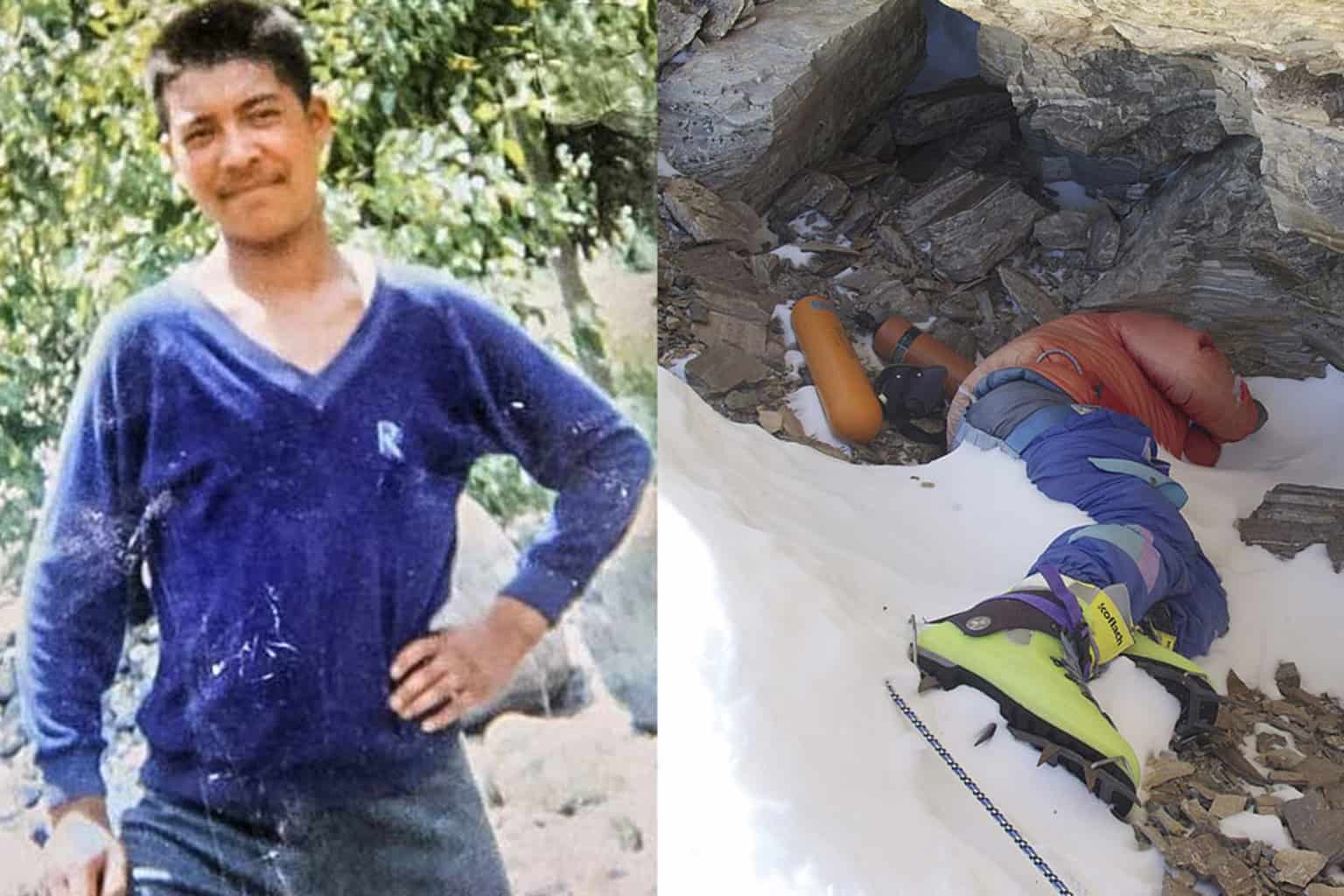
A mountain can keep a body. But it should not be allowed to keep a man’s name forever.
For almost 30 years, climbers on the north side of Mount Everest passed a frozen figure in green climbing boots. In expedition stories, documentaries and mountaineering circles, he became known as “Green Boots” — a silent landmark in the death zone, a warning before the summit, a body that the world remembered by footwear.
But before he became a landmark, he was a man.

A soldier.
A mountaineer.
An Indo-Tibetan Border Police climber.
And now, an official Government of India eProcurement record linked to ITBP identifies the recovery subject as Late Dorje Morup “Green Boot”. The tender is for a Phase-II retrieval operation from the Mount Everest Tibet side during June–September 2026, under DG, Indo-Tibetan Border Police Force.
This is not merely an Everest mystery. It is the story of a soldier whose identity was buried under a nickname — and the effort to return that identity with dignity.
He was not on Everest for adventure
Dorje Morup did not go to Mount Everest as a private tourist chasing a photograph. He was part of the Indo-Tibetan Border Police, a force whose relationship with the Himalayas is not casual.
The Himalayan Journal describes ITBP as a mountain force working close to the Greater Himalayan range, where rock climbing training was treated as essential and selected personnel received higher mountaineering training.
That background matters.
For ITBP personnel, mountains are not only scenery. They are training grounds, operational spaces and tests of endurance. A climber from such a force carries discipline, national pride and institutional responsibility into the snow.
Dorje Morup’s name also appears in an older ITBP mountaineering record. In 1973, he was listed among the summiters of Kakstet in the Pangong range, a 6,442-metre peak recorded as a first ascent.
So before the world ever called him Green Boots, Dorje Morup already had a mountaineering past. He was not a nameless figure on Everest. He was a trained Indian soldier-climber who had stood on difficult Himalayan ground long before the tragedy.
The 1996 Everest expedition
In 1996, an Indian ITBP expedition attempted Mount Everest from the North Ridge, the Tibet side. The Himalayan Journal records it as the Indian ITBP expedition to the North Ridge of Everest, where three climbers died after their ascent on 10 May 1996, while four others reached the summit later on 17 May 1996.
The first summit group included T. Smanla, Dorji Murup and Chewang Paljor, along with other members. On 10 May, the team was above Camp 6, moving through some of the most dangerous ground on Everest. The weather was closing in, the start had been late, and the men were climbing in the altitude zone where even trained bodies begin to fail.
Some members turned back near the First Step. But Smanla, Dorji and Paljor continued. They cleared the Second Step, moved toward the summit, and at around 1830 hrs Smanla radioed that the three had reached the top.
That moment should have been remembered as achievement.
But Everest does not end at the summit.
By 1900 hrs, a storm was raging over the summit section and radio contact was gone. At around 1930 hrs, two head-torches were seen moving in the darkness. Then the lights disappeared.
Three Indian climbers never returned safely to camp.
How a soldier became “Green Boots”?
After the tragedy, one body on Everest’s north-east ridge route became famous in the climbing world because of its visible green boots. Over time, climbers began using the body as a route marker. The Guardian reported that Green Boots became a landmark near a rocky alcove around 8,500 metres on the north-east ridge, used by climbers to judge progress and timing on the route.
That is the painful part.
A man who once had a name, a rank, comrades and a service record became a point of reference.
People no longer said, “We reached the Indian climber.”
They said, “We reached Green Boots.”
The mountain did not only take his life. It slowly took his identity from public memory.
Why the identity remained confused?
For years, Green Boots was widely believed to be Tsewang Paljor, another ITBP climber who died in the same 1996 disaster. But the latest ITBP-linked government tender identifies the recovery subject as Late Dorje Morup Green Boot.
This confusion was not difficult to understand.
Three Indian ITBP climbers were lost in the same storm. Their bodies were not recovered for a formal identification process at normal ground level. The location was in the death zone, where every movement is dangerous. The world identified one visible body by a feature — the green boots — and over the years, that nickname hardened into public belief.
The Guardian also reported that the new plan identifies Green Boots as Dorje Morup, not Paljor, while noting that both men died near the summit on the same day. It also said the document refers to a prior verification process, though public details are limited.
So the responsible line is clear:
For decades, Green Boots was widely believed to be Tsewang Paljor. The latest ITBP-linked government tender, however, identifies the remains as Late Dorje Morup “Green Boot.”
Until a separate official document publicly confirms DNA or another specific method, it is better not to claim DNA confirmation as a verified fact.
Why it took nearly 30 years?
The delay was not simply neglect. Everest’s death zone is one of the hardest places on earth to bring anyone back from.
Above 8,000 metres, oxygen is dangerously low. Weather changes quickly. A living climber can barely move. A frozen body in heavy climbing equipment can become almost impossible to shift without risking more lives.
The Guardian reported that about 200 bodies remain on Everest and that bringing bodies down is often too hard, too expensive or too dangerous, with helicopters unable to safely operate at such extreme altitudes.
That is why many climbers who die on Everest remain there. The mountain becomes their grave because recovery can create another tragedy.
In Dorje Morup’s case, the difficulty was even greater because the body is on the Tibet side of Everest. The recovery is not just a climbing operation. It involves high-altitude expertise, cross-border coordination, preservation of remains, legal formalities and safe transportation.

The 2026 recovery plan
The official eProcurement record shows that ITBP’s tender is for hiring an agency to provide services for the Phase-II retrieval operation of the mortal remains of Late Dorje Morup Green Boot from the Mount Everest Tibet side during June–September 2026. It carries Tender Ref No. 17013/88/2026/GBRO and Tender ID 2026_ITBP_910831_1.
This means the proposed mission is not symbolic. It is a structured, high-risk recovery effort.
The Guardian reported that the tendered mission requires a specialist team, including experienced Sherpas, and aims to bring the remains to Delhi by October. It also described how recovery above 8,000 metres can be physically brutal and dangerous even for expert high-altitude teams.
In simple words, this is not just about climbing up and carrying someone down.
It is about entering one of the most dangerous zones on Earth to bring back a soldier who has waited there for three decades.
The man before the mystery
The real strength of this story is not the mystery of Green Boots. It is the life before the mystery.
Dorje Morup belonged to a force built around mountain endurance. ITBP’s climbing culture was not accidental; it was part of the force’s identity.
He had earlier appeared in Himalayan climbing records through the 1973 Kakstet first ascent.
Then, in 1996, he became part of an Indian ITBP expedition to Everest’s North Ridge — an attempt that brought achievement, tragedy and decades of unanswered questions.
That journey must be remembered fully.
Not only as a body in a cave.
Not only as green boots under snow.
Not only as a landmark for climbers.
But as a soldier-mountaineer who served, climbed and disappeared in the storm while carrying the pride of an Indian expedition.
Why this story matters to India?
For the world, Green Boots became part of Everest folklore.
For India, he should be remembered differently.
He was not a mountain object. He was not a warning sign. He was not a photograph to be passed around with curiosity. He was a uniformed Indian who went to Everest as part of an official climbing effort and never came back.
In defence families, dignity does not end with death. A name matters. A body matters. A family’s closure matters. A force’s memory matters.
If this recovery mission succeeds, it may not only bring down mortal remains. It may restore a name that the mountain and the world had nearly replaced.
What readers should understand?
This story must be handled carefully.
Do not reduce it to a shocking Everest tale. Do not write it as a mystery solved beyond all doubt unless official documents provide that level of proof. Do not use the old public belief and the new tender identity carelessly.
The safe understanding is this:
Dorje Morup was an ITBP soldier-mountaineer with recorded high-altitude climbing experience. He was part of the 1996 Indian ITBP Everest expedition from the North Ridge. Three climbers died after the 10 May ascent. For decades, the body called Green Boots was widely believed to be Tsewang Paljor, but the latest ITBP-linked government tender identifies the recovery subject as Late Dorje Morup Green Boot.
That is enough to write a powerful and honest story.
Final takeaway
For almost 30 years, climbers passed by Green Boots on the way to the summit of Everest.
Some saw danger.
Some saw warning.
Some saw the cruelty of the death zone.
But India must see more.
India must see Late Dorje Morup — an ITBP soldier, a trained mountaineer, a man who had climbed before Everest and who disappeared into the storm with his comrades during an Indian expedition.
The world remembered the boots.
Now, the official record may help restore the name.
And sometimes, after 30 years of silence, a name is the most dignified homecoming of all.
Sources:-
Government of India eProcurement / ITBP Tender
https://eprocure.gov.in/eprocure/app?component=view&page=WebTenderStatusLists&service=direct&sp=S6iSog%2F%2FznG2Q7vMtJkzOfw%3D%3D
Himalayan Journal — Climbs of Indo-Tibet Border Police
https://www.himalayanclub.org/hj/45/21/climbs-of-indo-tibet-border-police/
Himalayan Journal — The Indian Ascent of Qomolungma by the North Ridge
https://www.himalayanclub.org/hj/53/7/the-indian-ascent-of-qomolungma-by-the-north-ridge/
The Guardian — Green Boots identity and recovery mission
https://www.theguardian.com/world/2026/jun/22/mt-everest-green-boots-man-cave-climber-identity
The Tribune — ITBP floats tender to get body of jawan lost on Mt Everest 30 years ago
https://www.tribuneindia.com/news/india/itbp-floats-tender-to-get-body-of-jawan-lost-on-mt-everest-30-years-ago/
NDTV — ITBP launches mission to retrieve body of Green Boots climber
https://www.ndtv.com/india-news/itbp-launches-mission-to-retrieve-body-of-green-boots-climber-after-30-years-on-everest-11642026
The Times — Mission to bring home Green Boots
https://www.thetimes.com/world/asia/article/mission-to-bring-home-green-boots-everests-grisliest-landmark-z9997jrg2
Moneycontrol — ITBP tender for Everest mission
https://www.moneycontrol.com/city/itbp-floats-tender-for-daring-everest-mission-to-bring-back-lance-naik-s-body-30-years-after-his-death-article-13947184.html



Leave a Reply