

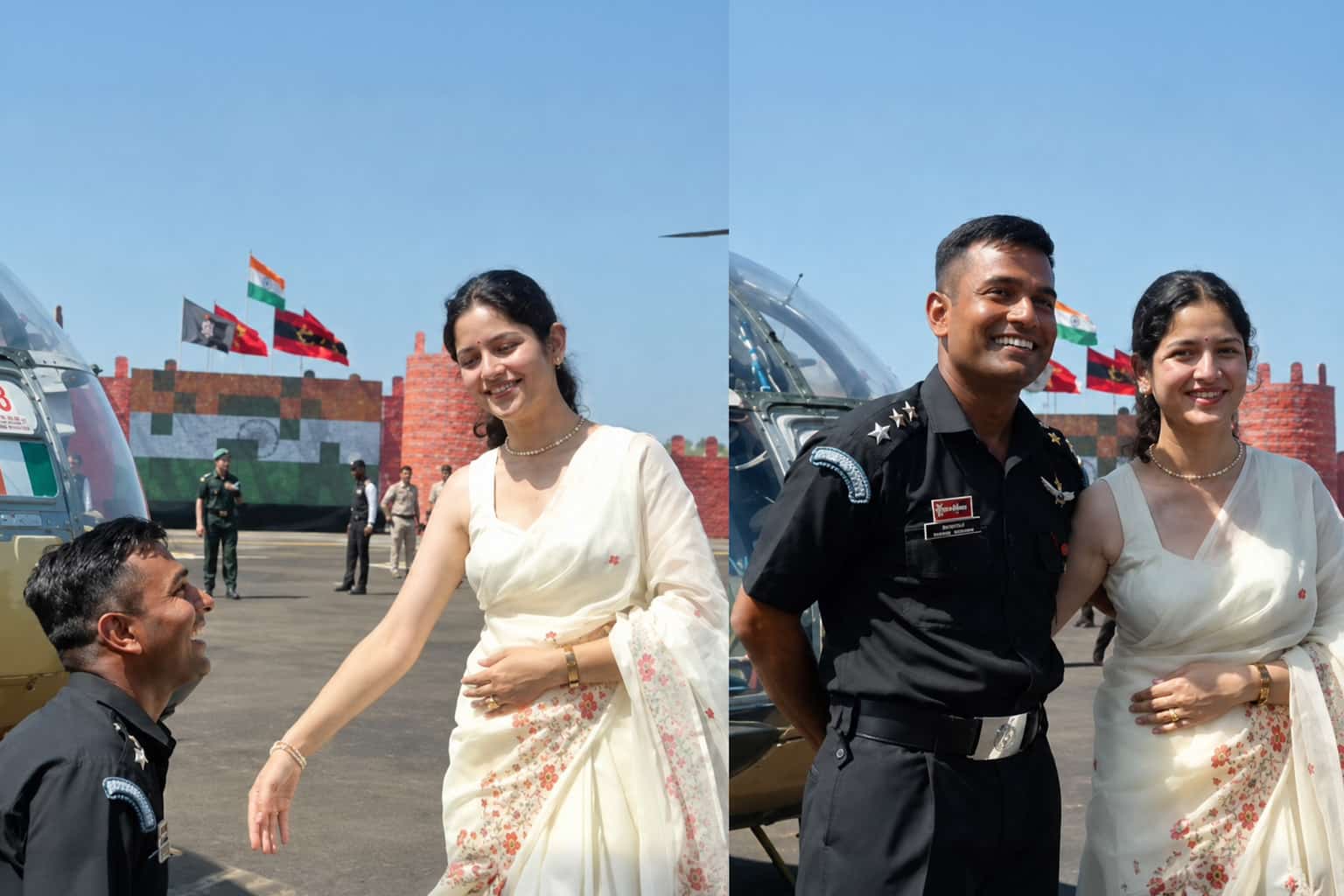
A young officer’s personal moment became a national talking point because it happened at a place where emotion and uniform meet.
After the passing-out parade at the Combat Army Aviation Training School, CAATS, Nashik, an Army Aviation Captain reportedly proposed to his partner in uniform, with a military helicopter visible in the background. The video was shared online and quickly became a viral moment.

Many people saw it as a beautiful expression of love after a major professional milestone.
But soon after, reports said the Indian Army had taken cognisance of the viral video and sought an explanation from the officer.
This is why the story needs to be understood carefully. It is not a simple “love story” and it is not a story to shame a young officer. It is a reminder that military life carries a different standard of public conduct, especially when uniform, official space and social media come together.
What happened at CAATS Nashik?
According to media reports, the moment took place after the passing-out parade at the Combat Army Aviation Training School in Nashik.
The officer, reported as Captain Bharat Bhardwaj, had completed an important aviation training milestone. After the parade, he went down on one knee and proposed marriage to his partner. Family members, fellow officers and guests were present, and the moment was recorded.
The video was later shared widely on social media, where many users described it as emotional, wholesome social media, where many users described it as emotional, wholesome and memorable.
For the officer and his family, it was clearly a very special day. Passing out from a military aviation training institution is not ordinary. It comes after months of hard work, discipline and professional effort.
That is why the proposal attracted public attention so quickly.
Why did the proposal become controversial?
The controversy did not arise only because a proposal happened.
The concern, as reported by media sources, was connected to the setting.
The officer was in uniform. The proposal happened in an official military environment. A military helicopter was visible in the background. The video was circulated widely on social media.
For the Armed Forces, these details matter.
Uniform is not treated as ordinary clothing. A parade ground is not treated like a private party venue. A military helicopter is not a decorative background. These things carry institutional dignity and operational symbolism.
This is why reports say the Army sought an explanation.
The emotional side should not be ignored
Before discussing rules and decorum, one thing must be said clearly: the personal emotion of the moment is understandable.
A young officer had completed a difficult training phase. His family was present. His partner was present. It was a day of achievement. In such a moment, a person may naturally want to make the day unforgettable.
There is no need to mock that emotion.
Defence personnel are not emotionless. They have families, relationships, dreams and personal milestones like everyone else.
But military life places those emotions inside a stricter frame of conduct.
That is the real issue here.
Why uniform changes the meaning of a personal act?
A proposal in civilian clothes at a private place is one thing.
A proposal in military uniform, at a training establishment, after an official parade, with military equipment in the background, becomes something else.
The moment is no longer purely private.
It gets attached to the institution.
When a uniformed person appears in public, people do not see only the individual. They also see the service, the regiment, the training establishment and the values represented by the uniform.
This is why the Armed Forces are careful about how uniform is used in public images and videos.
The uniform carries honour. It also carries restrictions.
Social media has changed the risk
Earlier, a personal moment in a parade area may have remained within family circles. Today, one video can travel across the country within minutes.
This is where social media changes everything.
A moment that was intended as personal can become public content. A gesture that felt spontaneous can become a debate. A short clip can be interpreted in many different ways by people who do not know the full context.
For serving personnel, this creates a new challenge.
They have to think not only about what they are doing, but also about how it will look once it appears online.
In military life, perception also matters.
Military decorum is not anti-emotion
Some people may ask: why should the Army object to a proposal?
That is not the correct way to understand the issue.
Military decorum is not against love. It is not against family. It is not against happiness.
Military decorum is about boundaries.
It asks a simple question: where should personal expression end and institutional space begin?
The Army does not function like a civilian workplace. Its symbols, equipment, uniforms and parade spaces are governed by a higher sense of discipline. What may be acceptable in a college campus or corporate office may not automatically be acceptable in a military setting.
That difference must be understood.
Why young officers need guidance in the social media age?
This incident also brings out a larger point: young officers today are serving in a world where every moment can become content.
They are trained in weapons, tactics, leadership and service conduct. But the social media environment adds a new layer of responsibility.
What can be posted?
What should not be recorded?
What background is inappropriate?
When does a personal act become institutional representation?
How should uniformed personnel behave in public digital spaces?
These questions are now part of modern military professionalism.
The issue is not only about one Captain. It is about how all young officers and soldiers understand public conduct in the age of viral videos.
The Army’s reported response should be read carefully
Reports say the Army sought an explanation from the officer.
That does not automatically mean punishment has been given. It does not mean the officer has been publicly declared guilty of a serious offence. It does not mean the Army is against his personal life.
Seeking an explanation is part of institutional review.
It allows seniors to understand what happened, why it happened, whether any rule or norm was crossed, and whether counselling or corrective guidance is needed.
This is how professional institutions maintain standards without turning every issue into public drama.
What should not be done by the public?
The public should avoid two extremes.
One extreme is to mock or shame the officer. That is unfair and unnecessary.
The other extreme is to dismiss all questions of decorum as outdated. That is also wrong.
A balanced view is better.
The proposal may have been emotional and sincere. At the same time, the Army may still be right to examine whether the setting, uniform and military backdrop were appropriate.
Both things can be true together.
Why this story became viral?
This story became viral because it had all the ingredients of social media attention: uniform, romance, parade, helicopter, family, applause and a young officer’s emotional milestone.
But viral attention often flattens serious subjects.
It turns discipline into drama and emotion into content.
A defence audience should look deeper.
The real question is not whether the proposal was sweet. The real question is how uniformed personnel should balance personal expression with military dignity in public spaces.

Lessons for defence aspirants
For defence aspirants, this incident offers an important lesson.
Joining the Armed Forces is not only about wearing the uniform. It is also about understanding what the uniform demands.
The uniform gives respect, but it also asks for restraint.
It gives identity, but it also limits casual public behaviour.
It gives pride, but it also makes the wearer responsible for institutional image.
This is why military life is different from ordinary life.
A mature way to understand the incident
A mature reading of the incident should avoid anger.
It should say:
The officer’s emotion was human.
The milestone was important.
The viral response was expected.
The Army’s concern over decorum is understandable.
The matter should be handled through guidance, sensitivity and institutional process.
This is not a matter that needs public humiliation. It is a matter that needs professional understanding.
Final view
The Army Captain’s viral proposal at CAATS Nashik is more than a social media clip.
It is a small but important case study in modern military life.
It shows that young officers today live at the intersection of tradition and technology, discipline and emotion, uniform and public visibility.
A personal moment may come from the heart, but when it happens in uniform and inside a military setting, it also becomes part of the institution’s image.
That is why this story matters.
It should not be used to shame the officer. It should be used to understand military decorum in the age of social media.
Love may be personal, but uniform carries public responsibility.
Source Note
This article is based on media reports. No separate PIB, MoD, ADGPI or Indian Army official press release or official disciplinary order was found at the time of writing. Reports say the Army sought an explanation; no confirmed punishment has been reported through an official public source.
Sources
ThePrint report:
https://theprint.in/defence/army-takes-cognisance-of-captain-proposal-viral-video-seeks-explanation/2949794/
Hindustan Times report:
https://www.hindustantimes.com/india-news/army-passing-out-parade-caats-nashik-surprise-proposal-captain-asks-partner-for-marriage-watch-101780395293761.html
Hindustan Times Trending report:
https://www.hindustantimes.com/trending/army-pilot-proposes-to-girlfriend-after-passing-out-parade-says-wanted-to-make-this-day-memorable-for-my-fianc-e-too-101780420163497.html
Moneycontrol report:
https://www.moneycontrol.com/defence/indian-army-seeks-captain-s-explanation-over-viral-proposal-in-front-of-military-helicopter-in-nashik-article-13940781.html



Leave a Reply