

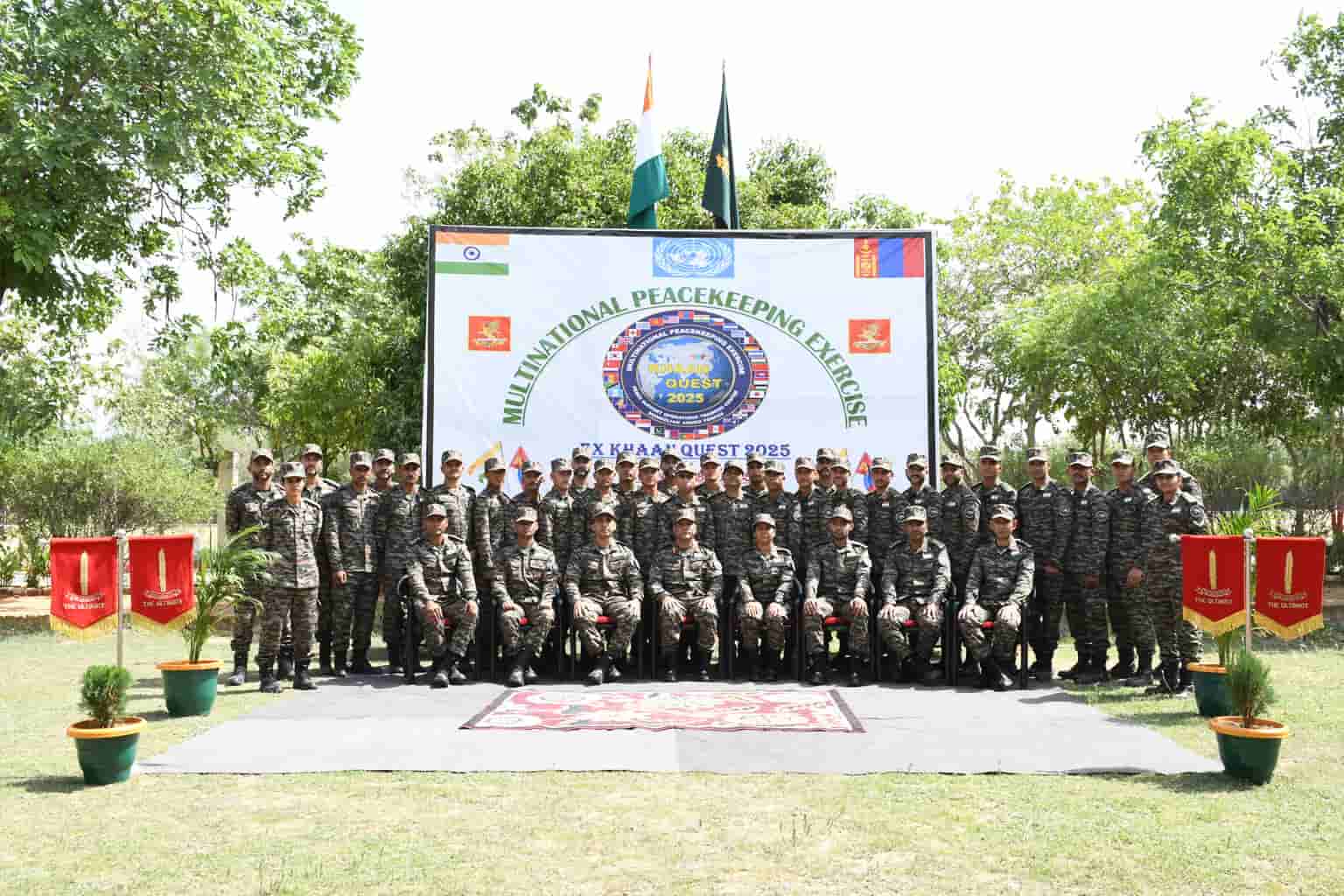
Indian Army contingent will participate in Exercise KHAAN QUEST 2026 in Mongolia from 20 June to 03 July. Know the aim, JAT Regiment participation, UN peacekeeping training drills and why this multilateral military exercise matters.

Indian Army to participate in Exercise KHAAN QUEST 2026
The Indian Army is set to participate in Exercise KHAAN QUEST 2026, a multilateral joint military exercise being conducted in Mongolia.
The exercise is scheduled from 20 June to 03 July 2026 at the Five Hills Training Area, Ulaanbaatar, Mongolia. The Indian Army contingent comprises 40 personnel, represented by troops from a battalion of the JAT Regiment along with personnel from other Arms and Services.
This is an important Army update because Exercise KHAAN QUEST is not a routine drill. It is a multinational peacekeeping exercise where participating countries train together for peace support operations under the United Nations framework.
For Sainik Welfare News readers, this story matters because it shows how the Indian Army continues to prepare its soldiers for international peacekeeping, multilateral cooperation and modern operational challenges beyond India’s borders.
What is Exercise KHAAN QUEST?
Exercise KHAAN QUEST is a multinational military exercise hosted in Mongolia. It brings together military forces from different countries to improve coordination, interoperability and peacekeeping capabilities.
The exercise first began in 2003 as a bilateral event between the United States and Mongolian Defence Forces. From 2006 onwards, it became a multilateral peacekeeping exercise.
The 2026 edition is the 23rd iteration of Exercise KHAAN QUEST.
This background is important because it shows that the exercise has grown from a bilateral activity into a wider international platform for peacekeeping training.
Where will Exercise KHAAN QUEST 2026 be held?
Exercise KHAAN QUEST 2026 will be conducted at Five Hills Training Area near Ulaanbaatar, the capital of Mongolia.
This training area has been associated with multinational peacekeeping drills for several years. Mongolia has used this platform to bring together different armies for joint training, tactical practice and exchange of operational experience.
For the Indian Army, participation in Mongolia provides exposure to a different geography, climate, training environment and multinational military culture.
Which Indian Army troops are participating?
The Indian Army contingent for Exercise KHAAN QUEST 2026 comprises 40 personnel.
The contingent is represented by troops from a battalion of the JAT Regiment, along with personnel from other Arms and Services.
The JAT Regiment has a long and respected history in the Indian Army. Its participation in such a multinational exercise reflects the Army’s continued confidence in infantry units for peacekeeping-oriented field training.
The presence of personnel from other Arms and Services is also important because modern peacekeeping missions require more than infantry skills. They require coordination, logistics, medical response, communication, engineering support, intelligence awareness and disciplined tactical execution.
What is the aim of Exercise KHAAN QUEST 2026?
The main aim of Exercise KHAAN QUEST 2026 is to prepare contingents of participating defence forces for peacekeeping missions while operating in a multilateral environment.
This means soldiers do not only train with their own unit or national command system. They train alongside foreign troops, exchange field methods and learn how to operate under shared mission objectives.
This kind of training is useful because United Nations peacekeeping missions often involve troops from many countries working together in sensitive and complex environments.
Why is Chapter VII of the United Nations Charter mentioned?
The official release mentions peace support operations under Chapter VII of the United Nations Charter.
In simple language, Chapter VII relates to action with respect to threats to peace, breaches of peace and acts of aggression. In peace support missions, troops may have to operate in difficult environments where civilian safety, security threats, hostile groups, checkpoints, patrolling, evacuation and protection tasks become important.
That is why Exercise KHAAN QUEST focuses on realistic peacekeeping drills instead of only ceremonial military interaction.
What drills will the Indian Army practice?
Exercise KHAAN QUEST 2026 will focus on joint planning and tactical drills.
The key training activities include:
Static and mobile checkpoints
Soldiers practice how to establish, manage and secure checkpoints in peacekeeping conditions.
Cordon and search operations
These drills help troops understand how to control an area, search suspected locations and maintain discipline during sensitive operations.
Patrolling
Patrolling is one of the most important peacekeeping tasks because troops must maintain presence, gather ground awareness and reassure civilians.
Evacuation of civilians from hostile areas
This is a crucial humanitarian and operational task in conflict zones.
Counter-IED drills
Improvised explosive devices are a major threat in modern conflict environments. Counter-IED training improves soldier safety and mission effectiveness.
Combat first aid
Immediate medical response can save lives before evacuation is possible.
Casualty evacuation
Peacekeeping soldiers must be trained to move injured personnel or civilians safely under pressure.
These drills make the exercise highly relevant for real-world peace support missions.
Why does this matter for Indian Army soldiers?
Indian Army soldiers have a long history of serving in United Nations peacekeeping missions. Such missions require a different kind of military maturity.
A soldier may have to be firm, but restrained.
He may have to respond quickly, but avoid unnecessary escalation.
He may have to protect civilians, but also remain alert to threats.
He may have to work with soldiers from many countries, each with different training systems and languages.
Exercise KHAAN QUEST helps soldiers develop this wider professional ability.

Why is multilateral training important?
Modern military operations are no longer limited to one country acting alone. In peacekeeping, disaster response, humanitarian evacuation and international security support, forces often work together.
Multilateral training helps soldiers understand foreign military procedures, communication styles, command structures and tactical approaches.
It also improves confidence when operating outside familiar terrain and national training areas.
For India, such exercises strengthen defence diplomacy and build trust with partner nations.
India-Mongolia defence partnership
India and Mongolia share friendly ties, and defence cooperation is one important part of that relationship.
India’s participation in Exercise KHAAN QUEST reflects its commitment to global peace and strategic partnership with Mongolia.
Such exercises are useful because they are not only about military drills. They also create goodwill, soldier-to-soldier bonding and long-term professional relationships between armies.
For the Indian Army, Mongolia provides a valuable training environment and an opportunity to engage with multiple foreign contingents in one exercise.
Why this exercise is useful for UN peacekeeping readiness?
United Nations peacekeeping missions often involve unpredictable conditions. Soldiers may be deployed in areas affected by conflict, internal instability, armed groups, humanitarian crises or civilian displacement.
Peacekeepers must understand discipline, restraint, rules of engagement, civilian protection, patrol planning, checkpoints, medical response and communication with local populations.
Exercise KHAAN QUEST helps prepare soldiers for this kind of environment.
It allows participating armies to share tactics, techniques and procedures for joint operations. This improves operational readiness and helps troops understand how peacekeeping works in practice.
What is the message for defence aspirants?
For defence aspirants, Exercise KHAAN QUEST 2026 gives a useful lesson: the Indian Army is not limited to border defence alone.
Army officers and soldiers may also represent India in multinational exercises, UN missions and global peacekeeping platforms.
This requires physical fitness, tactical knowledge, communication ability, discipline, cultural understanding and professional maturity.
Aspirants should understand that modern soldiering is not only about weapons and battlefield courage. It is also about responsibility, restraint, teamwork and international military cooperation.
Why this update matters for Sainik Welfare News readers?
Sainik Welfare News readers include serving personnel, veterans, defence families and aspirants. For them, this update shows the wider role of the Indian Army.
The Army is not only preparing for conventional military challenges. It is also preparing for peace support operations, international cooperation and humanitarian responsibilities.
Such exercises improve the confidence of troops and also strengthen India’s image as a responsible military power.
When Indian soldiers participate in multinational exercises, they carry the reputation of the Indian Army with them.
What should not be misunderstood?
Exercise KHAAN QUEST 2026 should not be misunderstood as a combat deployment.
It is a training exercise.
The purpose is to improve peacekeeping skills, interoperability, joint planning, tactical drills and cooperation among participating militaries.
It is also not a bilateral India-Mongolia exercise alone. It is a multilateral military exercise involving forces from different countries.
Final takeaway
Exercise KHAAN QUEST 2026 is an important Indian Army update because it connects field training, peacekeeping readiness and international defence cooperation.
The Indian Army contingent of 40 personnel, represented by troops from a battalion of the JAT Regiment and other Arms and Services, will train in Mongolia from 20 June to 03 July 2026.
The exercise will focus on peace support operations, joint planning, checkpoints, cordon and search, patrolling, civilian evacuation, counter-IED drills, combat first aid and casualty evacuation.
For India, this participation reflects commitment to global peace and partnership with Mongolia.
For soldiers, it is an opportunity to learn, share and train in a multinational environment.
For defence aspirants, it is a reminder that the Indian Army’s role is wider than many people imagine.
A strong Army does not only defend the nation’s borders. It also represents the nation’s discipline, professionalism and commitment to peace on international platforms.
Sources:-
PIB / Ministry of Defence official release:
https://www.pib.gov.in/PressReleasePage.aspx?PRID=2274656&lang=1®=48
News on AIR / Akashvani official report:
https://newsonair.gov.in/indian-army-contingent-leaves-for-mongolia-to-participate-in-exercise-khaan-quest-2026/
PIB 2025 background release:
https://www.pib.gov.in/PressReleasePage.aspx?PRID=2135590


Leave a Reply