

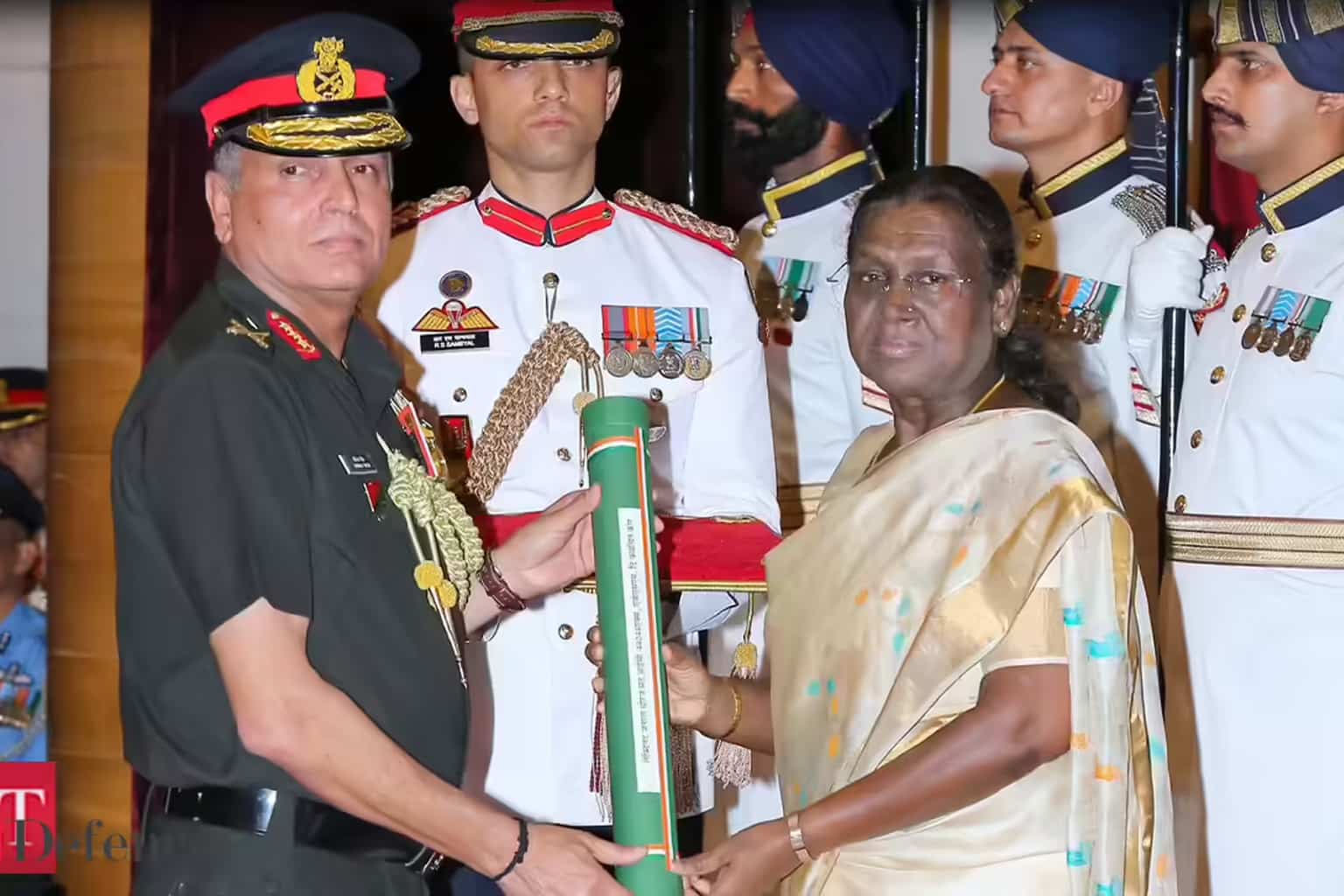
Lt Gen Dhiraj Seth has been appointed as the next Chief of the Army Staff from 30 June 2026. Read his profile, Armoured Corps background, command experience and what this leadership change means for the Indian Army.

Lt Gen Dhiraj Seth to take charge as Army Chief on 30 June 2026
India is set for a major Army leadership transition. Lt Gen Dhiraj Seth, PVSM, UYSM, AVSM, presently serving as the Vice Chief of the Army Staff, has been appointed as the next Chief of the Army Staff.
He will assume charge from the afternoon of 30 June 2026. The present Chief of the Army Staff, Gen Upendra Dwivedi, PVSM, AVSM, retires from service the same day.
This update is important for soldiers, veterans, defence families and Army watchers because the Army Chief is not only the senior-most officer of the Indian Army. He is also responsible for guiding operational preparedness, capability development, training focus, modernisation and the long-term direction of the force.
Who is Lt Gen Dhiraj Seth?
Lt Gen Dhiraj Seth is an alumnus of the National Defence Academy, Khadakwasla. He was commissioned into the Armoured Corps in December 1986.
His military career spans nearly four decades and includes experience across operational, strategic, capability-development and institutional domains. Before being named the next Army Chief, he was serving as the Vice Chief of the Army Staff.
This background matters because the Indian Army today is preparing for a future battlefield where technology, mobility, long-range firepower, drones, surveillance, integrated communication and rapid decision-making are becoming increasingly important.
Armoured Corps background: Why it matters?
Lt Gen Dhiraj Seth comes from the Armoured Corps, a combat arm closely linked with mobility, firepower, manoeuvre warfare and offensive operations.
An Armoured Corps officer is trained to think in terms of movement, speed, ground, concentration of combat power and coordination between different arms. These qualities are important for conventional military preparedness, especially in sectors where rapid mobilisation and battlefield dominance matter.
At the same time, Lt Gen Seth’s career has not remained limited to armoured warfare. His command profile includes desert-sector responsibilities, western theatre experience, counter-insurgency command, strike corps command and Army Command-level leadership.
This gives him a wider operational view of the Indian Army.
Command experience across different environments
Lt Gen Dhiraj Seth has commanded an Armoured Regiment in the Desert Sector and an Armoured Brigade in the Western Theatre. These roles are important because India’s western front remains one of the most sensitive conventional military theatres.
He has also commanded a Counter-Insurgency Force in Jammu & Kashmir. This experience adds another dimension to his profile because counter-insurgency requires a different kind of leadership: patience, local understanding, intelligence-led operations, coordination and restraint.
As a Lieutenant General, he commanded the Sudarshan Chakra Corps, one of the Indian Army’s premier strike formations. He later served as General Officer Commanding, Delhi Area, where national and international military engagements and ceremonial responsibilities form an important part of the role.
On elevation to Army Commander, he commanded South Western Command and Southern Command. This gives him the rare distinction of commanding two operational Army Commands for more than two-and-a-half years.
Why commanding two Army Commands is significant?
An Army Command is not a routine formation. It is a major operational responsibility involving large geographical areas, formations, logistics, training, infrastructure and strategic preparedness.
Commanding one Army Command is itself a major responsibility. Commanding two operational Army Commands gives a senior officer a wider understanding of the Army’s requirements across different theatres.
This experience can help at the top level because the Chief of the Army Staff has to look beyond one region or one arm. He must understand the entire Army as a national force.
Role in Army modernisation and capability development
One of the most important parts of Lt Gen Dhiraj Seth’s profile is his exposure to Strategic Planning and Capability Development at Army Headquarters.
This is significant because the Indian Army is undergoing transformation. Future warfare will not be fought only with traditional platforms. It will involve drones, electronic warfare, cyber capability, artificial intelligence, long-range precision systems, battlefield transparency, secure communication and multi-domain operations.
A modern Army Chief must therefore think beyond today’s equipment. He must also prepare the Army for tomorrow’s battlefield.
Lt Gen Seth’s background in capability development is important because it connects operational requirements with future technology and long-term force planning.

Southern Command and future-ready force message
Before becoming Vice Chief of the Army Staff, Lt Gen Dhiraj Seth relinquished command of Southern Command on 31 March 2026. In his message to all ranks of Southern Command, he emphasised tech-absorption, multi-domain operations and building a future-ready force.
This is a useful indicator of the kind of themes that have been important in his recent leadership journey.
For the Army, future readiness is not a slogan. It requires training, mindset change, better equipment, jointness, technology absorption and the ability to operate in complex battle conditions.
What are the key responsibilities of the Army Chief?
The Chief of the Army Staff has several responsibilities. He must maintain operational readiness, guide modernisation, oversee training priorities, advise the government on Army-related matters and ensure that the force remains prepared for present and future threats.
The Army Chief also has an institutional responsibility towards soldiers, officers, JCOs, veterans and families. Issues linked with welfare, morale, manpower management, dignity and service conditions remain important for the Army’s long-term strength.
Weapons and technology are essential, but the Indian Army’s core strength remains its soldiers. A successful Army leadership must balance both: modern capability and human morale.
What does this appointment mean for soldiers and veterans?
For soldiers, this appointment means a leadership transition at the top of the Army. It does not automatically mean an immediate change in welfare policy or operational doctrine. Any such change must come through official announcements.
But the appointment does indicate that the next Army Chief brings experience from field command, counter-insurgency, strike formations, Army Commands, Delhi Area, strategic planning and capability development.
For veterans and defence families, the key point is to follow official updates after he assumes charge. Areas such as modernisation, training transformation, technology absorption and soldiers’ welfare will remain important subjects to watch.
Why this update is important for defence aspirants?
For defence aspirants, Lt Gen Dhiraj Seth’s journey gives a strong lesson.
Military leadership is built over decades. A young officer grows through field appointments, staff responsibilities, operational challenges, training, command and constant learning.
Selection into the Armed Forces is only the beginning. Real leadership is shaped through responsibility, discipline, professional education and performance in varied conditions.
His profile also shows that an officer must be prepared for multiple environments: desert sector, western theatre, counter-insurgency, strike corps, command-level responsibilities and strategic planning.
What should readers not misunderstand?
There are three important clarifications.
First, Lt Gen Dhiraj Seth has been appointed as the next Chief of the Army Staff, but he will take charge from the afternoon of 30 June 2026. Until then, Gen Upendra Dwivedi remains the serving Army Chief.
Second, no new welfare policy, operational doctrine or reform should be attributed to him unless it is officially announced after he assumes charge.
Third, his profile should be written using official sources. Avoid social media speculation or unverified claims.
Final takeaway
Lt Gen Dhiraj Seth’s appointment as the next Chief of the Army Staff marks an important leadership transition for the Indian Army.
His profile brings together Armoured Corps experience, desert and western theatre command, counter-insurgency exposure, strike corps leadership, Delhi Area responsibility, two Army Commands and strategic planning experience.
For India, this appointment comes at a time when the Army is focused on modernisation, technology absorption, multi-domain readiness and future battlefield preparedness.
For soldiers and veterans, the hope will be that the next Army leadership continues to strengthen combat capability while keeping morale, dignity and welfare of the men in uniform at the centre.
A strong Army is built by equipment, training and technology. But above all, it is built by leadership that understands both the battlefield and the soldier.
Sources:-
- PIB / Ministry of Defence — Lt Gen Dhiraj Seth appointed as Chief of the Army Staff w.e.f. June 30, 2026
https://www.pib.gov.in/PressReleasePage.aspx?PRID=2272460 - PIB / Ministry of Defence — Lt Gen Dhiraj Seth relinquishes Southern Command and assumes VCOAS appointment
https://www.pib.gov.in/PressReleasePage.aspx?PRID=2247292 - News on AIR — Lt Gen Dhiraj Seth appointed as Chief of Army Staff from June 30, 2026
https://newsonair.gov.in/lt-gen-dhiraj-seth-appointed-as-chief-of-army-staff-with-effect-from-june-30-2026/


Leave a Reply