

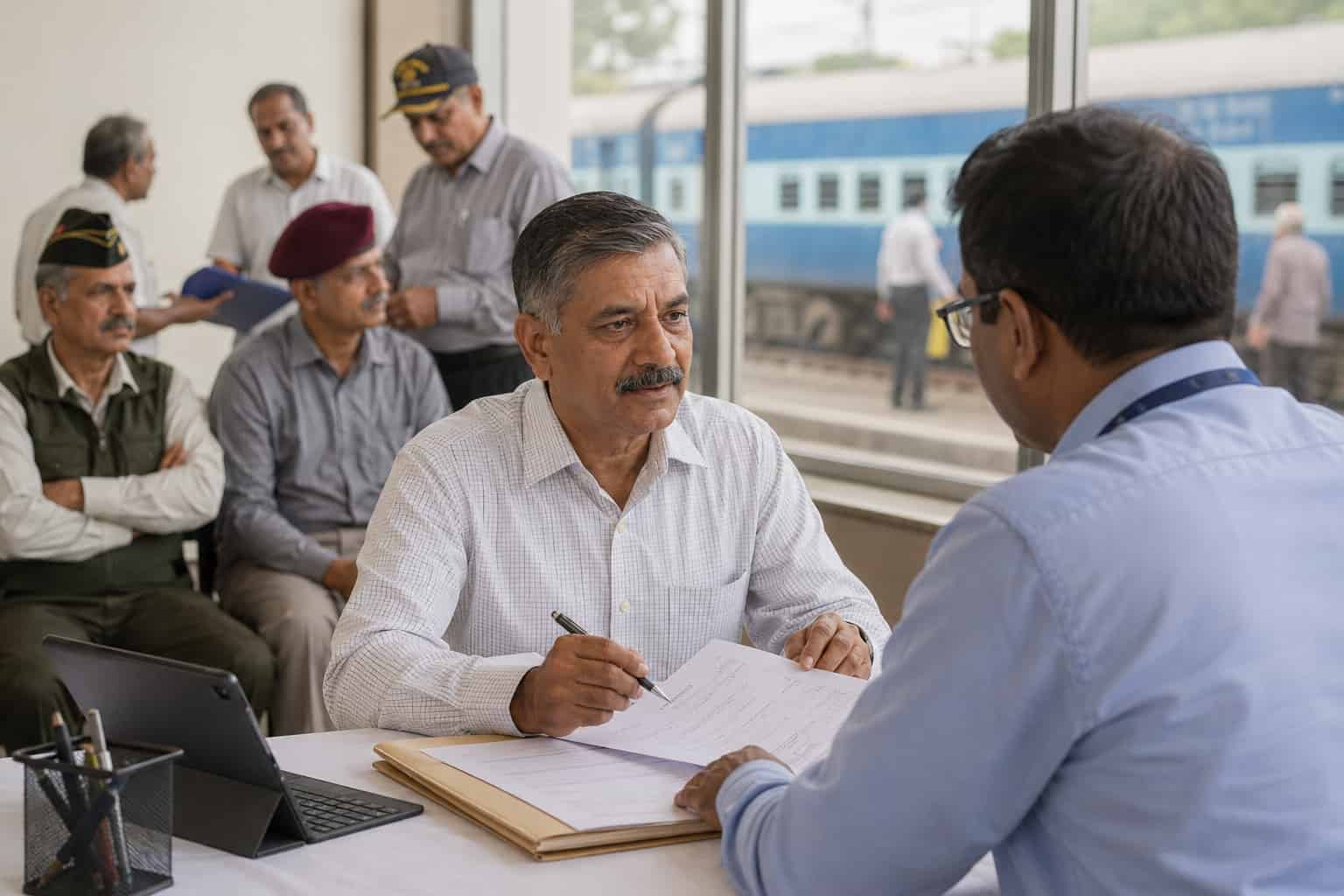
Indian Railways reserved 14,788 posts for ex-servicemen in 2024 and 2025 vacancy notifications. This is a major employment opportunity signal for veterans, but it also carries an important reminder: reservation helps only when ex-servicemen track official RRB and RRC notifications, understand eligibility and apply on time.

For a soldier, retirement from uniform does not mean retirement from responsibility.
Many ex-servicemen leave service at an age when they are still disciplined, active, alert and capable of handling major responsibilities. But after retirement, the world changes quickly. The daily routine of unit life is gone. The command structure is gone. The certainty of service life is replaced by a new question: what should I do next?
For many veterans, a second career is not only about income. It is about dignity, usefulness, family security and staying active after years of structured service. A retired soldier may have discipline, leadership, punctuality, technical ability and crisis-handling experience, but he still needs the right information at the right time.
That is why the Railway update on ex-servicemen reservation matters.
According to the official PIB release of the Ministry of Railways dated 26 February 2026, Indian Railways reserved 14,788 posts for ex-servicemen in 2024 and 2025 vacancy notifications. This included 6,485 Level-1 posts and 8,303 Level-2 and above posts. The release also says Level-1 recruitment is conducted through Railway Recruitment Centres, while Level-2 and above posts are recruited through Railway Recruitment Boards, through competitive examinations.
This is an important number.
But it should be understood correctly.
A reserved post is an opportunity. It is not an automatic appointment.
Many veterans may read a headline about 14,788 reserved posts and think that railway jobs are simply waiting for ex-servicemen. But the actual process is more structured. Veterans still need to watch official recruitment notifications, check eligibility, apply within the deadline, appear for the required selection process, submit documents and clear verification.
This is the real lesson behind the news.
The Railway reservation number shows that opportunities exist. But the opportunity reaches only those who remain informed and prepared.
Indian Railways is one of the largest public employers in the country. For ex-servicemen, railway service can be a meaningful second-career option because many railway roles value discipline, alertness, time sense, safety awareness, responsibility and operational seriousness. These are qualities that veterans already develop during military service.
Railways and the armed forces may be different systems, but both depend heavily on discipline and coordination.
A railway employee may have to follow procedures, remain alert, respect safety rules, handle pressure, maintain timing and work in a structured environment. These qualities are familiar to ex-servicemen. That is why the employment connection between Railways and veterans makes practical sense.
The PIB release also mentions that Indian Railways and the Indian Army introduced a Framework of Cooperation to strengthen post-retirement career opportunities for Agniveers and serving Army personnel transitioning to civilian life. It says the framework is aimed at structured engagement, awareness of job prospects and a support system for retiring personnel.
This part is important because the real challenge for many veterans is not ability. The challenge is transition.
A soldier knows how to handle responsibility. But after retirement, he may not know which website to check, how to fill an online form, what documents are needed, how the railway recruitment process works or how to translate military experience into civilian employment terms.
This is where awareness becomes as important as reservation.
The official release also explains the reservation structure. It states that ex-servicemen have 10 percent horizontal reservation in Level-2 and above posts and 20 percent reservation in Level-1 posts. It also mentions separate earmarking for ex-Agniveers: 5 percent in Level-2 and above posts and 10 percent in Level-1 posts.
This information should be understood carefully.
Horizontal reservation means ex-servicemen are adjusted within the overall vacancy structure as per rules. It does not mean a separate guaranteed job outside the recruitment process. The candidate must still meet the required qualifications, age rules, medical standards, document conditions and selection process.
This is why veterans must not depend only on WhatsApp forwards or informal information.
They should regularly check official RRB and RRC websites. They should read the employment notice properly. They should check whether the post has ex-servicemen reservation. They should verify the age relaxation rules, educational qualification, medical standard, document requirement and application deadline.
One missed notification can mean one missed second-career opportunity.
For Level-1 posts, the recruitment is handled through Railway Recruitment Centres. These posts may include operational and support roles where discipline and physical suitability can matter. For Level-2 and above posts, Railway Recruitment Boards handle the recruitment through competitive examinations. This means veterans must know which channel applies to which type of post.

A simple mistake in understanding RRB and RRC recruitment can lead to confusion.
Many ex-servicemen are strong candidates because of their service background, but civilian recruitment demands paperwork. The system will not understand verbal service experience unless documents support it.
Veterans should keep basic documents ready. These may include discharge book, ex-servicemen certificate, educational certificates, identity proof, date-of-birth proof, service record, caste or category certificate if applicable, disability documents if relevant, photographs, signature scan and updated mobile number and email ID.
Family members can also help.
Many veterans may not be fully comfortable with online applications, document upload, PDF scanning, password recovery or portal tracking. Children, spouses and trusted family members can support them by checking official websites, saving login details safely, scanning documents and reminding them about deadlines.
A second career should not be treated as the veteran’s burden alone. It affects the whole family.
Another important part of the PIB release is the Pointsman contract engagement. It says the Ministry of Railways decided to recruit ex-servicemen as Pointsmen on contract basis across Indian Railways until regular recruitment processes are completed. It also states that more than 5,000 Level-1 posts were being processed at zonal and divisional levels, and 9 divisions had entered into MoUs with concerned Army organisations for hiring Pointsmen.
This should also be reported carefully.
Contractual engagement is not the same as regular permanent recruitment. It may provide immediate work opportunities in specific railway operational roles, but veterans should read the terms, duration, pay, duties and conditions clearly before joining.
The safe understanding is this: Railways is looking at both regular recruitment through RRB/RRC systems and faster contractual engagement for specific operational vacancies.
For ex-servicemen, both routes may be useful, but both require official verification.
This update also connects with the larger issue of veteran resettlement. Many soldiers retire early compared to civilian employees. They may have many productive working years left. If their discipline and experience are used properly, they can contribute strongly to national institutions like Railways.
But veterans need guidance.
A retired soldier may be excellent at team handling, security, movement control, equipment discipline, documentation or crisis response. But if he does not know when a recruitment notice is released, he cannot apply. If he does not understand the eligibility, his form may be rejected. If his documents are not ready, he may miss verification. If he depends only on forwarded messages, he may fall behind.
This is why the headline should not create false hope. It should create practical awareness.
The message is not “railway job guaranteed.”
The message is: “Railway reservation exists, but veterans must stay alert and apply correctly.”
This is especially important for younger retirees and Agniveers transitioning to civilian life. They may have energy, discipline and service exposure, but they must learn the recruitment system early. If they begin preparing before retirement or immediately after release, they will be better positioned.
For Sainik Welfare News readers, the takeaway is simple.
Indian Railways has reserved 14,788 posts for ex-servicemen in 2024 and 2025 vacancy notifications. This is a significant employment signal. But the real benefit will reach only those veterans who track official notices, prepare documents, understand RRB and RRC recruitment, and apply within deadlines.
Veteran employment is not only about vacancies. It is about awareness, preparation and timely action.
An ex-serviceman has already proved discipline in uniform. The second-career challenge is to use that discipline in the civilian recruitment process: read the notice, prepare documents, apply correctly, appear for the process and follow official updates.
Railway employment can give veterans a respected second chapter. But that chapter begins with correct information.
For veterans and families, the practical message is clear: do not wait for someone to forward a vacancy. Check official RRB and RRC updates. Keep documents ready. Understand reservation rules. Avoid fake agents. Apply only through official channels.
A reserved post is a door.
But the veteran must still reach that door on time.
Sources:-
Official PIB source, Ministry of Railways:
https://www.pib.gov.in/PressReleseDetailm.aspx?PRID=2233196
News On AIR supporting report:
https://newsonair.gov.in/indian-railways-indian-army-launch-framework-to-boost-post-retirement-jobs-for-agniveers-ex-servicemen/



Leave a Reply