

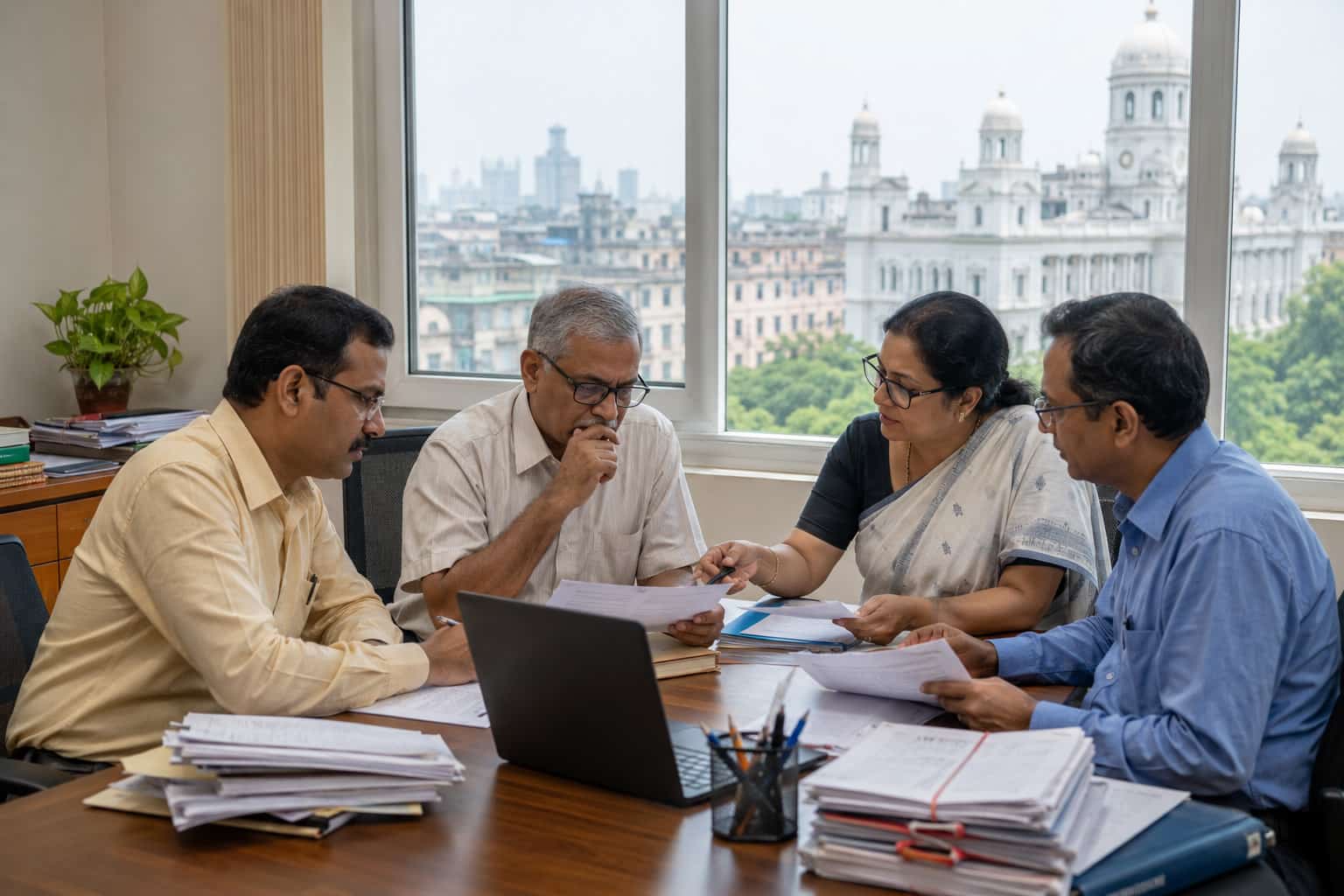
For central government employees, pensioners and staff associations, the 8th Pay Commission is no longer only a Delhi-based process. Slowly, the Commission is moving across different states and cities to listen to stakeholders directly. This is why the latest Kolkata visit notice matters.
The Eighth Central Pay Commission has issued a notice saying that it will visit Kolkata, West Bengal on 9 and 10 July 2026. On paper, this may look like a simple tour notice. But for employees, unions, associations and government institutions in West Bengal and nearby regions, this is a major opportunity.

Because this is not just about a visit.
It is about who gets a chance to place their issue before the Commission in person.
The notice clearly says that concerned stakeholders, including organisations and institutions of the Central Government, as well as associations and unions who want to interact with the Commission at Kolkata, must submit their request for appointment on or before 15 June 2026.
This one line should be read carefully.
The Commission is not saying that everyone can directly walk into the meeting. It is asking stakeholders to first seek an appointment through the given form. More importantly, the request has to be submitted along with the unique Memo ID generated after submitting the memorandum.
That makes the Memo ID very important.
For the last few weeks, many employees and pensioners have been hearing about the memorandum process. Some may have treated it like a routine formality. Some may have thought that the real discussion will happen later. But this notice shows why memorandum submission is not a small step. Without a memorandum and without a Memo ID, getting a formal appointment for such interaction may become difficult.
This is where the story becomes serious.
The 8th Pay Commission is expected to examine issues connected with pay structure, pension, allowances, service conditions, anomalies, staff-side concerns and financial impact. Every union or association may have its own demands. Railway employees may have different concerns. Defence civilian employees may have different issues. Postal, audit, accounts, pensioners, ex-servicemen-linked bodies, family pensioners and other employee groups may also have their own expectations.
But a demand becomes stronger only when it is properly submitted.
A slogan may create attention, but a structured memorandum creates record.
This is why the Kolkata notice should be seen as a reminder to all employee organisations. If they want to meet the Commission, they first need to complete the basic process properly. Submit memorandum through the official 8th CPC website, generate the unique Memo ID, then use that Memo ID while seeking an appointment.
For employees in West Bengal, Kolkata is important not only because it is a major administrative and institutional centre. It is also a city with a large number of central government offices, defence-related establishments, railway presence, pensioner groups and staff organisations. A Pay Commission visit here can give many stakeholders a chance to bring regional and category-specific issues into discussion.
But the deadline is tight.
The appointment request has to be submitted on or before 15 June 2026. The actual visit is scheduled for 9 and 10 July 2026. Venue details and meeting schedule will be intimated separately. This means the Commission will first collect appointment requests, examine them, and then communicate meeting details to selected or concerned stakeholders.

Employees and unions should not wait for the venue announcement before taking action. The venue will come later. The appointment request has to go first.
This is a practical point that many people may miss.
Some may think, “Pehle venue bata do, phir apply karenge.” But the notice does not work that way. It says venue details and meeting schedule will be intimated separately. That means the first job is to submit the request within the deadline.
The notice also says that for submitting memorandum, the Commission’s website should be referred. This again confirms that the official route is the online memorandum process through 8cpc.gov.in. If a stakeholder has not submitted memorandum, they should not assume that an appointment request alone will be enough.
The bigger message is that the 8th Pay Commission is trying to build a structured consultation process. It is not only holding meetings in one place. It is visiting different cities and states. The notice also says the Commission will hold separate meetings at cities in other States and Union Territories in due course.
This means Kolkata is one part of a larger outreach process.
For employee unions, this is the time to prepare well. A meeting with the Commission should not be treated like a general discussion. Representatives should go with facts, category-wise problems, examples, comparative data and clear suggestions. They should avoid vague demands and focus on specific issues that can be examined by the Commission.
For example, if an association wants to raise an allowance issue, it should explain what the existing allowance is, why it is outdated, which employees are affected, what hardship is involved and what correction is being requested. If a pensioners’ body wants to raise pension revision concerns, it should explain the affected group, current problem and the specific relief being requested.
A good memorandum should not only say “increase pay” or “increase pension.” It should show why the demand is necessary, who is affected and how the issue can be resolved.
The same applies to defence-related and ex-servicemen-linked welfare issues. If there are concerns related to pension parity, family pension, disability pension, MSP, risk and hardship-related concerns, early retirement impact or veteran welfare, these must be properly documented and presented with discipline.
The Pay Commission is not a social media platform. It is a formal body. The language, structure and evidence of representation matter.
That is why this Kolkata visit should be treated as a serious opportunity.
For individual employees and pensioners, the message is slightly different. Not everyone may get a personal meeting with the Commission. But every individual should still ensure that their concern is submitted properly through the memorandum process. Associations and unions may represent collective issues, but individual submissions also help show the spread and seriousness of concerns.
For unions and associations, the message is direct: do not miss the appointment deadline.
For employees, the message is equally clear: do not ignore the Memo ID.
For pensioners, the message is simple: your issues should be placed in writing before the Commission through the proper channel.
The Kolkata visit also tells us that the consultation stage of the 8th Pay Commission is now active. This is not the final recommendation stage. This is not a salary announcement. This is not a fitment factor declaration. This is the stage where issues are being collected, heard and recorded.
And sometimes, this stage is more important than people realise.
Once recommendations are drafted, it becomes difficult to insert new issues. The right time to place a problem is before the Commission finalises its understanding. That is why these city visits, memorandum deadlines and appointment requests matter.
The 8th Pay Commission’s Kolkata visit should therefore be read as a working signal. The Commission is moving, meetings are being planned and stakeholders are being asked to come through a formal process.
Those who prepare now may get a better chance to be heard.
Those who delay may later say their issue was ignored.
In the end, the Kolkata notice is not just about a date and city. It is about participation. It tells employees, pensioners, unions and associations that the 8th Pay Commission process is open, but it is structured. If you want your voice to reach the Commission, you must follow the route.
Submit the memorandum.
Generate the Memo ID.
Seek appointment before the deadline.
Prepare your issues properly.
That is the real message from the Kolkata visit notice.
Sources:-
Official 8CPC Kolkata visit notice page
https://8cpc.gov.in/document/notice-regarding-8cpc-visit-to-kolkata-west-bengal-9-10-july-last-date-15th-june/
Direct PDF of the Kolkata visit notice
https://cdnbbsr.s3waas.gov.in/s354b2b21af94108d83c2a909d5b0a6a50/uploads/2026/05/20260529713441244.pdf
Official 8CPC appointment/meeting page
https://8cpc.gov.in/link-for-appointment-meeting/
Official 8CPC memorandum submission page
https://8cpc.gov.in/8cpc-memorandum-submission/
Official 8CPC What’s New page
https://8cpc.gov.in/whats-new/
Official clarification on memorandum submission
https://8cpc.gov.in/document/clarification-regarding-submission-of-8cpc-memorandum-representations-on-its-website-8cpc-gov-in/



Leave a Reply