

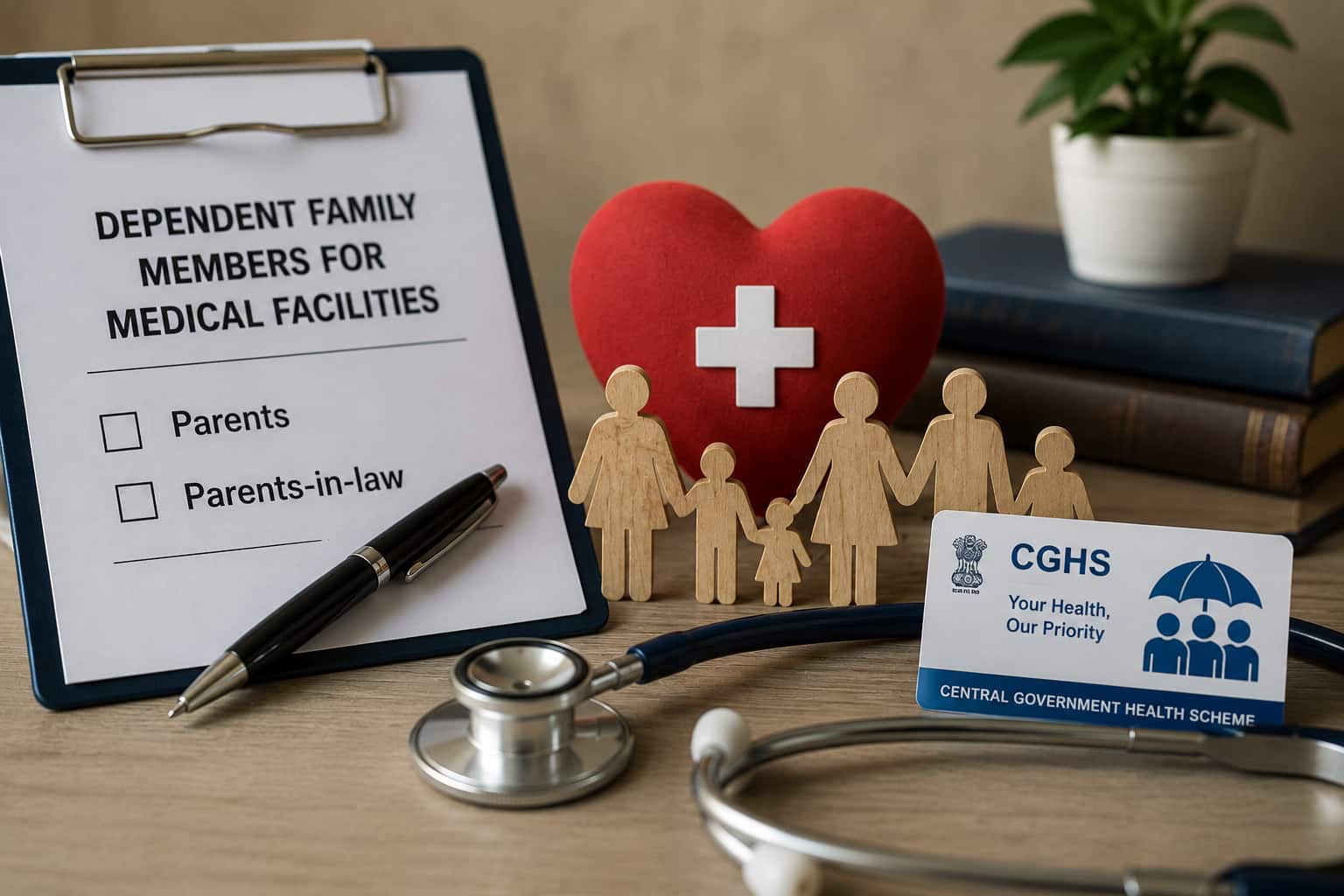
For many Central Government employees, medical benefits are not just a service rule. They are part of family security. A CGHS card or medical facility under CS(MA) Rules can support parents, spouse, children and dependent family members during illness, treatment and regular medical needs. That is why any rule about who can be included as a dependent family member becomes important for employees and their families.

A recent Office Memorandum from the Ministry of Health & Family Welfare has brought one such issue into focus. The clarification is about the option available to Central Government employees to avail medical facilities either for their parents or parents-in-law under CGHS and Central Services (Medical Attendance) Rules, 1944.
At first glance, many employees may read this as a simple benefit. But the real message of the order is much more serious: for a male government employee, choosing parents or parents-in-law as dependent family members is a one-time option. Once exercised, the option cannot be changed later.
This is why employees need to understand the rule carefully before filling any form or making any declaration.
The Office Memorandum dated 13 May 2026 refers to earlier Ministry orders and reiterates that eligible beneficiaries under CGHS and CS(MA) Rules can avail the facility subject to prescribed dependency and other eligibility conditions. The important clarification is that a male Government employee can choose either his parents or his parents-in-law as dependents for medical facilities, but this choice is one-time only. The OM further states that once the option is exercised in favour of parents, the employee will not be permitted to opt for parents-in-law later, including in cases arising due to demise of parents or otherwise. Similarly, if the option is exercised in favour of parents-in-law, it cannot later be changed in favour of parents.
This is the core of the update.
The news should not be misunderstood as “CGHS parents-in-law benefit started now.” The background is older. The document refers to a Ministry of Health & Family Welfare OM dated 03 March 1987 and another OM dated 26 July 2023, through which the facility to choose either parents or parents-in-law for CGHS medical benefits was available to eligible Central Government employees. A 2023 CGHS office memorandum shows that the earlier provision, originally available to female government employees, was extended to male government employees also for CGHS benefits.
Later, the same type of facility was extended to beneficiaries covered under the CS(MA) Rules, 1944 through an OM dated 28 March 2024, bringing them at par with CGHS beneficiaries. The 13 May 2026 clarification refers to this background and confirms that the provisions apply to eligible beneficiaries covered under both CGHS and CS(MA) Rules, subject to the required dependency and eligibility conditions.
This background matters because many employees may wrongly believe that the government has newly allowed parents-in-law under CGHS in 2026. That is not the main story. The main 2026 clarification is about the finality of the choice, especially for male government employees.
To understand the importance, imagine a Central Government employee who has ageing parents on one side and parents-in-law on the other side. Both may need medical care. Both may have genuine health concerns. But under this option, the employee cannot include both sets as dependent parents for CGHS or CS(MA) medical facilities. He has to choose one side, subject to dependency rules.
That choice can become difficult because family circumstances change over time. Parents may be healthy today but may need support later. Parents-in-law may be dependent now but family arrangements may change. A spouse may expect support for her parents. The employee may feel responsibility towards his own parents. This is not just a government form. It can become a family-level decision.
The 13 May 2026 clarification makes this decision even more important because it says the option cannot later be changed. Even if the parents pass away, the employee cannot subsequently switch to parents-in-law. Similarly, if parents-in-law are chosen first, the employee cannot later shift the medical facility option to parents.
This is why the employee should not treat the form casually. Before exercising the option, the family should discuss the long-term impact. The employee should check who is actually dependent, who satisfies the eligibility conditions, who needs medical support, and what the department’s current procedure requires.
Another important point is dependency. The OM clearly says the benefit is subject to fulfilment of prescribed dependency and other eligibility conditions under the respective rules or scheme. This means parents or parents-in-law cannot be added automatically just because the employee wants to add them. They must meet the conditions applicable under CGHS or CS(MA), such as dependency and other prescribed requirements.

This is a missing angle in many social media discussions. People may only read “parents or parents-in-law can be included” and assume the process is open to everyone. But the official position is more limited. Eligibility and dependency conditions remain important.
CGHS itself is a major health-care support system for Central Government employees, pensioners and other eligible beneficiaries. The CGHS portal describes the scheme as providing comprehensive medical care to Central Government employees and pensioners enrolled under the scheme. This is why any dependent-family rule under CGHS has direct importance for lakhs of families.
The CS(MA) Rules, 1944 side is also important because not every employee is covered under CGHS in the same way. Some employees may be in non-CGHS areas or covered through CS(MA) provisions. By referring to both CGHS and CS(MA), the OM makes the clarification relevant for a wider group of Central Government employees.
The Times of India also reported that the Union Health Ministry’s fresh order bars Central Government employees from changing the parents or parents-in-law option later under CGHS and CS(MA) Rules. The report highlights the same key point: once the choice is made, it cannot be altered in the future.
For employees, the practical takeaway is simple but serious. Do not rush this option. Do not choose only because someone in the office said it can be changed later. Do not assume that the department will allow a switch later if family circumstances change. The latest clarification says the option is one-time and final.
Before making the declaration, employees should check three things. First, whether the parent or parent-in-law proposed to be included satisfies the dependency and eligibility conditions. Second, whether the choice is being made after discussion with the spouse and family members. Third, whether the department has issued any internal process or form for exercising this option.
Employees should also keep copies of the relevant documents, including the Office Memorandum, dependency proof, CGHS or CS(MA) related forms, and any departmental approval. Since medical claims can involve hospital treatment, reimbursement, referrals and card details, paperwork should be clear from the beginning.
For families, this rule also raises an emotional question. In Indian households, responsibility often extends across both sides of the family. Many employees genuinely want to support both parents and parents-in-law. But a government medical-benefit scheme has to define eligibility clearly. The latest OM does not remove that family dilemma. It only clarifies that the choice must be made carefully because it cannot be reversed later.
This is why awareness is important. A wrong or hurried decision today may create difficulty tomorrow. If an employee chooses parents without understanding the rule, he cannot later shift the option to parents-in-law. If he chooses parents-in-law under family pressure and later needs to support his own parents under CGHS/CS(MA), the OM says the option cannot be changed.
The safest approach is to verify from the official CGHS circulars section, department administration, or the concerned medical-benefit authority before exercising the option. Employees should not rely only on WhatsApp forwards, short social media posts or half-read headlines.
For Sainik Welfare News readers, the main message is clear: this is not just a new welfare headline. It is a decision-warning for Central Government employees. The facility to choose parents or parents-in-law can be useful, but the choice is one-time, subject to eligibility, and final.
The headline may look simple, but the effect can be long-term. Therefore, employees must choose carefully, document properly and understand the rule before submitting their option.



Leave a Reply