

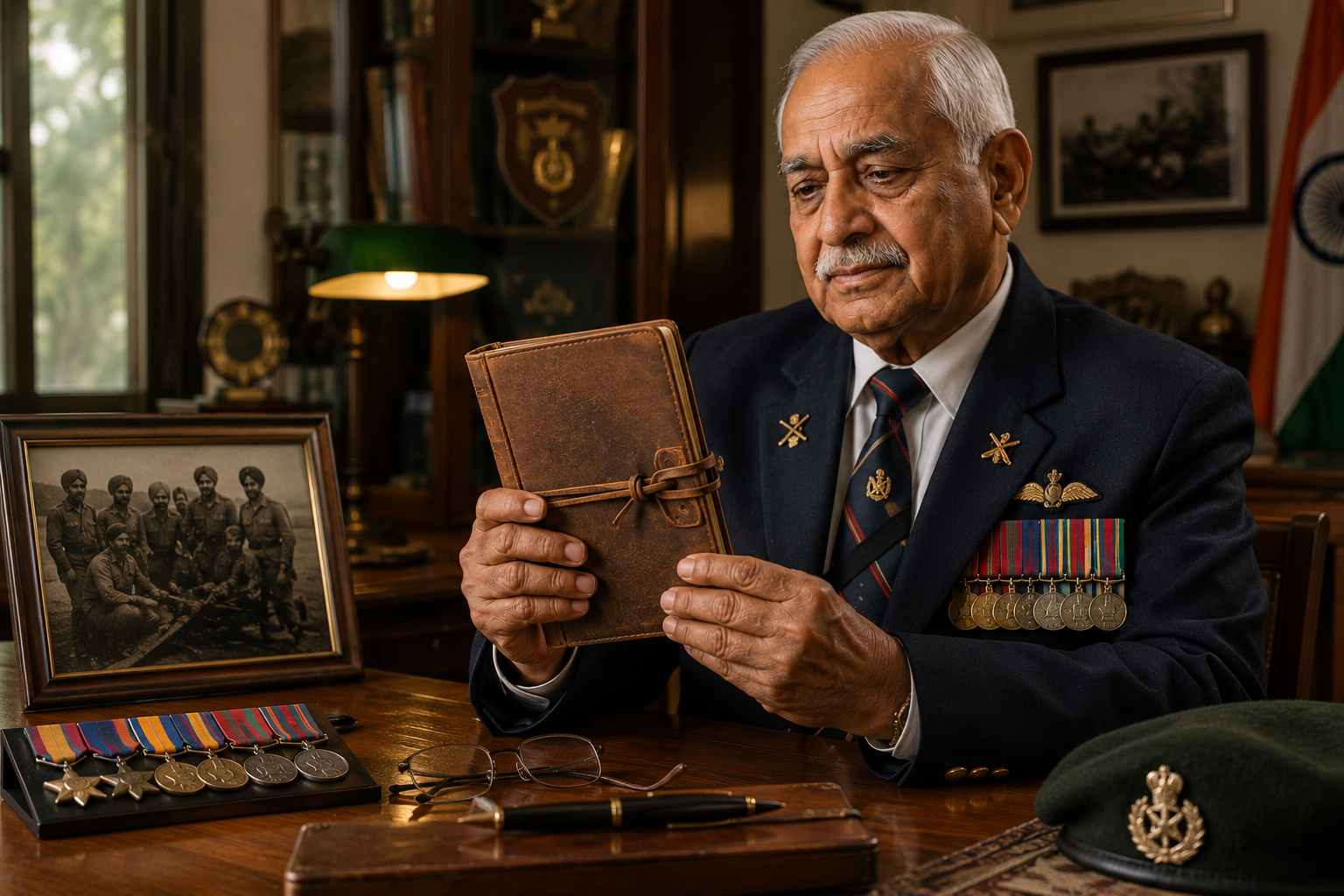
A soldier’s story is not always written in official records. It is often hidden in letters, diary pages, memories, photographs and quiet conversations with family. These personal accounts may not look like big defence news at first, but they carry something extremely valuable: the human side of military service.

That is why the launch of “Ek Sainik Ki Diary” by Chief of Defence Staff General Anil Chauhan is more than a book release. It is a reminder that the roots of the Indian Army are not built only by tanks, rifles, aircraft or commands. They are built by individual soldiers who carry discipline, courage, hardship and duty through different phases of history.
According to reports, the book was launched during the Joint Commanders’ Conference at the Sapta Shakti Command in Jaipur. It is a collection of diary entries written by Honorary Captain Mohar Singh Bainsla, covering his service years from 1943 to 1971. The book was published posthumously and compiled by his niece, retired IRS officer Sunita Bainsla.
This timeline itself makes the book important. The period from 1943 to 1971 was not ordinary. It covered the final years before Independence, the transformation of the Indian Army after 1947, and major changes in India’s military and national journey. When such a period is seen through the eyes of one soldier, history becomes personal.
General Anil Chauhan described the book as a deeply personal account that presents the world through the eyes of a soldier. He also said that it reveals the human face of the soldier and would help strengthen the roots of the Indian Army.
This is a powerful thought. In most public discussions, a soldier is seen through a role: jawan, JCO, officer, veteran, martyr or pensioner. But behind every role is a human being. He has fears, responsibilities, family memories, discipline, loneliness, pride and pain. A diary captures these details in a way that official documents usually cannot.
Official history tells us what happened. A soldier’s diary tells us how it felt.
That difference matters.
A war diary, personal notebook or service account may record small things: weather, movement, unit life, food, fatigue, comradeship, letters from home, the pressure of duty, the meaning of command and the emotional cost of service. These small details may look ordinary, but together they build the real texture of military life.
General Chauhan also highlighted that the individual soldier is the core of any army and the foundation of military strength. This is an important message at a time when modern warfare is often discussed through technology, missiles, drones, cyber systems and artificial intelligence.
Technology matters, but the soldier remains central. Machines can improve capability, but character gives meaning to military power. A modern army can have the best platforms, but its real strength comes from the men and women who operate them under pressure.

This is why soldier stories must be preserved.
For young officers, cadets and recruits, such books can teach values that cannot be fully learned from manuals. A manual teaches procedure. A diary teaches lived experience. It shows how a soldier thinks, adapts, suffers, learns and continues despite uncertainty.
For veterans, such books provide recognition. Many soldiers serve quietly and retire without public attention. Their stories remain within families. When a personal account is published, it gives respect not only to one soldier but to an entire generation that served without asking for fame.
For families, it gives pride and continuity. Children and grandchildren often know that their elder served in the Army, but they may not know what he experienced. A diary can connect generations. It can turn family memory into national memory.
The story of Honorary Captain Mohar Singh Bainsla also reflects how the Army shaped many lives in rural India. Reports mention that his niece Sunita Bainsla spoke about how the Indian Army influenced their lives and how youth from eastern Rajasthan who joined the forces were exposed to a wider world, helping social development in the region.
This is an important point for Sainik Welfare News readers. The Army has never been only a place of employment. For many families, villages and regions, it has been a path to discipline, education, exposure, identity and national contribution. A soldier who joins from a small village often returns with a wider view of life. That influence spreads through family, community and future generations.
Rajasthan’s contribution to the armed forces was also mentioned at the event, with General Chauhan referring to the state as a land of valour and heroism. He noted the courage and sacrifices of soldiers from the region in battles and military operations.
But this article should not be seen only as a Rajasthan story. It is an Indian Army story. Every region of India has given soldiers whose names may never appear in headlines, but whose service helped build the country’s defence strength. Their memories deserve space.
Today, many military stories are reduced to viral clips, short posts or dramatic headlines. That is why serious personal writing becomes even more important. A diary slows us down. It asks us to listen. It reminds us that behind a salute there is a life, and behind a medal there is a journey.
For the younger generation, this is especially valuable. Many young people are interested in the Army, but they often see only the glamorous side: uniform, weapons, adventure and status. A soldier’s diary can show the fuller truth: discipline, sacrifice, loneliness, responsibility and service before self.
It can also teach humility. Not every soldier’s story is about a famous battle. Some stories are about endurance, duty, routine, hardship and quiet courage. These are also part of military greatness.
Books like “Ek Sainik Ki Diary” should encourage more veterans and families to preserve service memories. Old letters, diaries, photographs, citations and oral histories should not be lost. They are part of India’s military heritage. Families should digitise them, translate them where needed and share them responsibly with institutions, museums, regimental centres or future generations.
The Indian Army’s roots are strengthened when its stories are remembered honestly. Not only the stories of generals and battles, but also the stories of soldiers who lived the everyday life of service.
In the end, a soldier’s diary is more than a personal notebook. It is a bridge between past and present. It tells young soldiers where they come from. It tells families what service means. It tells citizens that the Army is not an abstract institution, but a living force built by individuals.
That is why this book launch matters. It honours one soldier’s journey, but it also sends a larger message: the memory of a soldier is national wealth. When such memories are preserved, the Army does not only remember its past. It strengthens its character for the future.


Leave a Reply