

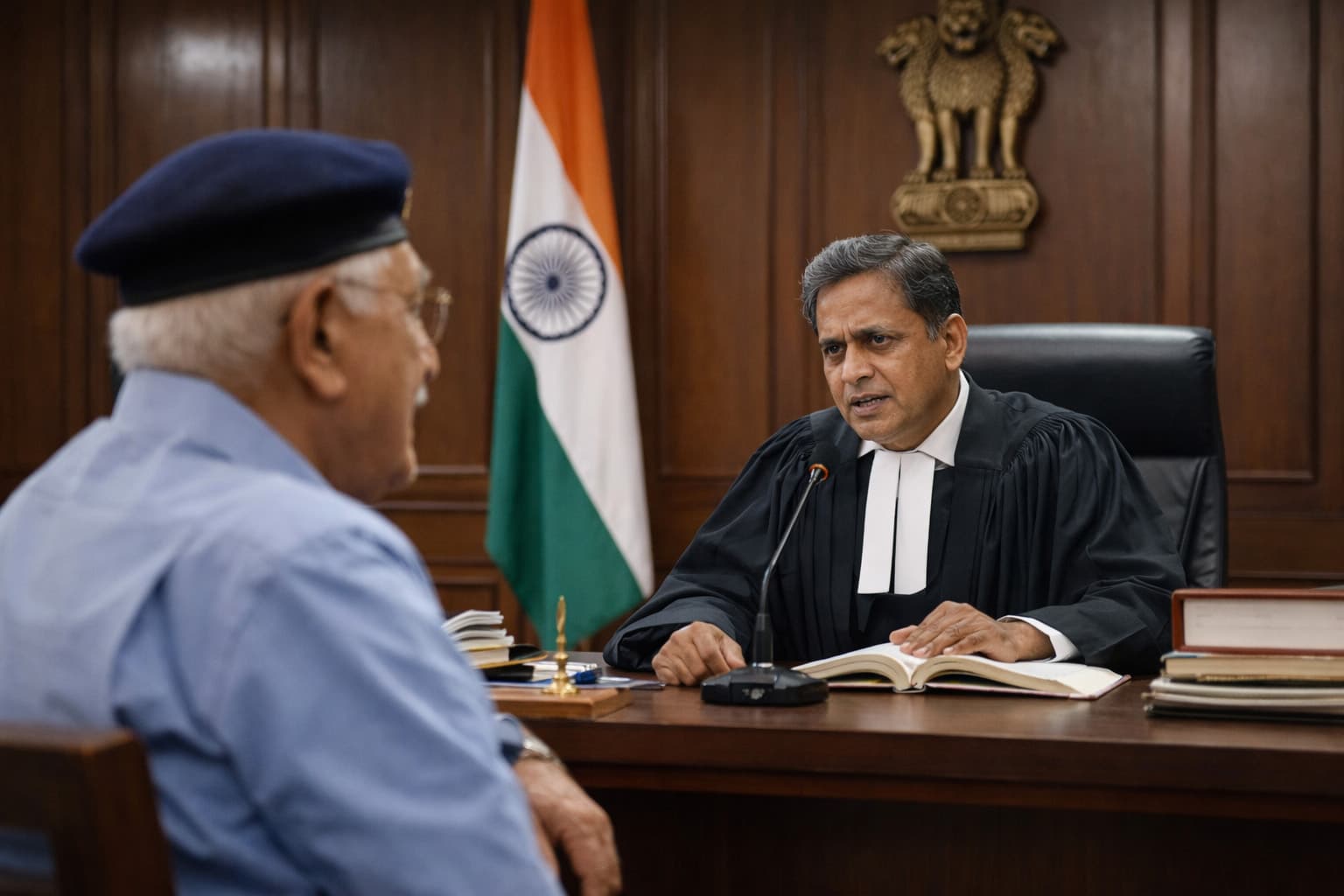
The issue of pay fixation and pension calculation has once again come into sharp focus, this time through a significant High Court intervention that directly impacts ex-servicemen who later joined government service. For years, many veterans have faced uncertainty over whether their earlier military service would be counted when calculating civil pay and pension. Now, a strong judicial observation has made one thing clear: rightful benefits cannot be delayed indefinitely under the excuse of administrative approval.
This development is being seen as an important moment, especially for those who transitioned from the armed forces into civilian roles and are still waiting for clarity on their service benefits.
The background of the case and why it matters?
The case revolves around a former Indian Navy serviceman who served for over 15 years before moving into a civilian government role as an Assistant Teacher. After completing his naval service from 1981 to 1996, he later underwent training and joined the civil sector, eventually retiring in March 2025.
The core dispute began when his earlier military service was not considered for pay fixation and pension calculation in his civilian role. This effectively reduced his overall service benefits, despite the fact that rules exist to allow such counting under certain conditions.
For many veterans, this situation is not new. A large number of ex-servicemen who enter civil services face similar challenges, where their prior service is either ignored or kept pending due to procedural delays.
What the petitioner demanded?
The petitioner’s demand was straightforward and based on existing rules. He argued that his 15 years and 27 days of naval service should be counted as qualifying service for the purpose of:
- Pay fixation in his civil post
- Pension calculation after retirement
- Release of all consequential arrears and benefits
To support his claim, he relied on provisions under Civil Service Regulations (CSR) 526 and 527, which deal with counting of previous service under specific circumstances.
These regulations are not new, and they have been part of the service framework for years. However, their implementation often becomes inconsistent, leading to disputes.
Government’s stand and the key issue
Interestingly, the government did not outright deny the petitioner’s eligibility. Instead, the matter was kept pending, with authorities citing that “administrative approval” was still awaited.
This is where the case became significant.
The delay was not due to legal ambiguity or lack of rules. It was purely procedural. The petitioner had to wait for years without clarity, even though his entitlement was not strongly disputed.
This reflects a broader issue in administrative systems, where valid claims often get delayed due to internal processes, file movement, and approvals that take an indefinite amount of time.
What the Court observed?
The High Court took a firm view on this matter. It made it clear that administrative delays cannot override legal entitlement.
The court observed that once the rules permit counting of service and the eligibility is not seriously contested, the authorities cannot keep the matter pending indefinitely. The idea that a benefit can be delayed endlessly due to internal approvals was strongly rejected.
This observation is crucial because it shifts the focus from process to principle. It reinforces that service benefits are not discretionary favours, but rights governed by established rules.
The final direction and relief
In its final order, the court directed the concerned department to:
- Count the petitioner’s military service as part of qualifying service
- Refix his pay accordingly
- Recalculate pension based on the revised service
- Release all arrears and retirement benefits
The court also imposed a clear timeline, stating that the entire exercise must be completed within 8 weeks from the date of submission of the certified copy of the order.
This time-bound direction is important because it prevents further delay and ensures accountability.
Why this judgment is important for Ex-Servicemen?
This case goes beyond one individual. It sends a clear message that applies to a much larger group of people.

For ex-servicemen who later join government service, the judgment highlights three key points:
First, previous military service can be counted, provided it falls within the framework of applicable rules.
Second, delays caused by administrative processes are not acceptable grounds to deny or postpone benefits.
Third, courts are willing to intervene when rightful entitlements are not granted in a reasonable timeframe.
For many veterans, this could act as a reference point when dealing with similar issues in their own cases.
What employees and veterans should do now?
If you are an ex-serviceman who later joined civil service and your previous service has not been counted, this case offers a direction.
Here are some practical steps:
- Check whether your case falls under CSR 526 and 527 or similar provisions
- Gather all service records from both military and civil tenure
- Submit a formal representation to the concerned department
- If the matter remains pending for long, consider legal consultation
The key is to act based on documented rules and not rely solely on verbal assurances or informal responses.
The bigger picture
This judgment is part of a broader trend where courts are increasingly addressing issues related to pay, pension, and service benefits. It reflects a growing recognition that delays in such matters can have a direct impact on the financial stability of retirees.
For policymakers, it also serves as a reminder that implementation gaps can weaken otherwise well-designed rules. Bridging these gaps is essential to ensure that benefits reach the intended beneficiaries without unnecessary delay.
The High Court’s intervention in this case has brought much-needed clarity to an issue that affects thousands of ex-servicemen across the country. By rejecting indefinite administrative delays and enforcing time-bound compliance, the court has reinforced the principle that service benefits must be delivered fairly and promptly.
For veterans and government employees alike, the message is clear: if the rules support your claim, delays cannot be used as an excuse to deny your rights.
This is not just a legal victory for one individual. It is a reminder that systems must work in favour of those who have already served the nation.







Leave a Reply