

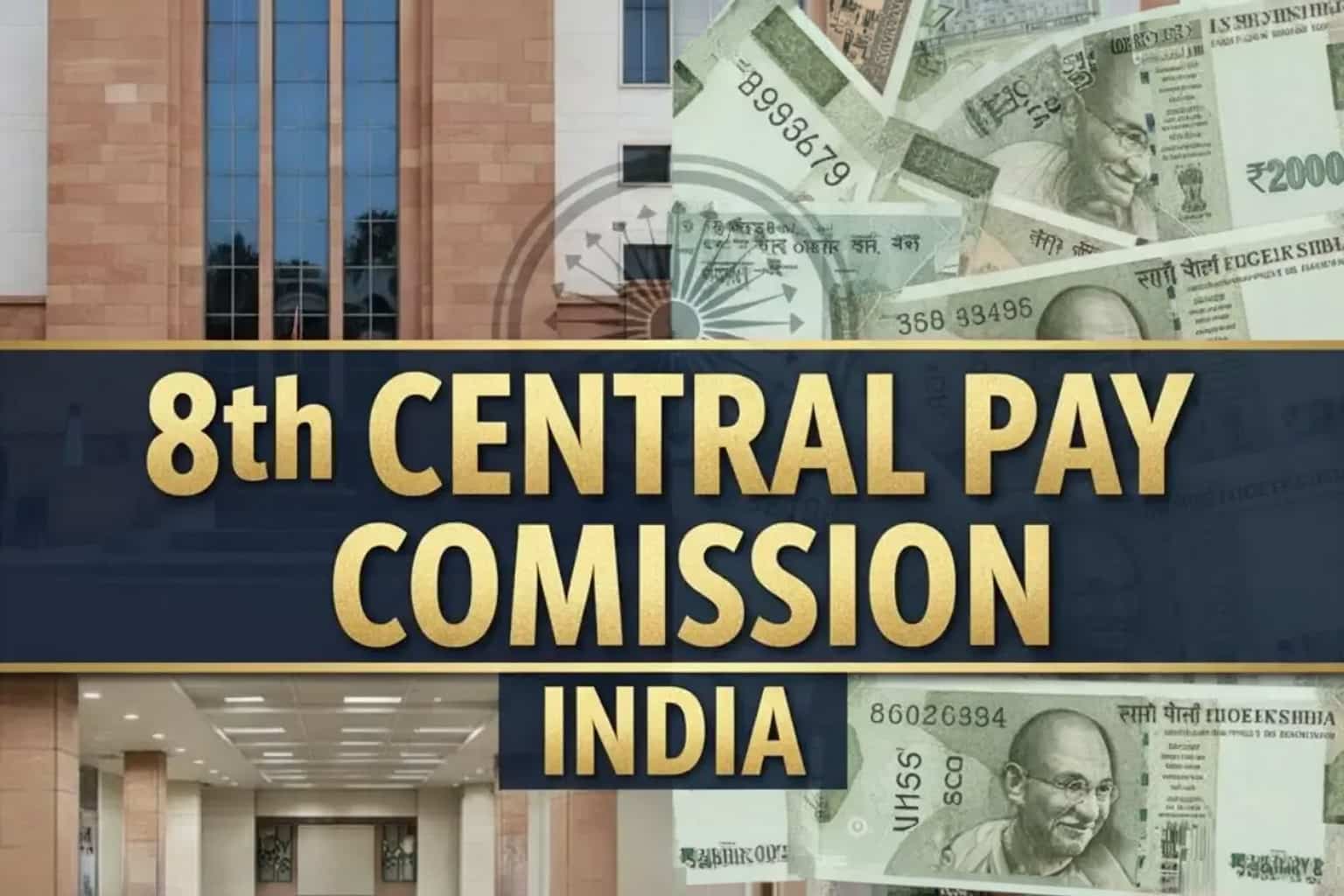
For central government employees, pensioners, defence pensioners and ex-servicemen, the 8th Pay Commission is not just another administrative update. It is directly linked to salary revision, pension protection, allowances, retirement benefits, family security and the financial planning of lakhs of households.
That is why every update around the 8th Central Pay Commission creates strong interest. Employees want to know how their pay matrix may change. Pensioners want clarity on pension revision. Defence veterans are watching issues like MSP, OROP anomalies, disability pension, ECHS and service-related parity. For many families, the 8th CPC is not only about a higher salary. It is about whether future income will match today’s rising cost of living.
The important point is that the 8th CPC has already moved beyond the announcement stage. The Government of India issued the Gazette notification on 3 November 2025 appointing the Eighth Central Pay Commission. The Commission includes Justice Ranjana Prakash Desai as Chairperson, Prof. Pulak Ghosh as Member (Part-Time), and Shri Pankaj Jain as Member-Secretary.
This means employees and pensioners are no longer waiting for the basic question of whether the Commission exists. The Commission is now a formal body with a defined mandate.
The Gazette notification also says that the Commission will examine and recommend desirable and feasible changes in emoluments, including pay, allowances and other facilities or benefits. It covers several categories, including central government employees, defence forces personnel, All India Services personnel, Union Territory employees, audit and accounts staff, certain regulatory bodies, Supreme Court employees and specified judicial categories.
This wide coverage is why the 8th CPC matters to such a large section of the country’s workforce and pensioner community.
The Commission has been given 18 months from the date of its constitution to submit its recommendations. It may also consider interim reports if needed after recommendations are finalised on any matter. This timeline is important because it shows that salary and pension revision will not happen overnight. The process will involve study, consultation, examination of data and final recommendations.
For employees, the biggest expectations are linked to minimum pay, fitment factor, pay matrix, annual increment, MACP, promotions, HRA, TA, LTC and other allowances. For pensioners, the core concerns are pension revision, Dearness Relief, commutation, gratuity, family pension and medical facilities. For defence personnel and veterans, the issues are more specific because military service involves early retirement, field postings, high-risk duties and unique service conditions.
This is why the current stage is so important. The 8th CPC is accepting representations and memorandums from stakeholders. The official 8CPC memorandum page states that the last date for submission of responses is 31 May 2026, and all submissions must be made only through the specified online link. It also clearly says that paper-based memorandums, hard copies, PDFs and emails are not being considered or entertained by the Commission.
This is a major message for every employee and pensioner. Informal discussion is not enough. A WhatsApp message, local meeting, social media comment or printed letter may create awareness, but it does not automatically become part of the Commission’s official record. If an issue has to be counted and examined, it must be submitted properly through the official online process.
The official website also shows that the Commission is now in an active consultation phase. Its recent updates include the extension of the memorandum deadline to 31 May 2026, information on forthcoming meetings, clarification on memorandum submission, Delhi interactions from 28 to 30 April 2026 and the Pune visit scheduled for 4 to 5 May 2026.

This confirms that the 8th CPC process is moving from announcement to action.
For ordinary employees, this is the right time to prepare clear points. A memorandum should not be written like a long emotional complaint. It should be practical, specific and easy to understand. The best format is simple: mention the issue, explain who is affected, describe the current problem, write the correction demanded and add a short justification.
For example, if the issue is MACP, the memorandum should explain how stagnation is affecting the employee category. If the issue is pension revision, it should explain the anomaly and its financial impact. If the issue is allowance revision, it should clearly mention the duty condition, hardship, risk, location or service requirement involved.
The same approach should be followed for fitment factor and minimum pay. Instead of only demanding a higher number, employees and associations should explain why the present structure is insufficient, how inflation has affected households, and why the revised pay should reflect real living costs.
Pensioners should also take this opportunity seriously. Pension is not only a post-retirement payment. It is the primary financial support for many senior citizens. Rising healthcare expenses, inflation, family responsibilities and medical dependency make pension revision a sensitive matter. A properly drafted representation can help bring these realities before the Commission.
Defence pensioners and ex-servicemen should highlight service-specific issues separately. OROP anomalies, disability pension, MSP, ECHS, CGHS, early retirement and rank-related parity should not be lost inside general employee demands. Military service conditions are different, so the representation should also be specific.
Associations and unions have an even larger responsibility. They can collect inputs from members, prepare data-backed submissions, refer to previous Pay Commission orders, attach calculations and present structured demands. A strong collective memorandum can carry more weight than scattered individual complaints.
However, employees and pensioners must also remain careful about viral claims. No final 8th CPC fitment factor, revised pay matrix or salary hike percentage has been officially announced yet. Many figures circulating in public discussion are expectations or demands, not approved benefits. The final outcome will depend on the Commission’s report and the government’s decision.
The real good news is not that salary will increase tomorrow. The real good news is that the formal process is active, the Commission has been constituted, the memorandum route is open, and stakeholders still have time to place their concerns on record.
For central government employees and pensioners, this is the moment to act with clarity. Submit the memorandum early. Save the confirmation and Memo ID. Help senior pensioners and veterans who may not be comfortable with online forms. Do not wait until the last day.
The 8th Pay Commission can shape pay, pension and allowances for years to come. But what enters the official discussion depends on what is submitted now.
The opportunity is real. The process is open. The responsibility is now with employees, pensioners, veterans, associations and families to make sure genuine issues reach the Commission in a clear, timely and documented way.




Leave a Reply