

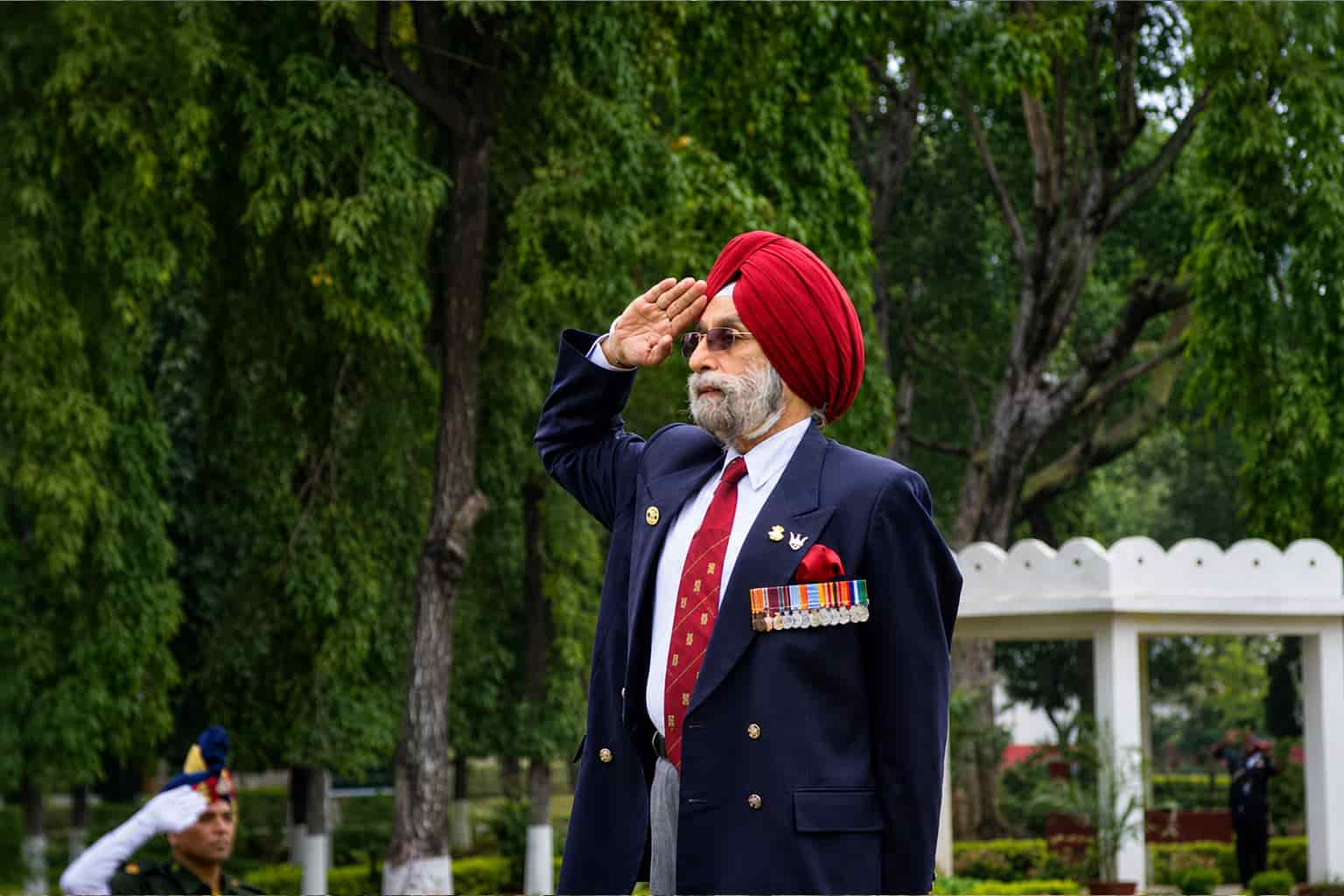
Some Army stories are not about medals, battles or victory.
Some stories are about the few seconds when an officer has to decide whether he will protect himself or stand with his men.
In a powerful conversation on Sainik Welfare News, General SVP Singh, VSM, shared two incidents from his service life that explain what leadership in uniform really means. One incident happened when he was a young Lieutenant. The other came years later, when he was a Commanding Officer during a difficult operational environment.
Both stories are different. But both carry the same message.
A leader is not remembered only for the orders he gives. He is remembered for the responsibility he owns when something goes wrong.
The first story goes back to his early days as a young Lieutenant in Artillery. He was a Gun Position Officer. During a firing situation, a wrong command was passed. The data should have been 345 degrees, but 354 degrees was passed to the gun. A shell went in the wrong direction.
In artillery, such a mistake is not small. Every command matters. Every degree matters. Every correction matters. When a shell has been fired, there is no time to hide behind explanations.
There was pressure. The safety officer came in. The data was checked. The situation became serious.
At that moment, a young Lieutenant could have blamed someone below him. He could have said the mistake happened at the board. He could have allowed the Havaldar or the operator to carry the burden. But General Singh remembered something that stayed with him for decades.
The TA Havaldar told him that he was close to pension. He feared that if the blame came on him, his whole service and pension could be affected. Another operator told the young officer that only he could save them.
Imagine that moment.
A young officer, still learning the weight of command, suddenly hears the fear of a man who has spent years in service and is nearing retirement. This was not only about one mistake. It was about a man’s future, his family and his dignity.
General Singh accepted the responsibility.
He said it was his mistake.
The inquiry happened. Warning and anger followed. But he stood by his statement.
Years later, when he met his Commanding Officer again and told him the full truth, the CO’s reaction became a lifelong lesson. The CO told him words that stayed with him deeply: he was fit to command the regiment because the regiment would follow him.
This is where the story becomes bigger than one artillery incident.
The lesson is not that mistakes should happen. The lesson is that when you are the leader, you cannot throw your men under the bus to save yourself. If the mistake belongs to your team, the responsibility first comes to you.
That is command.
That is also the difference between rank and leadership.
Rank gives authority. Leadership earns trust.
The second story is even more intense. It happened years later when General Singh was Commanding Officer during Operation Rakshak environment. His regiment was connected with operational deployment areas, and one night, at about 1:30 AM, he received a phone call.
One man from his unit had run away with a 7.62 mm rifle loaded with 20 rounds.
Technically, due to movement order, that man was under another command arrangement at that moment. But General Singh’s instinct as a Commanding Officer did not look for technical escape.
His thought was simple: the regiment is mine. The name, honour and responsibility belong to my paltan.
That is where the second lesson begins.
A rifle with 20 rounds in the hands of a disturbed or angry man is not just a missing weapon. It is a threat to lives. One round can take one life. Twenty rounds can change the fate of many families.

General Singh immediately understood the seriousness. He did not think only of paperwork. He thought of possible targets. He thought of family quarters. He thought of school-going children. He thought of officers, JCOs, havaldars, bus stands, railway stations, check posts and civilians.
This was not a battlefield, but the pressure was immense.
He later described it as a night of tremendous pressure. In war, a commander thinks about the enemy and his own men. But here, the fear was different. If the weapon was used, an innocent person could die. A family could be destroyed. The unit’s name could be damaged. The soldier himself could be lost forever.
So he acted.
He called the Adjutant, Subedar Major and Second-in-Command. He informed intelligence links. He planned gate security. He alerted important transit points. He ensured family quarters were protected. He stopped children from going to school that morning. He ordered extra guards and perimeter patrolling. He asked that railway stations, bus stands and routes towards Jammu be watched carefully.
This is where the story becomes a case study in command thinking.
A good commander does not react emotionally. He thinks in layers.
Where can the man go?
Whom can he harm?
What is his mental condition?
Who might he blame?
What is the fastest route home?
Where can he be intercepted?
How can civilians be protected?
How can the matter be reported honestly?
This last question is very important.
When some people suggested waiting before sending the formal report, General Singh refused. His logic was clear: one mistake should not be followed by another mistake. If the rules require reporting, then reporting must be done. A weapon and ammunition were missing. This was not a matter to hide.
That decision shows another form of courage.
Physical courage is visible on the battlefield. Moral courage is visible in files, reports and decisions when nobody wants bad news to travel upward.
Finally, the man was caught near Madhopur check post. He had covered himself and hidden the rifle, but alert military police and intelligence personnel identified him before the weapon could be used.
When General Singh got the news, his first question was not about his own career. His first question was whether the weapon had been used.
It had not.
That was the relief.
The soldier later revealed that he had come to know he was being discharged. He was upset and was moving with the weapon for a personal act of revenge linked to his family issue. The situation could have become tragic. But timely action prevented loss of life.
After this, discipline followed. The soldier was punished under military process. General Singh knew punishment was necessary because the Army cannot run without discipline. But the story did not end with punishment.
This is the most human part.
Even after the soldier was sent to jail, General Singh ordered that every two weeks, a JCO and another person should visit him, take fruits and sweets, and ask about his welfare.
Why?
Because in the Army, even a man who has committed a serious mistake is not immediately thrown away as a useless human being. Discipline and humanity can exist together.
Later, when the man came out, he visited General Singh with sweets. He accepted that he had made mistakes. But he also remembered that the unit did not abandon him.
This is a rare lesson.
In civilian life, when someone fails, many organisations simply cut the person off. A termination letter is issued, and the relationship ends. But the Army often carries a deeper bond. A man may be punished, but if he wore the same uniform, ate the same salt and served the same paltan, the human connection is not easily erased.
That does not mean discipline becomes weak. It means discipline is applied with responsibility.
This is why General Singh’s stories are important not only for soldiers but also for civilians, leaders, managers and families.
If someone under you makes a mistake, your first duty is not to escape. Your first duty is to understand, correct, protect and take responsibility where required.
If punishment is necessary, punish fairly.
If the person can be reformed, do not destroy his dignity completely.
If your team fails, look first at your own role.
If you are a leader, your shoulders must be broad enough to carry blame, not only praise.
General Singh also remembered the role of senior leaders above him. His GOC showed trust. His commander listened calmly. His intelligence links helped. This shows another important point: good leadership does not exist only at one level. It travels through the chain of command.
A strong Army is built not only by weapons, tanks and guns. It is built by trust between officers and men, trust between commanders and units, and trust that when something goes wrong, someone will stand up and own responsibility.
That is the real message of this podcast.
General SVP Singh did not share these stories to praise himself. In fact, he made it clear that the purpose was to draw lessons. That humility makes the stories more powerful.
One story began with a wrong artillery command.
The other began with a 1:30 AM phone call about a missing rifle.
Both ended with the same truth.
Leadership is not about standing in front only when applause is coming. Leadership is about standing in front when blame, risk and pressure are coming.
A real commander protects his men, tells the truth, acts quickly, accepts responsibility and never forgets the human being behind the uniform.
That is what real command means.


Leave a Reply