

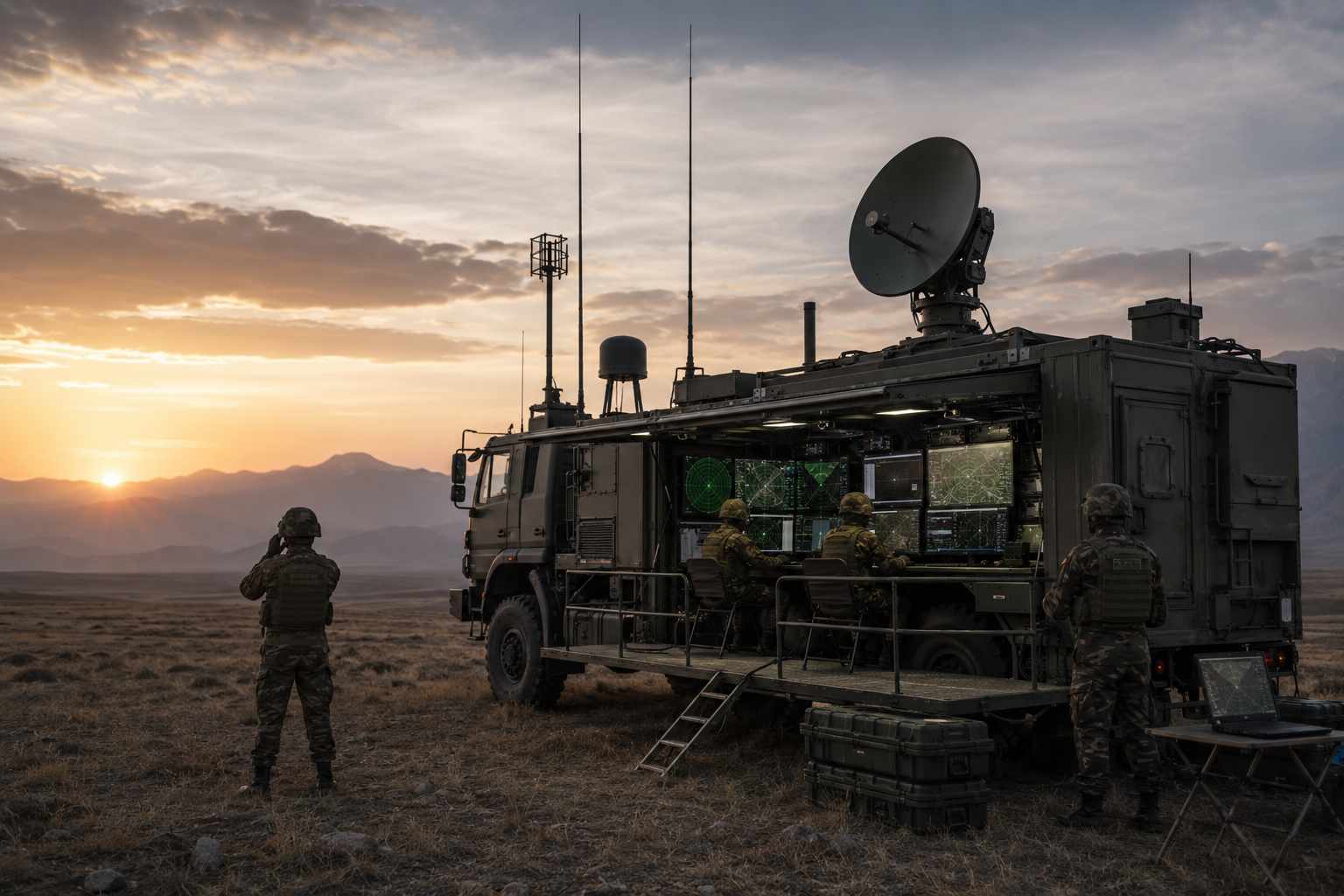
The Indian Army is preparing for a battlefield where the fight will not be decided only by bullets, tanks, missiles or artillery. Future wars will also be shaped by signals, radar, communication networks, drones, sensors and the ability to detect the enemy before the enemy detects you. That is why the latest electronic warfare contract with Bharat Electronics Limited deserves serious attention.

The Ministry of Defence has signed a contract with Bharat Electronics Limited, Hyderabad, for the procurement of five Ground-Based Mobile Electronic Systems for the Indian Army. Public reports have placed the contract value at around ₹1,476 crore, with a minimum of 72% indigenous content, under the Buy Indian, Indigenously Designed, Developed and Manufactured category.
BEL’s own press release says the company signed a contract with the Ministry of Defence valued at ₹1,251 crore excluding taxes for the supply of Ground Based Mobile ELINT System to the Indian Army. This means the larger ₹1,476 crore figure being reported likely reflects the broader contract value including tax or associated components, while BEL’s release gives the excluding-tax contract figure.
For ordinary readers, the most important question is simple: what does this system actually do?
BEL says the GBMES is a totally indigenous, state-of-the-art system designed and developed by the Defence Electronics Research Laboratory in Hyderabad and manufactured by BEL. The system can detect, classify and locate different types of radars. It can also intercept and analyse communication signals. In practical terms, this gives the Army better battlefield awareness and helps strengthen air defence capability.
This is why electronic warfare matters. In modern conflict, the enemy’s radar, communication signals and electronic emissions can reveal where units are located, how they are operating and what kind of systems they are using. If the Army can detect and analyse those signals in time, commanders can make faster and smarter decisions.
A normal citizen may think of war as a direct clash between soldiers. But on the modern battlefield, before a soldier moves, there is already a silent fight happening in the electromagnetic spectrum. Radars search for aircraft. Communication systems guide units. Drones send data. Command centres exchange information. Air defence systems track targets. If any side can read, confuse, interrupt or exploit these signals, it gains a major advantage.
This is why a mobile ground-based electronic system becomes important. Mobility means it can move with operational formations and support different sectors. A fixed system has limitations, but a mobile system can be deployed closer to where the requirement exists. In a border environment, high-altitude area, desert sector or sensitive operational zone, such flexibility can make the system more useful.

The deal also shows that the Army is looking beyond conventional weapons. A rifle helps the soldier engage a visible target. A tank gives firepower and protection. Artillery gives long-range strike. But electronic warfare gives something different: awareness, detection and information advantage. Without information, even powerful weapons can be used late or wrongly. With better information, smaller actions can become more effective.
For the Indian Army, this system can become a battlefield force multiplier. It can help units understand enemy radar activity, track electronic patterns and support air defence planning. Times of India reported that GBMES would improve battlefield surveillance, help modernise Army units and strengthen the indigenous defence manufacturing ecosystem.
The indigenous angle is equally important. The system is designed and developed by DLRL, Hyderabad, and manufactured by BEL, with public reports mentioning minimum 72% indigenous content. This supports India’s broader defence self-reliance goal because sensitive electronic warfare systems cannot always depend on foreign suppliers.
Electronic warfare is a sensitive domain. Countries do not openly share everything about their capabilities because signals, frequencies, interception methods and radar signatures are operationally important. That is why indigenous capability matters even more. If India can design, manufacture, maintain and upgrade such systems within the country, the Army gains greater control over future improvements.
This also fits into the larger lesson from recent conflicts around the world. Drones, missiles, radars, satellite links, electronic jamming, communication interception and sensor networks are becoming central to military operations. A force that cannot protect its signals or understand the enemy’s electronic activity can suffer serious disadvantages.
The Indian Army’s future battlefield will require coordination between soldiers, drones, artillery, air defence units, surveillance systems and command networks. In such a situation, electronic intelligence is not a luxury. It becomes part of survival and success.
For soldiers on the ground, such systems may not look glamorous. They may not appear in public like tanks during a parade. But their impact can be deep. Better electronic awareness can help commanders avoid surprise, detect threats early and plan responses more effectively. In many cases, knowing what the enemy is doing can be as important as having the weapon to respond.
The deal also sends a message to the defence industry. India needs more high-end systems in electronics, sensors, surveillance, cyber, communication and artificial intelligence-linked military tools. Traditional manufacturing is important, but future military strength will depend heavily on advanced electronics. BEL’s role in producing such systems shows how defence public sector companies remain central to India’s military modernisation.
However, this deal should not be treated as a magic solution. A system becomes effective only when it is properly integrated with doctrine, training, operators, maintenance, command structure and real-time decision-making. The Army will need trained personnel who can interpret signals correctly, commanders who can use that information quickly and networks that can share it securely.
This is the real challenge of future warfare. Buying technology is one step. Building a full ecosystem around that technology is the bigger task.
For Sainik Welfare News readers, the takeaway is clear. This ₹1,476 crore electronic warfare deal is not just another procurement headline. It reflects a shift in how the Indian Army is preparing for modern conflict. The focus is moving from only visible firepower to invisible battlefield control through signals, sensors and information.
In simple words, the wars of tomorrow may begin long before the first bullet is fired. They may begin when one side detects the other’s radar, intercepts communication patterns, understands movement and builds a clearer battlefield picture. The Army that sees first, understands first and acts first may hold the advantage.
That is why this deal matters. It strengthens the Army’s electronic warfare capability, supports indigenous defence technology and prepares India for a battlefield where information dominance may decide the outcome. For the soldier at the front and the commander behind the screen, better awareness can mean better protection, faster action and stronger national security.



Leave a Reply